
Insights
How to Hire Employees in El Salvador: A Step-by-Step Guide
Insights · By YuDing Wang · Updated 26 October 2026
To hire an employee in El Salvador you need an employer registered in the country, a written contract in Spanish filed with the Ministry of Labour, and registration with the Social Security Institute (ISSS) and a pension fund (AFP) before the first day. If your company has no Salvadoran entity, an employer of record can employ the person for you. These are the steps, in the order they happen.
Last reviewed in October 2026 against the Labour Code, the ISSS and pension rules, the 2025 income tax withholding tables and the 2026 Quincena 25 and aguinaldo reforms. General information, not legal advice.
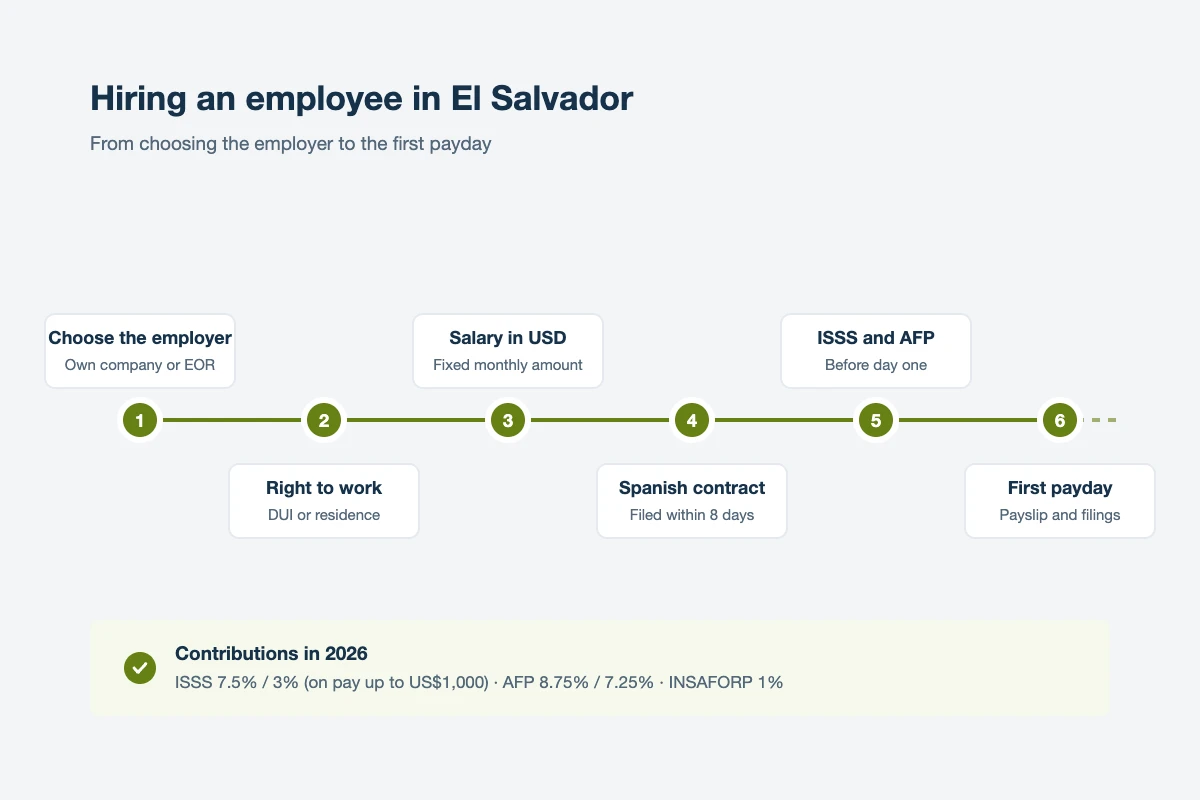
Step 1: Decide who will employ the person
A company that is not registered in El Salvador cannot put someone on a Salvadoran payroll. You have three realistic options.
| Option | When it fits | What to know |
|---|---|---|
| Your own Salvadoran company | You plan a larger team, local customers or local invoicing | Company registration, tax registration and employer registration come before the first hire |
| Employer of record | One or a few employees, a market test, or a first hire before an entity | The EOR is the legal employer; you direct the work. How NNRoad’s El Salvador EOR works |
| Independent contractor | A defined project, delivered independently | If the person works under your direction for more than two consecutive days, the Labour Code presumes employment |
For a closer comparison, read doing business in El Salvador without a local entity.
Step 2: Check identity and the right to work
Salvadoran citizens are identified by their DUI (Documento Único de Identidad), which also serves as their tax number. A foreign national needs temporary or permanent residence that allows work, issued by the Directorate General of Migration and Foreigners (DGME). The Labour Code also requires that at least 90% of an employer’s staff be Salvadoran.
NNRoad’s El Salvador EOR service covers Salvadorans and foreign residents who already have the right to work. If the person needs residence with authorization to work, see Expat Employment in El Salvador. For the permit steps, read our El Salvador work permit guide.
Step 3: Set the salary
El Salvador uses the US dollar, so salaries are agreed and paid in USD. Set a fixed monthly gross salary; if you are used to hourly rates, convert to a monthly figure based on the agreed schedule. The minimum wage for commerce, services and industry has been US$408.80 a month since 1 June 2025, with lower rates for textile maquila and agriculture.
Decide at the same time on any bonus or commission plan and on benefits such as private health insurance, which are common in competitive roles but not required by law.
Step 4: Budget for the costs on top of salary
Employer contributions are ISSS 7.5% (capped at US$75 a month), AFP 8.75% and a 1% training levy (INSAFORP) for employers with 10 or more workers. Add accruals for the aguinaldo (15 days’ salary a year in the first years) and the 30% vacation premium. From 2027, employees earning up to US$1,500 also receive Quincena 25 in January. In total, plan for roughly 17% to 23% above salary.
See El Salvador EOR cost for worked examples, or try the El Salvador labor cost calculator.
Step 5: Write the employment contract
The contract must be in writing, in Spanish, in three copies: one for each party and one filed with the Ministry of Labour within 8 days of signing. An indefinite term is the default; a fixed term is allowed only where the work itself is temporary. The first 30 days of an indefinite contract can be a probation period.
The contract should state at least:
- the job and its main duties
- the salary, how and when it is paid
- working hours and the place of work, or the telework arrangement
- the start date, the term and any probation period
- leave, benefits and any bonus or commission
Step 6: Register the employee and set up payroll
Before the first working day the employer registers the employee with the ISSS and an AFP. Each month it calculates gross to net, pays the salary, deducts the employee’s ISSS (3%, at most US$30) and AFP (7.25%) contributions and income tax, and files and pays contributions and the tax withheld for the month.
Income tax is withheld using the monthly tables in force since May 2025: there is no tax on the first US$550 of monthly income after ISSS and AFP, then bands of 10%, 20% and 30%. For the monthly deadlines, see our El Salvador payroll guide.
Step 7: Working hours, leave and payments through the year
| Topic | The rule |
|---|---|
| Hours | Day work up to 8 hours a day and 44 a week; night work up to 7 and 39 |
| Overtime | Paid at double the hourly rate; night hours carry a 25% premium |
| Vacation | 15 days after each year of service, paid with a 30% premium |
| Public holidays | Paid national holidays, including Holy Week days, 1 May, 15 September and 25 December |
| Sick leave | The ISSS pays 75% of salary from the fourth day of illness |
| Maternity and paternity | 16 weeks of paid maternity leave; 3 paid days of paternity leave |
| Aguinaldo | 15, 19 or 21 days’ salary by length of service, paid between 1 October and 20 December |
| Quincena 25 | Half a month’s salary between 15 and 25 January for salaries up to US$1,500; mandatory for private employers from 2027 |
Step 8: If the employee works remotely
Many companies hire in El Salvador for remote roles. The Teleworking Law (2020) requires the employer to provide or pay for the equipment, software and connectivity the teleworker needs, and to agree the telework terms in writing. Set these out before the start date, together with working hours and how availability is measured.
Step 9: Ending the employment
There is no statutory notice period for a dismissal. Dismissing an indefinite-term employee without just cause costs 30 days’ basic salary for each year of service, with a minimum of 15 days, on a salary capped at four times the minimum wage. An employee who resigns after two years of service is entitled to 15 days’ salary per year. In every case, pro rata vacation and aguinaldo are paid in the final settlement, and the ISSS and AFP records are closed.
Hiring checklist for El Salvador
- Employer chosen: own company, employer of record or, for a true project, a contractor
- Right to work confirmed (DUI, or residence that allows work)
- Fixed monthly salary in USD agreed, at or above the minimum wage
- Total cost budgeted, including the aguinaldo, vacation premium and Quincena 25
- Spanish contract signed and filed with the Ministry of Labour within 8 days
- ISSS and AFP registration completed before day one
- Telework terms and equipment in place for a remote role
- Payroll calendar and first payday confirmed
Questions about hiring in El Salvador
Can a foreign company hire an employee in El Salvador?
Yes, either through its own registered Salvadoran company or through an employer of record that employs the person on its behalf. A company without a local registration cannot run Salvadoran payroll itself.
How long does it take to hire someone in El Salvador?
Once a candidate accepts, the contract can be signed, filed with the Ministry of Labour within 8 days and the employee registered with the ISSS and an AFP before the start date. Through an employer of record, the timing mainly depends on how quickly the offer, documents and deposit are in place.
Do I have to pay salaries in US dollars?
Yes. The US dollar is El Salvador’s currency, and salaries, contributions and taxes are calculated and paid in USD.
Can I hire someone in El Salvador as a contractor instead?
Only for genuinely independent work. If the person works under your direction for more than two consecutive days, the Labour Code presumes an employment relationship, with back pay and contributions due if it is reclassified. Our On-Demand Talent service covers project-based engagements.
What is the minimum wage in El Salvador?
Since 1 June 2025 it has been US$408.80 a month for commerce, services and industry, US$402.32 for textile maquila and lower rates for agricultural work.
Hiring your first employee in El Salvador?
If you do not have a Salvadoran company, we can employ the person for you and run payroll from the first month. Tell us about the role and we will reply with the total cost and a realistic start date.
Related
Every way to operate and hire in El Salvador without a company.
What a hire costs each month, with worked examples.
Official sources: Labour Code (Código de Trabajo), Ministry of Labour and Social Welfare (MTPS), Salvadoran Social Security Institute (ISSS), Ministry of Finance income tax withholding tables (2025), 2025 minimum wage decree, Teleworking Law guide (MTPS). Also: Integral Pension System Law (2022); Legislative Decree No. 499 of 2026 (Quincena 25 Law); Legislative Decree No. 669 of 2026 (aguinaldo payment window). Reviewed October 2026; general information, not legal or tax advice.