
How to Choose the Best Employer of Record in the UK: 8 Checks Before You Sign
Choose a UK employer of record by assessing its payroll accuracy, employment compliance, service scope and total cost for your proposed hire. Ask each shortlisted provider for a sample contract, an itemised cost estimate and a written explanation of onboarding, ongoing support and termination procedures. The eight checks below provide a framework for comparing providers consistently.
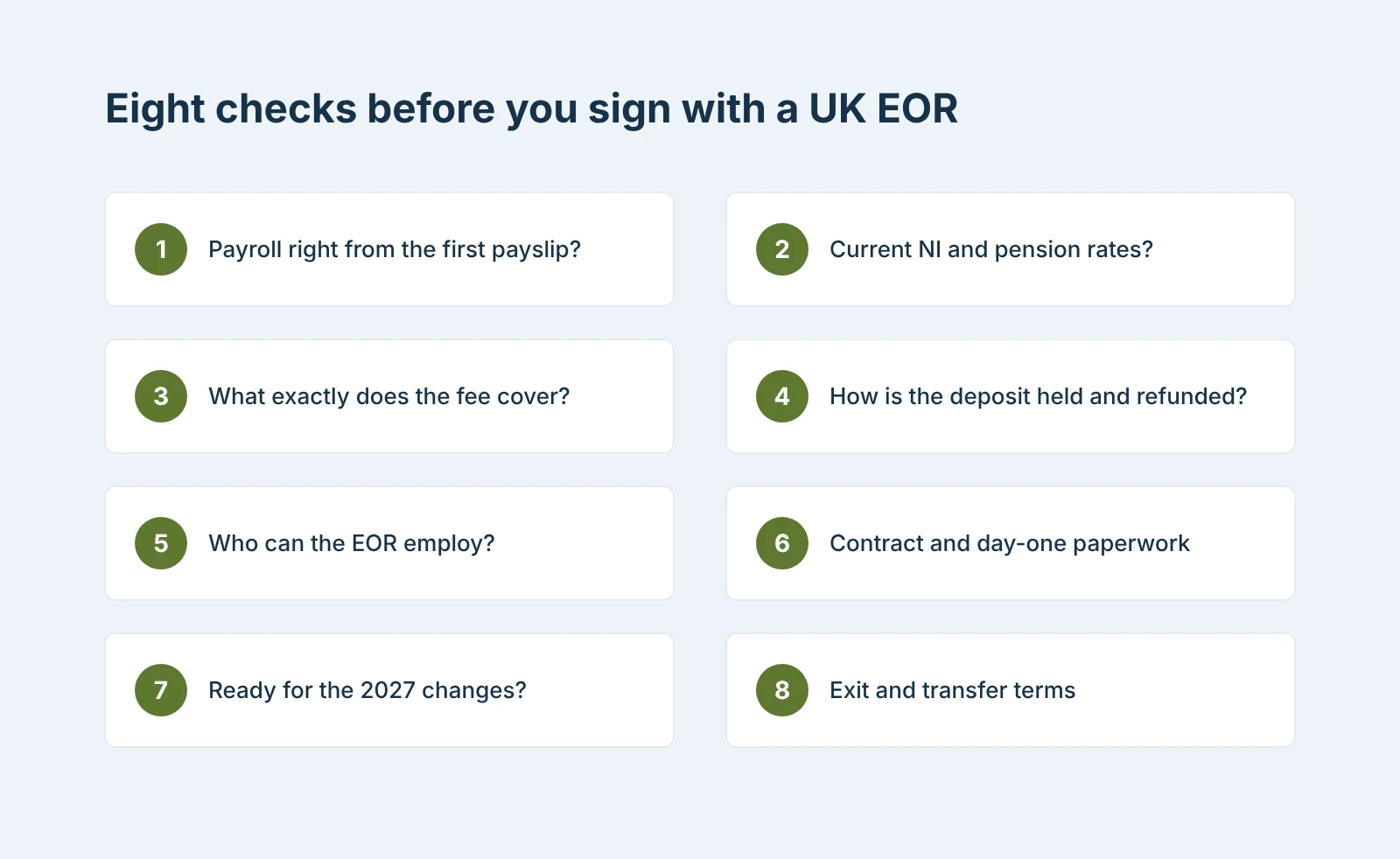
1. Will payroll be right from the first payslip?
UK employees are paid through PAYE. Income tax and National Insurance are deducted from each payment and reported to HMRC on or before payday, and the employee must get an itemised payslip on or before payday. GOV.UK Payroll errors can affect deductions, HMRC records and employee confidence. Ask how corrections are identified, reported and resolved.
| Ask to see | Red flag |
|---|---|
| A sample payslip for your hire’s salary, with the monthly cut-off date and pay date. | No fixed pay date, or payslips that arrive after payday. |
2. Are National Insurance and pension set at the current rates?
| Ask to see | Red flag |
|---|---|
| A cost breakdown for your hire’s salary, with National Insurance and pension as separate lines. | Employer National Insurance quoted at 13.8%, or no pension line at all. |
3. What exactly does the fee include?
| Ask to see | Red flag |
|---|---|
| A written price list that covers every recurring and one-off charge. | Extra charges that appear only in the contract. |
4. How is the deposit held and returned?
| Ask to see | Red flag |
|---|---|
| A clear refund point, such as after the final invoice. | Vague wording about deposits being “applied” to fees. |
5. Is the provider clear about who its EOR can employ?
Ask the provider to confirm which local employees its EOR service covers, how it checks employment eligibility and which entity will employ the person. NNRoad’s UK EOR service is for local employees. Foreign employee hiring is assessed separately through our Hire Foreigner in the UK service.
| Ask to see | Red flag |
|---|---|
| A clear answer for each candidate’s citizenship or immigration status. | “We can employ anyone” with no questions about the right to work. |
6. Will the contract and day-one paperwork follow UK law?
| Ask to see | Red flag |
|---|---|
| A sample contract and the onboarding checklist. | A global template with no UK holiday, pension or notice terms. |
7. Is the provider ready for the 2027 changes?
| Ask to see | Red flag |
|---|---|
| A written process for probation reviews and for ending employment. | “You can let anyone go in the first two years.” |
8. What happens when the employment ends or moves to your company?
The statutory notice an employer normally gives starts at one week after one month of service and increases with service, up to 12 weeks; the contract may require more. Confirm how accrued holiday, final pay and any statutory redundancy entitlement are assessed. If employment will transfer to your company or another provider, ask whether TUPE applies and how continuity of employment and existing rights will be protected.
| Ask to see | Red flag |
|---|---|
| A written exit and transfer process. | Exit fees or long minimum terms you only learn about at the end. |
Flat fee or percentage: which pricing is better?
How NNRoad answers these checks
| Check | NNRoad UK EOR |
|---|---|
| Payroll | Monthly PAYE payroll in pounds, with a payslip on or before payday |
| National Insurance and pension | Calculated at 2026/27 rates and shown as separate lines in your proposal |
| Fee | A monthly service fee per employee, quoted after a role review; every charge itemised |
| Bonuses and expenses | Part of employment cost, so the 9% applies |
| Who we employ | Local employees through UK EOR; foreign employee hiring through Hire Foreigner in the UK |
| Start | About one month from signing to the first day |
| Exit | Notice and final pay handled under UK law; a move to your own company is supported |
Common questions
What is the best EOR for hiring employees in the UK?
There is no single best provider. If you want a self-service platform and a flat fee, the large global platforms all cover the UK. If you want a named contact, a percentage fee and a straight answer on whether EOR is the right route at all, NNRoad is built for that. Either way, run the eight checks above before you sign.
How long does it take to start with a UK EOR?
With NNRoad, allow about one month from signing to the employee’s first day. Ask each provider what its timeline covers and what it needs from you and from the employee.
Is the cheapest UK EOR a good choice?
Sometimes. Compare the yearly cost, including setup, the minimum fee and the deposit, and check the eight points above. A low fee with errors in tax, National Insurance or pension costs more in the end.
Can we change EOR provider later?
Yes. The employee moves to a new employer, so plan the switch around a month end to keep payroll and tax records clean, and agree in writing how the employee’s length of service is treated.