
Employer of Record · Scotland
Employer of Record in Scotland
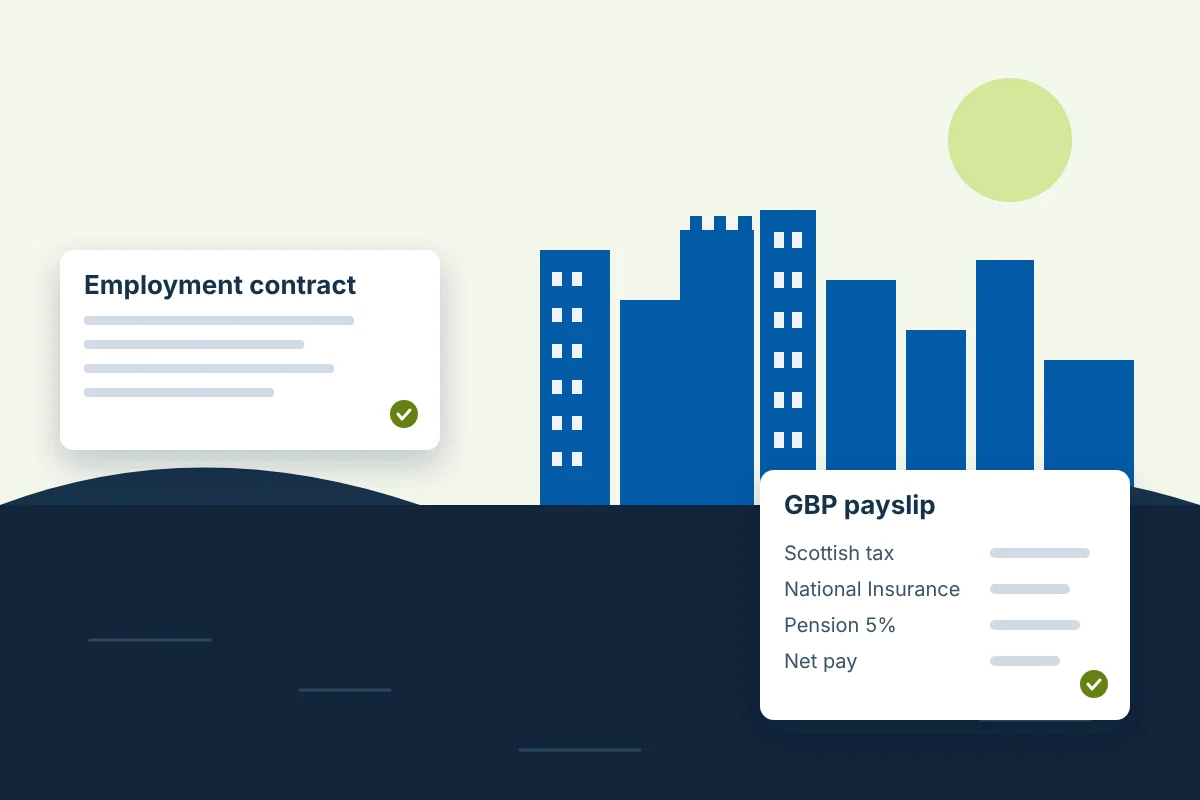
Hire employees in Scotland without setting up a UK company. Our Local Team becomes the legal employer: it issues the written statement, runs PAYE with Scottish S tax codes, pays employer National Insurance, auto-enrols staff into a pension and files RTI with HMRC. Your team directs the day-to-day work, and every role is reviewed under UK employment law and Scottish tax rules before an offer is made.
Every role is reviewed before an offer is made. Last reviewed November 2026; general information, not legal advice.
The short answer
Can you hire in Scotland without your own UK company?
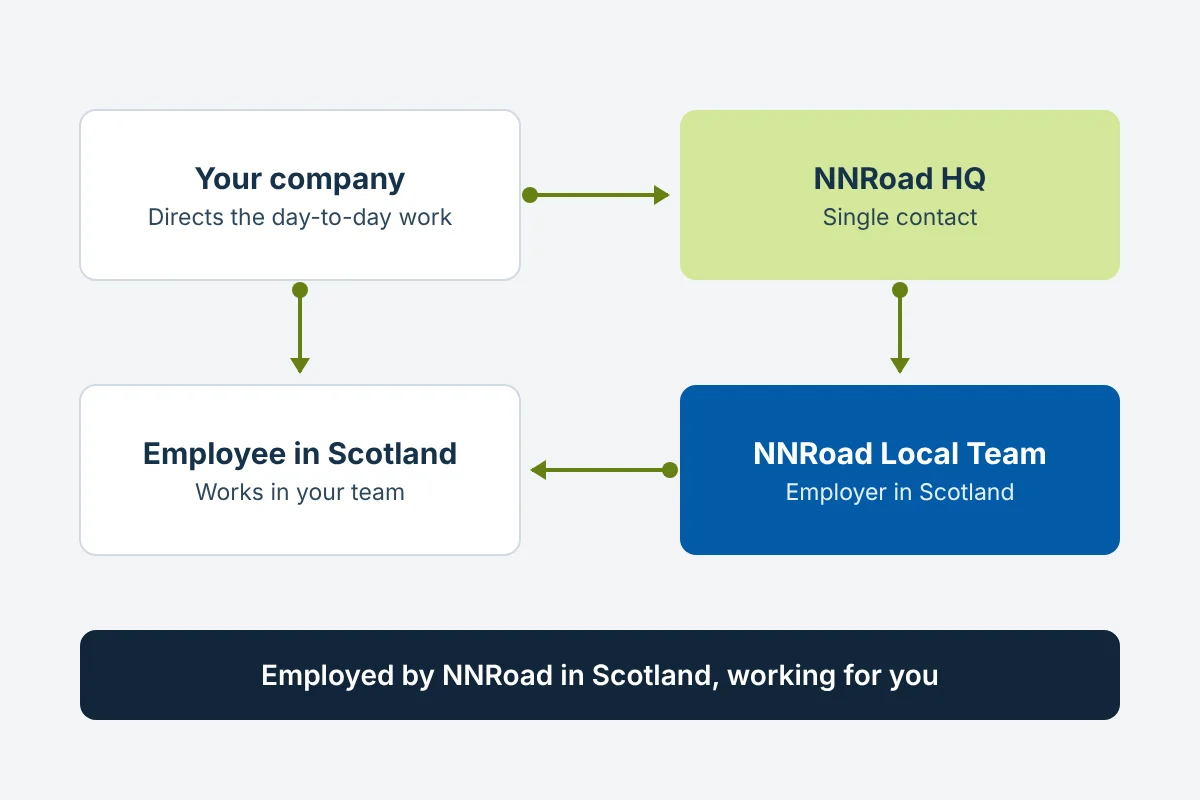
Yes. Every employee in Scotland needs a UK employer registered for PAYE that operates Scottish income tax, National Insurance and pension auto-enrolment, and reports each payment to HMRC in real time. A foreign company can register as an employer, but most find it hard to run from abroad. Our Local Team does it for you: the legal employer is in the UK, the employee works in your team in Scotland, and the employee keeps every statutory right.
A good fit
Engineers in Edinburgh or Glasgow, energy specialists in Aberdeen, games and fintech roles in Dundee, a small team while you test the UK market, or roles you plan to move to your own UK company later.
Hiring someone who needs a visa
People without the right to work in the UK need a Skilled Worker visa from a licensed sponsor. See Expat Employment in Scotland.
Another route is better
You already have a UK company and only need payroll run (Scotland payroll), the work is a project for a genuinely independent professional (On-Demand Talent), or the role is elsewhere in the UK (UK Employer of Record).
How it works
How our employer of record service works in Scotland
You agree the role, salary, start date and work location with NNRoad HQ. Our Local Team then employs the person under a UK contract and carries the employer’s legal obligations. Your managers set the tasks and supervise the work, and NNRoad HQ remains your single point of contact for the agreement, invoices and any change to the role.
NNRoad HQ and our Local Team
- Right-to-work checks, contract and written statement
- PAYE with Scottish S tax codes
- Monthly payroll in GBP with RTI filing
- Pension auto-enrolment
- P60s, P11Ds and year-end
- Lawful dismissals, resignations, redundancy and final pay
Your company
- Setting the employee’s daily tasks and supervising the work
- Sharing the pay and conditions of comparable staff
- A safe workplace, equipment and the access the role needs
- Confirming attendance, overtime, leave and changes by the monthly cut-off
- Funding the monthly invoice on the agreed dates
The legal position
How UK and Scottish law treat an employer of record
Employer of record (EOR), professional employer organization (PEO) and global employment organization (GEO) are commercial labels. Employment law is set UK-wide, while income tax for people who live in Scotland follows Scottish rates. These are the rules we build every Scottish role around:
- One legal employer. Our Local Team employs the person in its own name and runs PAYE.
- Equal treatment. Where the arrangement counts as agency work, the person gets the same basic pay and conditions as comparable staff after 12 weeks.
- A written statement. Issued on or before day one, covering pay, hours, holiday, probation and notice.
- Scottish income tax. Six rates for anyone whose main home is in Scotland, applied through an S tax code.
- Right to work. Checked before day one for every employee.
What this means for you
You manage the work as you would with your own team, while employment decisions such as pay changes, discipline and dismissal are made through NNRoad HQ and carried out by the Local Team under Acas-compliant procedure. When you set up your own UK company, the employee can move to it on an agreed date with continuity of service. Planning the whole process? Read how to hire employees in Scotland.
Your proposal
How we quote a Scotland EOR
We quote after reviewing the role, so the proposal reflects the real salary, Scottish tax position, pension and benefits rather than a headline rate.
What your proposal shows
Every line, before you sign
Gross salary, employer National Insurance of 15% above £5,000 a year, at least 3% employer pension, and any bonuses or benefits you agree, each as its own line.
NNRoad’s service fee listed separately. One-time items or a deposit, if any, are confirmed in writing before you approve the hire.
One invoice a month, with a payroll summary you can reconcile.
Included in the service
- Contract and right-to-work checks
- Monthly payroll, tax and RTI
- Payslips and employee questions answered locally
- Leave, sick pay and pension
- P60s and year-end
- Final pay and redundancy when a job ends
Employer cost
What a Scotland hire costs on top of salary
Employer costs are the same across the UK: National Insurance of 15% above £5,000 a year and at least 3% pension on qualifying earnings. On a salary of £45,000 a year, that is about £7,160, for a total cost of about £52,160.
| Item | Who pays | Position in 2026–27 |
|---|---|---|
| National Insurance | Employer 15% above £5,000; employee 8% then 2% | UK-wide |
| Pension auto-enrolment | Employer at least 3%, employee 5% | On qualifying earnings |
| Income tax | Employee, withheld through PAYE | Scottish rates from 19% to 48%. See the Scotland payroll and tax guide |
| Apprenticeship Levy | Employer 0.5% | Only on pay bills above £3 million |
Also budget for
Private medical insurance, bonuses, enhanced pension or holiday you agree. Plan for notice and statutory redundancy pay after two years.
Quick estimate
Model a salary in our calculator
See employer contributions, employee deductions and net pay for an annual salary in GBP.
Employment law
Employment rules to plan around in Scotland
Employment law is reserved to Westminster, so the core rules match the rest of the UK, but tax, bank holidays and some public-sector conditions are Scottish. These are the rules most overseas companies need before they make an offer.
| Topic | Position in 2026 |
|---|---|
| Written statement | On or before the first day |
| Minimum wage | £12.71 an hour at 21 and over from April 2026 |
| Probation | No statutory length; three to six months is usual |
| Working time | 48-hour weekly average unless the employee opts out |
| Annual leave | 5.6 weeks, capped at 28 days |
| Bank holidays | Usually 9 in Scotland, including St Andrew’s Day |
| Notice | One week per year of service, up to 12 weeks |
| Unfair dismissal | Two years’ service, falling to six months from January 2027 |
For the full picture, see our Scotland employment law guide.
Process
How a Scotland EOR engagement works with NNRoad
Every engagement starts with a review of the role, so we can confirm the arrangement and the employment terms in writing before anyone is hired. Cut-off, invoice and pay dates are fixed in a working calendar we agree with you.
Once, before your first hire
01 · Client onboarding
YouShare the role, salary, city, start date and the employee’s right to work, and complete our company verification.
NNRoad HQConfirms that an employer of record suits the role, then sends the proposal, the service agreement and the working calendar.
Local TeamChecks pay against comparable staff and the Scottish tax position, and models the total employment cost.
For each hire, before the start date
02 · Employee onboarding
YouConfirm the candidate, salary and start date, and prepare equipment and access.
Local TeamChecks right to work, issues the contract and written statement, sets up PAYE with the right tax code and enrols the employee in the pension scheme.
NNRoad HQConfirms the start date with you.
Every month, on the working calendar
03 · Monthly payroll cycle
YouConfirm attendance, overtime, leave and any change in pay by the cut-off, and fund the invoice.
Local TeamCalculates gross-to-net with Scottish income tax, files the RTI submission on or before payday, pays salaries in pounds and issues payslips.
NNRoad HQSends the invoice with a payroll summary and answers your questions in English.
Every year
04 · Year-end
The Local Team issues P60s by 31 May, files any P11D for benefits by 6 July, applies new tax codes and rates each April and carries out pension re-enrolment when due. NNRoad HQ reviews salaries, contract terms and the working calendar with you for the year ahead.
When a job ends
05 · Employee offboarding
YouTell NNRoad HQ in writing that the role is changing or ending, and when. Please do not raise it with the employee yourself.
Local TeamFollows a fair procedure under the Acas Code, gives the notice due, pays final amounts and any redundancy pay, and issues the P45.
NNRoad HQAgrees the timeline and the cost with you before anything is communicated.
When you end the service or move to your own company
06 · Client offboarding
You give the notice set in your service agreement. We end each employment lawfully or arrange the employee’s move to your UK company on an agreed date, run the final payroll and filings, and reconcile the last invoices and any deposit.
Checklist
What we need to start in Scotland
From you
- Job title and duties
- City, and whether the role is office-based, hybrid or remote within Scotland
- Gross annual salary in GBP, bonus and benefits
- Start date and expected duration
- Pay of comparable roles at your business
From the employee
- Passport or right-to-work share code
- National Insurance number
- P45 from the last employer, if any
- Home address, for the tax code
- Bank account for salary
Before day one
- Right to work checked
- Written statement signed
- PAYE and tax code set up
- Pension enrolment done
- Start date confirmed with your team
Why NNRoad
Choosing an employer of record service provider in Scotland
One contact, in English
NNRoad HQ handles the agreement, invoices and escalations, so you do not juggle several local providers.
A UK employer with a Local Team in Scotland
Our Local Team is a UK employer registered for PAYE and employs people in Scotland in its own name.
Current law, current numbers
Contracts, payroll and costs follow UK employment law and Scottish tax rules.
Itemised costs
Every contribution, benefit and fee is a separate line.
Predictable months
A working calendar fixes cut-offs, invoices and pay dates, and every payroll comes with a summary.
Data handled with care
Employee data is used only for employment and payroll and handled under UK GDPR.
Looking for the best EOR in Scotland? Ask each provider which company employs the person, whether it applies Scottish tax codes correctly, how it handles pension auto-enrolment and equal treatment, and whether the proposal itemises every cost.
PEO or global employment organization in Scotland? The UK has no co-employment category. For a company without a UK entity, a PEO or GEO offer works as an employer of record arrangement, so the same questions apply.
Get a quote
Review my Scotland hiring plan
Tell us about the role, salary, start date and work location. We reply with a cost estimate, the employment terms and the next steps, and tell you plainly if another route suits you better.
- Total employment cost and what drives it
- Whether an employer of record fits the role
- A realistic start date and the documents needed
FAQ
Scotland employer of record FAQs
Straight answers to what overseas companies ask before their first hire in Scotland.
Can a foreign company hire employees in Scotland without a UK company?
Yes. A UK employer, here our Local Team, employs the person and handles the contract, PAYE, National Insurance and pension while your team directs the work. See operating in Scotland without a company.
Is an employer of record legal in Scotland?
Yes. It follows UK employment law, including equal treatment rules where the arrangement counts as agency work.
How much does it cost to employ someone in Scotland?
On top of salary, budget 15% employer National Insurance above £5,000, at least 3% pension and NNRoad’s service fee. Try the Scotland salary calculator.
How is income tax different in Scotland?
People whose main home is in Scotland pay six Scottish rates, from 19% to 48%, instead of the rest-of-UK rates.
Which bank holidays apply in Scotland?
Usually nine, including 2 January, the first Monday in August and St Andrew’s Day.
When can an employee claim unfair dismissal?
After two years’ service now, and after six months for dismissals from January 2027.
Can we move the employee to our own UK company later?
Yes. When your company is ready, we agree a transfer date and the employee joins your company.
Further reading
Plan your hire in Scotland
Hiring routes, contracts, pay, leave and dismissal.
When you need a UK company, and when you do not.
Scottish income tax, National Insurance and an example.
Employer cost and net pay for any salary.
Official sources: GOV.UK Scottish Income Tax, HMRC, Acas, mygov.scot, GOV.UK Skilled Worker visa. More Scotland services: Scotland hiring options; rules in detail: Scotland employment law guide.
Ready when you are
Hire in Scotland before you open a UK company
Tell us about the role and we’ll come back with the total cost, the employment terms and a realistic start date.