
Expat Employment · Japan
Expat Employment in Japan
Plan a foreign hire in Japan with an eligibility review first. Where the role, residence status and dispatch arrangement permit, our licensed Local Team employs the person and handles payroll and employer administration. Your team directs daily work within the approved model, and NNRoad HQ coordinates the service and work-authorisation support.
Every assignment is reviewed before an offer is made. Reviewed November 2026; general information, not legal or immigration advice.

The short answer
Can a foreign national work in Japan without your own company?
An eligible foreign hire may be employed through our licensed Local Team without your own Japanese company, but availability depends on the actual duties, employer, client arrangement and residence status. A Certificate of Eligibility may form part of an overseas application; existing residents may need a different procedure. We confirm the lawful route before offering employment. Our service includes employment support and is not visa-only.
A good fit
A foreign specialist, manager or project lead delivering a defined function or project in Japan, before or instead of opening a Japanese company.
Hiring locally
For Japanese nationals working in Japan, see Employer of Record in Japan.
Another route is better
You have a Japanese company that employs the person (Japan payroll), or the work is a project for a genuinely independent professional (On-Demand Talent).
How it works
How Expat Employment works in Japan
You define the business need, duties and package requirements. HQ and our licensed Local Team assess residence-status eligibility and dispatch requirements before confirming employment and client supervision. Ordinary dispatch restricts client pre-interviews and acts intended to select a specific worker; any proposed candidate or alternative model requires review. Where approved, the Local Team signs the employment contract and handles employer duties, while your team directs work within the agreed lawful conditions.
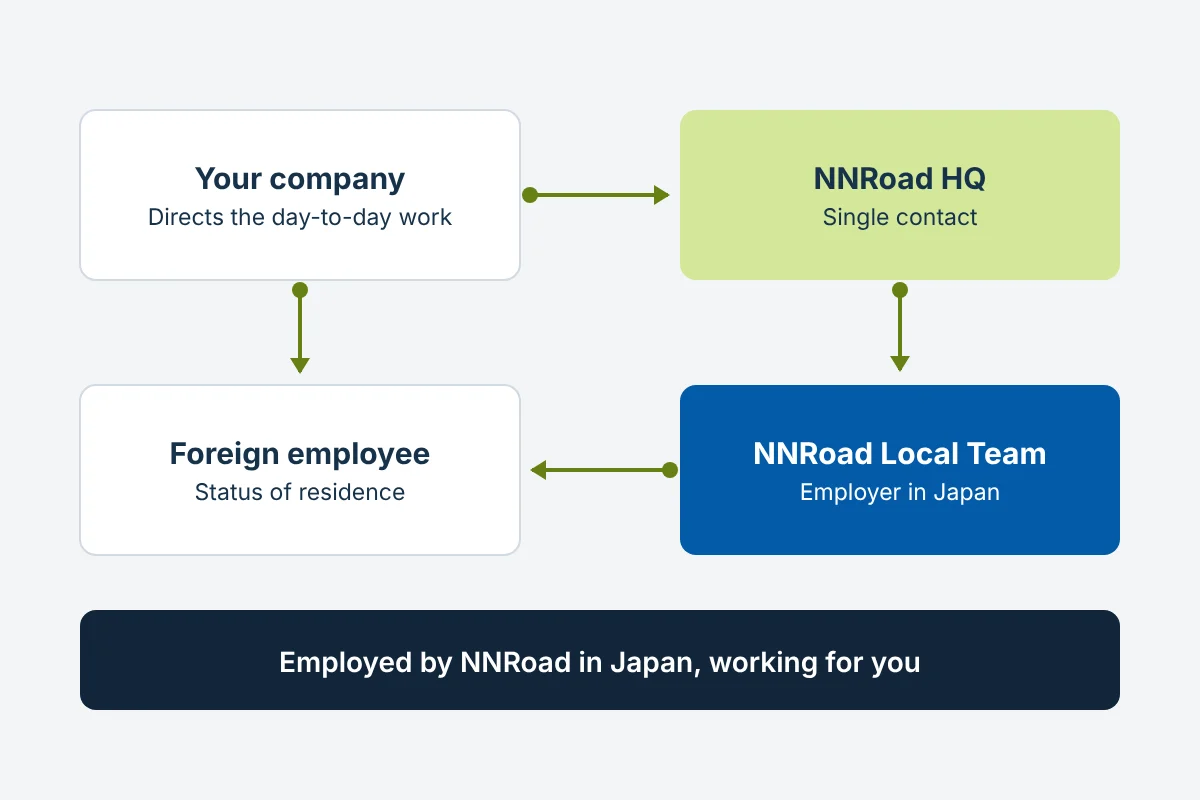
NNRoad HQ and our Local Team
- The status of residence assessment: Engineer/Specialist in Humanities/International Services, Highly Skilled Professional or an existing status
- The Certificate of Eligibility application and the employer documents
- Written working conditions with pay equal to Japanese staff
- Leave, working-time records and HR administration
- Social insurance, employment insurance and workers' accident insurance
- Payroll, income tax withholding, resident tax and year-end adjustment
- Hello Work notifications for hires and leavers
- Stay extensions and the steps when employment ends
- Online portal for employee information, reports and payslips
Your company
- Defining the role, package requirements and priorities within the lawful selection process
- Discussing candidate requirements before selection activity; ordinary dispatch restricts client pre-interviews and worker designation
- Directing daily work only within the approved dispatch model and residence-status conditions
- Managing performance and telling NNRoad HQ about changes
- Funding the monthly invoice on the agreed dates
NNRoad HQ coordinates your agreement, reporting and escalations. Our licensed Local Team handles the agreed local employment, immigration support, payroll and employer filings. Clients and employees use the Portal for relevant records, payslips and tasks. Risk management depends on accurate information, timely funding and following adviser guidance; client-side legal duties remain.
The legal position
Is this legal in Japan?
Visa support, PEO and expat employment are commercial labels, not legal categories. What Japan looks at is who employs the person and whether the work fits the status of residence. Pay must be at least what a Japanese national would receive for the same work.
Client direction generally brings worker-dispatch requirements into scope, including a valid licence, eligible work and client-side duties. Engineer/Specialist in Humanities/International Services applications involving dispatch have additional employer and client documentation requirements, introduced in March 2026 and subsequently updated. We confirm the current checklist and actual duties before filing. A licence alone does not establish immigration eligibility, and facilitating unauthorised work can lead to serious penalties.
The Local Team performs its legal-employer duties under the confirmed arrangement. Your company must also comply with applicable dispatch-client, working-time, safety and immigration obligations; these cannot all be transferred to the employer by contract.
| Your situation | Better fit |
|---|---|
| No Japanese company, and a foreign professional to deliver work in Japan | Expat Employment |
| No Japanese company, and a Japanese national in an eligible role | Employer of Record |
| Your Japanese company employs the person | Japan payroll |
| Project work by an independent professional | On-Demand Talent |
Not sure about the status of residence? Read our guide to the Japan work visa.
Employer cost
What a foreign hire in Japan costs on top of salary
In addition to yen salary, budget for applicable employer insurance contributions, agreed benefits and case-specific immigration or relocation expenses. Insurance eligibility, remuneration bands, caps and industry classifications affect the amount.
| Item | In 2026 | Notes |
|---|---|---|
| Employees’ pension | 18.3%, split equally | On standard monthly pay up to ¥650,000 |
| Health insurance | 9.85% in Tokyo, split equally | Plus 1.62% nursing care from age 40 to 64 |
| Child support contribution | 0.23%, split equally | New from April 2026 |
| Employment insurance | 0.85% employer, 0.5% employee | General businesses, FY2026 |
| Workers’ accident insurance | Employer only | Rate depends on the industry |
Also budget for
Relocation, if you choose to fund it; housing and commuting allowances; bonuses, which also attract social insurance; overtime at the statutory premiums; and paid leave.
Quick estimate
Model a salary in our calculator
See employer contributions, benefit accruals, employee deductions and net pay for any monthly salary.
Employment law
Japan work visa and employment rules to plan around
The person must have a residence status that authorises the proposed activities. An overseas application may involve a Certificate of Eligibility, consular visa and landing permission; an existing resident may need a status change, extension or notification instead. Documents, eligibility and government review determine timing. No approval or start date is guaranteed.
| Topic | What applies |
|---|---|
| Engineer/Specialist in Humanities/International Services | Eligibility depends on the activity: engineering/humanities generally use relevant education or experience criteria, with designated IT exceptions; international services have a separate experience test and graduate exceptions. Comparable Japanese remuneration is required. |
| Highly Skilled Professional | The points-based route generally requires 70 points plus the category’s other criteria. Benefits and any permanent-residence pathway have separate conditions. |
| Certificate of Eligibility | Processing varies; check the issued certificate’s validity and current entry rules. A COE does not itself authorise work or guarantee a visa. |
| Period of stay | 5 years, 3 years, 1 year or 3 months |
| Notifications | For relevant statuses, specified affiliation or contract changes require employee notification within 14 days. Employer Hello Work reporting has its own rules and exceptions. |
| Working conditions | Written terms, including the scope of possible changes to workplace and duties |
| Minimum wage | Tokyo’s regional rate is ¥1,280 an hour from 1 October 2026; check the applicable workplace and any higher industry rate |
For the full picture, see our Japan employment law guide. For each assignment we confirm the status of residence before an offer is made.
Process
How NNRoad manages your Japan service
Every engagement starts with a review of the role, the person’s nationality and the visa route, so we can confirm the arrangement in writing before an offer. Cut-off, invoice and pay dates are fixed in a working calendar we agree with you.
Once, before your first hire
01 · Client Onboard Process
YouDescribe the role in Japan, the city, the salary budget and the target start date, and complete our company verification.
NNRoad HQConfirms that Expat Employment is the right model, or recommends another route, then sends the proposal, the service agreement and the working calendar.
Local TeamChecks the person’s qualifications against the status of residence, the salary against Japanese pay for the role, and simulates the total employment cost.
For each hire, before the start date
02 · Employee Onboard Process
YouConfirm the role and salary requirements; discuss any proposed person with us before selection activity, since ordinary dispatch restricts client selection.
NNRoad HQTracks documents and confirms the start date with you.
Local TeamCoordinates written employment terms, the applicable immigration procedure, insurance enrolment and required hire notifications. Work starts only after the required permission, employment documents and lawful dispatch conditions are in place.
Every month, on the working calendar
03 · Monthly Payroll Cycle
YouConfirm any change in role or salary, approve agreed variable pay and fund the monthly invoice.
NNRoad HQSends the invoice with a payroll summary, and answers your questions in English.
Local TeamRecords working time and overtime, calculates payroll, withholds income and resident tax, pays social insurance and issues payslips.
Through the year and at year-end
04 · Year-end Process
The Local Team performs year-end adjustment for eligible employees, prepares withholding records and the applicable insurance review, and tracks residence expiry dates. Any extension requires a separate eligibility and document review and is decided by Immigration. HQ coordinates annual payroll and service planning with you.
When a job ends
05 · Employee Offboard Process
YouTell NNRoad HQ in writing that the employment is changing or ending, and when. Please do not raise it with the person yourself.
Local TeamEnds the employment lawfully, pays final wages, closes social insurance, reports the leaver to Hello Work and reminds the person of their 14-day notice to Immigration.
NNRoad HQConfirms the final invoice and closes the file.
When you end the service or move to your own entity
06 · Client Offboard Process
Give notice under the service agreement. HQ and the Local Team coordinate the lawful employee transition or termination, final payroll, account reconciliation, records handover and Portal closure. A move to your entity requires employee agreement and the necessary immigration review; service closure does not itself end employment or remove statutory record-retention duties.
Checklist
What we need to start in Japan
From you
- Job title, duties and reporting line
- City in Japan
- Salary budget in yen, any bonus and allowances
- Planned start date
- Contacts for invoices and reporting
From the person
- Passport and current immigration status
- CV, degree certificate and proof of relevant experience
- A recent photo
- Language certificates where the role relies on language skills
Before day one
- Current status and actual duties checked
- Required immigration approval obtained for this case
- Employment and lawful dispatch documents completed
- Applicable insurance and payroll information ready
Why NNRoad
What you can expect from us in Japan
One contact, in English
NNRoad HQ handles the agreement, invoices, reporting and escalations, so you do not juggle several local providers.
A model that holds up
We confirm whether the proposed employer, activities and client direction can fit Japan’s dispatch and immigration rules. If they cannot, we explain the limitation and assess another lawful route.
Predictable months
A working calendar fixes cut-offs, invoices and pay dates, and every payroll comes with a summary you can reconcile.
Benefits on time
The calendar tracks applicable insurance reviews, tax deadlines and residence-expiry milestones. Timely documents and action from the client and employee are essential; renewal and tax outcomes cannot be guaranteed.
Local support for the person
The person gets answers on payslips, leave, benefits and visa steps from the Local Team.
Data handled with care
Employee data is collected only for employment and payroll, and processed under our data protection policy.
Comparing providers Ask each one who signs the contract, who applies for the work permit, who gives the person day-to-day instructions, how their model fits Japan’s labour contractor rules, and what the proposal includes line by line.
When your Japanese presence grows, we can help move the person to your own Japanese company on an agreed date, with new permits where needed.
Get a quote
Tell us about your assignment in Japan
We aim to reply within 24 hours on business days and provide a proposal within 3 business days after receiving sufficient information. These response times are indicative; country procedures and individual cases vary. Employment readiness depends on eligibility, complete documents, approvals and funding.
- Total employment cost and what drives it
- The likely visa route and documents
- A realistic start date
FAQ
Japan Expat Employment questions
Straight answers to what overseas companies ask us before bringing a foreign national to Japan.
Can I employ a foreign national in Japan without a Japanese company?
It may be possible for an eligible role and residence status through our licensed Local Team. We first review the actual employer, work location, duties, client direction and dispatch documents. An employment contract or dispatch licence alone does not guarantee immigration eligibility or approval.
Which status of residence will the person need?
The actual activities determine the route. Engineer/Specialist in Humanities/International Services has different education or experience criteria for its activity categories. A points-based Highly Skilled Professional application generally requires at least 70 points and the category’s other conditions. Existing unrestricted or activity-specific statuses require their own review.
How long does a Japan work visa take?
Timing depends on the application route, current status, employer and client documents, and government review. An overseas case may involve a COE, consular visa and landing permission; existing residents may need a different procedure. We confirm the required steps for the case without promising a fixed processing time or approval.
What salary does a foreign employee need?
At least what a Japanese national would receive for the same work, and never below the minimum wage.
Can the person be placed at our office in Japan?
Only after the role, residence status and dispatch arrangement are confirmed as eligible. Client direction generally requires a licensed dispatch provider and compliance with client duties. Engineer/Specialist in Humanities/International Services dispatch cases require additional employer and client documents under the current Immigration checklist. We review the actual workplace and duties before confirming delivery.
Does a foreign employee join Japanese social insurance?
Foreign employees generally join the applicable Japanese insurance schemes when eligibility conditions are met. A social-security agreement and certificate of coverage may affect some contributions. A departing non-Japanese worker may qualify for a pension lump-sum withdrawal under separate conditions; it is not a refund of all contributions and can affect future pension entitlement.
Can someone with an existing work status start sooner?
Possibly, after we check that the current status, employer and actual activities permit the proposed work. Any required change, notification, employment documentation and dispatch review must be completed as applicable. An existing residence card alone does not guarantee an immediate start.
Who manages the person day to day?
Your team directs daily work where the confirmed dispatch and immigration arrangements permit it. Our licensed Local Team remains the legal employer and handles employer administration. You retain applicable client-side safety, working-time and immigration duties; if the proposed management model is not lawful, it must change before work begins.
Do you offer a visa-only service?
No. We only sponsor a status of residence when our Local Team employs the person.
Can the person bring their family?
Eligible spouses and children may apply under an appropriate dependent route, subject to the principal status and supporting requirements. Each application is decided separately. Dependent status does not automatically allow unrestricted work; Highly Skilled Professional family benefits also have specific conditions.
Further reading
Plan your assignment in Japan
Statuses of residence, the COE, timing and documents.
Contracts, hours, benefits, contributions and termination.
Withholding, social insurance and year-end adjustment for your own entity.
For Japanese nationals in eligible local employment arrangements.
Ready when you are
Bring a foreign specialist to Japan without opening a company
Tell us about the work and the person, and we’ll come back with the likely route, the total cost and a realistic start date.