
EOR and Labour Leasing in Vietnam: What the Law Allows in 2026
An employer of record in Vietnam is lawful when it is set up as what it really is. If a Vietnamese company employs a person and your business directs that person’s daily work, Vietnamese law calls the arrangement labour leasing (cho thuê lại lao động). It is open only to providers that meet the leasing conditions, only for 20 listed types of work, and for up to 12 months per assignment. This article explains how the rules work and what they mean for a company hiring in Vietnam without its own entity.
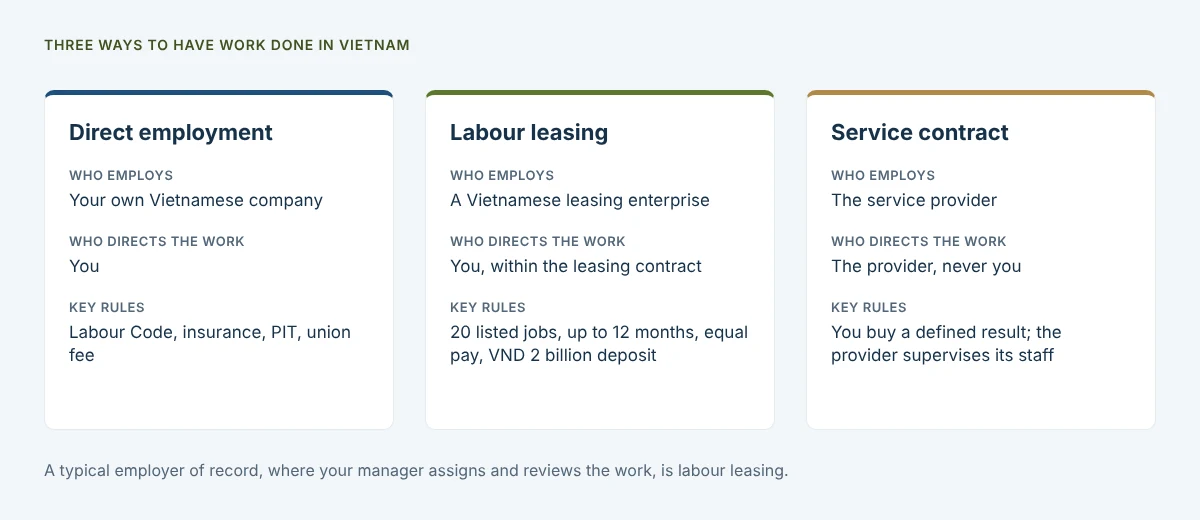
When an employer of record becomes labour leasing
The Labour Code 2019 defines labour leasing in Article 52: an enterprise recruits a worker and then sends them to work for, and under the direction of, another employer, while keeping the employment contract. Vietnam has no separate law for employers of record, so a typical EOR, in which the provider employs the person and your manager assigns and reviews the work, falls within this definition.
The name of the contract does not change the analysis. If the agreement says “consulting” or “outsourcing” but your team sets hours, assigns tasks and supervises the person, the arrangement is treated as leasing, and the rules below apply.
Who may provide labour leasing
Labour leasing is a conditional business line. The provider must be a Vietnamese enterprise that meets the leasing conditions, including a deposit of VND 2 billion held with a bank, and must report on its leasing activity. From 1 July 2026, under a government resolution simplifying business conditions, a new provider notifies the provincial Department of Home Affairs instead of applying for a licence, and firms already licensed can keep operating without a new notice. The deposit and quarterly reporting stay. These are interim rules while Decree 145 is being amended. Ask any provider which company will employ your hire and on what basis it provides leasing.
The 20 types of work open to leasing
Appendix II of Decree 145/2020/ND-CP lists the only jobs that may be leased:
| # | Type of work |
|---|---|
| 1 | Interpreting, translation and shorthand |
| 2 | Secretarial work and administrative assistance |
| 3 | Reception |
| 4 | Tour guiding |
| 5 | Sales support |
| 6 | Project support |
| 7 | Programming of production machine systems |
| 8 | Manufacturing and installing television and telecommunications equipment |
| 9 | Operating, inspecting and repairing construction machinery and production electrical systems |
| 10 | Cleaning buildings and factories |
| 11 | Document editing |
| 12 | Bodyguard and security work |
| 13 | Telemarketing and telephone customer care |
| 14 | Handling financial and tax matters |
| 15 | Car repair and operational inspection |
| 16 | Scanning, industrial technical drawing and interior decoration |
| 17 | Driving |
| 18 | Managing, operating, maintaining and serving on ships |
| 19 | Managing, supervising, operating, repairing, maintaining and serving on oil and gas rigs |
| 20 | Piloting and serving on aircraft, aircraft maintenance, flight dispatch and flight supervision |
Many common office roles fit: interpreting, administrative assistance, sales support, project support, telephone customer care and finance and tax processing. Others do not. General software development, for example, is not on the list; “programming of production machine systems” covers industrial machinery. A draft amendment to Decree 145 under consultation in 2026 would clarify some of the listed jobs, so check the current list for your role.
Allowed purposes and the 12-month limit
Article 53 sets two further conditions. First, one leasing assignment may last up to 12 months. Second, the client may use a leased worker only to:
- meet a temporary, sudden increase in work for a period of time;
- replace an employee on maternity leave, recovering from a work accident or occupational disease, or performing civic duties;
- fill a need for highly qualified or highly skilled staff.
A leased worker may not be used to replace employees who are on strike or in a labour dispute, or employees dismissed for restructuring, economic reasons or a merger, and may not be passed on to another business. Plan at the start what happens when the 12 months end: the assignment ends, the person moves to your own company, or the work moves to another lawful structure.
Equal pay and the client’s duties
The leased worker’s pay must not be lower than that of your own employees with the same qualifications doing the same or similar work. As the client, you must tell the worker about your internal rules, provide a safe workplace and the same working conditions as your own staff, agree with the worker before asking for night work or overtime beyond the leasing contract, within the legal limits, and agree with the employer, in the leasing contract, who compensates the worker for a work accident or occupational disease. You also need to and tell the employer about any breach of discipline and give it the evidence, rather than discipline the worker yourself. The employer keeps the contract, pays the salary and insurance and handles any ending.
What happens if the rules are not met
Leasing outside the conditions exposes the provider to administrative fines, and the client can be fined for using workers from a provider that does not meet them. There is also a tax angle: payments for leasing outside the permitted list may not be accepted as deductible costs, and the related input VAT may not be creditable. Most of these risks are avoided by checking the role, the purpose and the period before the start date.
If your role does not fit
| Situation | Lawful alternative |
|---|---|
| The role is not on the list, or you need it for longer than 12 months | Your own Vietnamese company, with payroll outsourcing |
| You want an outcome rather than a person, such as a support desk or a bookkeeping function | A managed service, in which the provider takes on a defined scope of work and supervises its own staff; you set deliverables, not daily tasks |
| The work is a defined project done by a genuinely independent professional | An independent contractor, under a services contract |
| The person is a foreign national | Expat Employment in Vietnam, which starts with a work permit |
How to check a provider
- Ask for the name of the Vietnamese company that will employ your hire and sign the employment contract.
- Ask how the arrangement meets the leasing rules, and whether the provider holds a leasing licence or has notified the authority.
- Ask whether your role is on the list and which allowed purpose applies.
- Ask what the contract term will be and what happens at 12 months.
- Be wary of a provider that says yes to any role, for any length, without questions.
Our ten-point checklist is in choosing an EOR provider in Vietnam.
Questions about EOR and labour leasing in Vietnam
Is an employer of record legal in Vietnam?
Yes, when it is structured as lawful labour leasing: a provider that meets the leasing conditions, a role on the list of 20 types of work, an allowed purpose and an assignment of up to 12 months. Calling it a service contract does not change the rules if your team directs the work.
Can I hire a software developer through an EOR in Vietnam?
General software development is not on the leasing list. For a developer you would normally need your own company, a managed service in which the provider delivers the work and supervises its staff, or a genuine independent contractor.
How long can a leased employee work for us?
Up to 12 months per assignment under Article 53 of the Labour Code. Agree at the start what happens when the period ends.
Who is responsible for the employee’s salary and insurance?
The employer, which is the leasing enterprise. It pays the salary, social, health and unemployment insurance and withholds personal income tax. The client provides the workplace and working conditions and must not pay the employee less than its own comparable staff.
Can a leasing arrangement be used for foreign employees?
Foreign nationals need a work permit or exemption sponsored by their Vietnamese employer, and a draft amendment to the Labour Code proposes that leasing should not apply to them. We assess foreign hires separately through our Expat Employment service.
Check whether your role fits
Tell us about the role, its purpose and how long you need it. We will review it under the leasing rules before any offer.