
How to Hire Employees in the UK: A 2026 Guide for Overseas Companies
Hiring in the UK requires a compliant employment arrangement, right-to-work checks, employment terms and payroll administration. Overseas companies commonly use their own UK entity or an employer of record (EOR). This guide explains the main steps for Great Britain, including PAYE and pension assessment. Northern Ireland has a separate employment-law framework, so confirm the rules for the employee’s location before making an offer.
Step 1: Decide who will employ the person
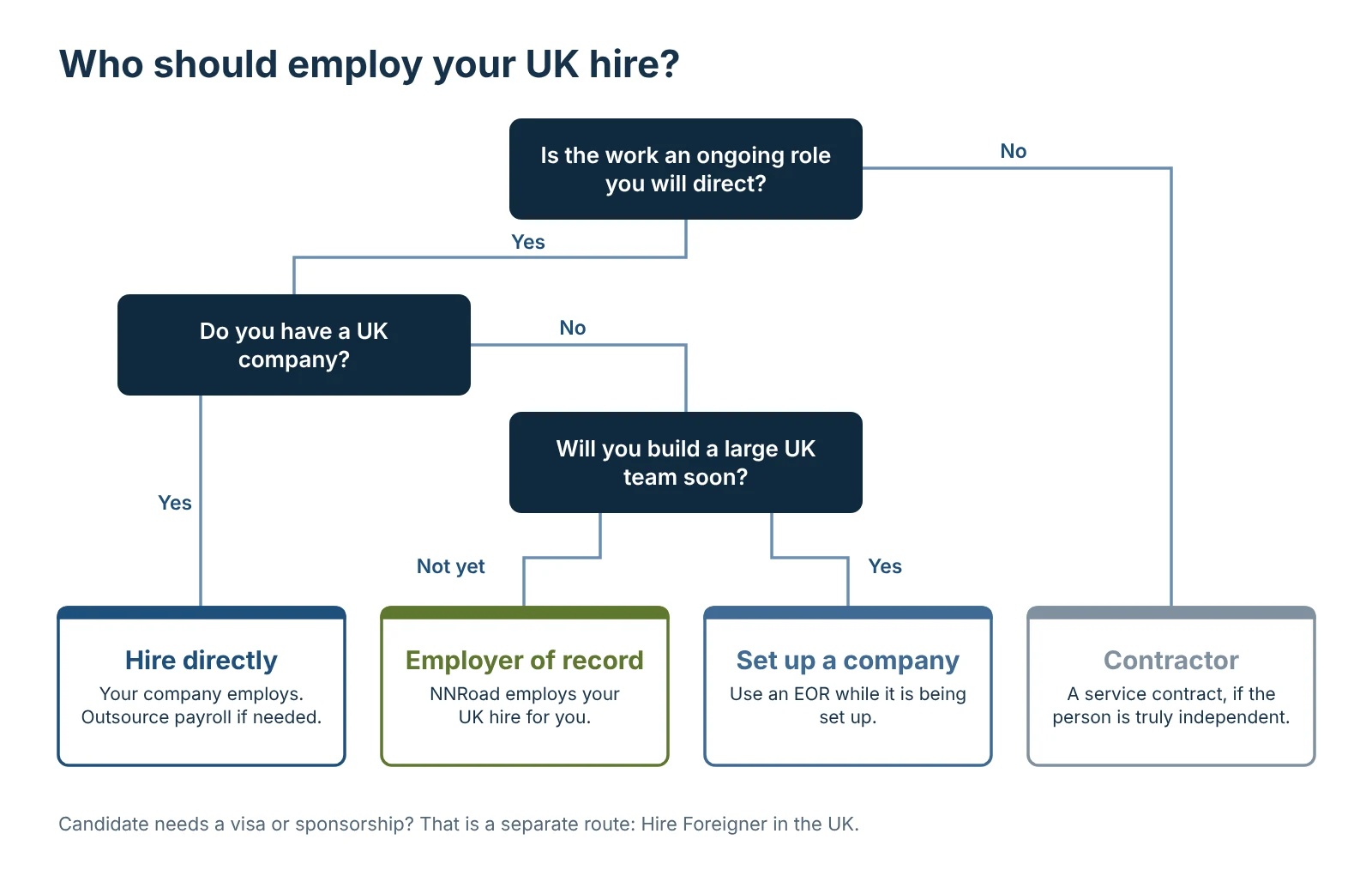
| Option | When it fits |
|---|---|
| Your own UK company | You plan a team or will sign contracts with UK customers. |
| Employer of record | You need NNRoad to employ a local employee for your business in the UK. |
| Hire Foreigner service | You need NNRoad to employ a foreign employee; eligibility and the employment arrangement are assessed separately. |
| Payroll outsourcing | You already have a UK company but no payroll team. |
| Contractor | You need a contractor engagement, subject to assessment of the actual working arrangement and applicable status rules. |
Step 2: Check the candidate's right to work
| Candidate | How the check is done |
|---|---|
| British or Irish citizen | Check the original passport, or use an identity service provider. Keep a dated copy. |
| Settled status, or a visa that allows the work | The candidate gives you a share code and you check it on GOV.UK. If the permission has an end date, check again before it expires. |
| No permission to work yet | The person cannot start until a visa is granted. |
NNRoad’s UK EOR service is for local employees, subject to right-to-work checks and role review. Foreign employee hiring is handled through our separate Hire Foreigner in the UK service.
Step 3: Set the salary and package
- 25 days of holiday plus bank holidays, against a legal minimum of 28 days in total
- An employer pension contribution above the 3% minimum
- Private medical insurance or a health cash plan
- Sick pay above the statutory rate for a set number of weeks
- A bonus or commission for sales and senior roles
Step 4: Give written terms on day one
- The employer’s name, the employee’s name, job title and start date
- Pay, and how often it is paid
- Working hours and days, and whether they can vary
- Holiday entitlement, and whether it includes bank holidays
- Place of work
- The length and conditions of any probation period
- Other benefits, and any training the employee must complete
- For a fixed-term role, the end date
Step 5: Set up PAYE, National Insurance and pension
| Contribution | Employer | Employee |
|---|---|---|
| National Insurance | 15% of pay above £417 a month | 8% of pay between £1,048 and £4,189 a month, 2% above |
| Workplace pension (minimum) | 3% of qualifying earnings | 5% of qualifying earnings, including tax relief |
| Income tax (PAYE) | None | 20%, 40% or 45%, deducted from pay |
Rates for the tax year 6 April 2026 to 5 April 2027. Qualifying earnings for pensions are pay between £520 and £4,189 a month. Sources: GOV.UK rates and thresholds for employers, GOV.UK workplace pensions.
- Report pay and deductions to HMRC on or before each payday, and pay what is due each month.
- Enrol employees aged 22 to State Pension age who earn more than £10,000 a year in a workplace pension. GOV.UK
- Take out employers’ liability insurance of at least £5 million as soon as you become an employer. GOV.UK
- Give employees still employed on 5 April a P60 by 31 May, and issue a P45 when employment ends.
- Keep payroll records for 3 years from the end of the tax year they relate to.
Step 6: Holiday, working hours, sick pay and family leave
| Topic | The rule |
|---|---|
| Paid holiday | 5.6 weeks a year, which is 28 days for a five-day week. Bank holidays can be included. GOV.UK |
| Working hours | No more than 48 hours a week on average over 17 weeks, unless the employee opts out in writing. GOV.UK |
| Sick pay | Statutory Sick Pay of £123.25 a week, or 80% of average weekly earnings if lower, from the first day of illness for up to 28 weeks. GOV.UK |
| Maternity leave and pay | Up to 52 weeks of leave. Statutory pay for 39 weeks: 90% of average weekly earnings for 6 weeks, then £194.32 a week or 90% if lower. GOV.UK |
| Paternity leave | Up to 2 weeks, a right from the first day of employment since 6 April 2026. GOV.UK |
| Flexible working | Employees can make a request from their first day. GOV.UK |
| Bank holidays | 8 a year in England and Wales; Scotland and Northern Ireland have more. GOV.UK |
Step 7: If the employee will work from home
- Write the place of work and any home-working arrangement into the contract.
- Employees can ask for flexible working from their first day. GOV.UK
- Agree who provides equipment and how expenses are reimbursed.
- Set clear rules on confidentiality, data access and ownership of work.
Step 8: Ending the employment
| Length of service | Minimum notice from the employer |
|---|---|
| Less than 1 month | None set by law |
| 1 month to less than 2 years | 1 week |
| 2 to 12 years | 1 week for each full year |
| 12 years or more | 12 weeks |
Assess the lawful reason, procedure, notice and any redundancy obligations before dismissing an employee. The usual service requirement for an ordinary unfair dismissal claim is two years; many automatically unfair reasons and discrimination claims have no such qualifying period. For dismissals from 1 January 2027, the ordinary unfair dismissal qualifying period is due to fall to six months and the compensation cap is due to be removed. Obtain case-specific advice when planning a dismissal or transfer.
Hiring checklist for the UK
- Employer decided: your own UK company or an EOR
- Right to work checked before the first day, with a dated record
- Salary, holiday, pension and benefits agreed
- Written statement of terms issued on or before day one
- Employer registration with HMRC and a payroll calendar
- Workplace pension scheme and enrolment in place
- Employers' liability insurance of at least £5 million
- Equipment, system access and home-working rules agreed
Questions about hiring in the UK
Can a foreign company hire employees in the UK without a UK company?
Yes, through an employer of record. The EOR employs the person in the UK and handles the contract, PAYE, National Insurance and pension, while you manage the work. At NNRoad this route is for British and Irish citizens and people with settled status. A candidate who needs a visa is hired through a different route, such as our Hire Foreigner service.
How long does it take to hire in the UK?
Through NNRoad’s EOR, allow about one month from signing to the employee’s first day. The candidate’s notice period with their current employer often sets the pace. With your own company, add the time to register it, open a bank account and set up payroll and a pension scheme.
What does an employer pay on top of salary in the UK?
Employer National Insurance at 15% of pay above £5,000 a year, and a pension contribution of at least 3% of qualifying earnings. On a £60,000 salary the two come to £797.52 a month.
Is a bonus or 13th-month salary mandatory in the UK?
No. Bonuses are a matter for the contract. The statutory items are the minimum wage, paid holiday, sick pay and the workplace pension.
What does it cost to hire through an EOR in the UK?
With NNRoad, a monthly service fee for each employee, quoted after we review the role, plus the employment cost at cost. See worked examples of the employment cost.