
Insights
How to Hire Employees in Colombia: A 2026 Guide for Overseas Companies
Insights · By Chen ChunJie · Updated 25 October 2026
To hire an employee in Colombia you need a Colombian employer, a written contract, affiliations to health, pension, occupational risk and a family compensation fund before the first day, monthly contributions through PILA, electronic payroll reporting to DIAN, and the mandatory benefits: prima, cesantías and vacation. Without a Colombian company, you can work through a provider that takes on the work and employs the people who do it, but how that is set up matters more in Colombia than in most countries.
Last reviewed in October 2026 against the Substantive Labour Code, Law 2101 of 2021, Law 2466 of 2025 and Decree 581 of 2026. General information, not legal or tax advice.
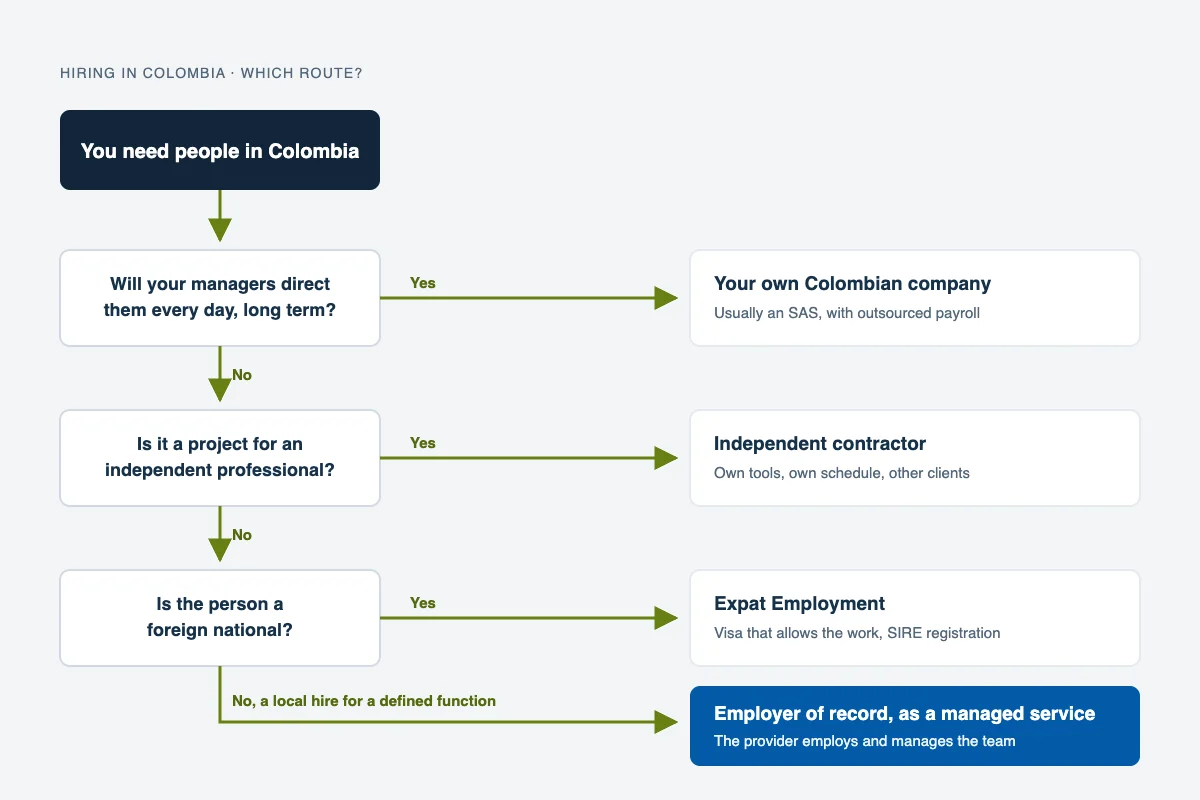
Step 1: Choose a lawful way to engage people
A company abroad cannot simply put someone living and working in Colombia on its home payroll. Someone has to be the Colombian employer, and Colombian law looks at the facts: who directs the work, sets the hours and can discipline the worker. You have four practical routes.
| Route | When it fits | Watch out for |
|---|---|---|
| Your own Colombian company (usually an SAS) or a branch | A growing team your managers will direct every day, Colombian customers to invoice, or a regulated activity | Set-up time, and running payroll, PILA and DIAN reporting yourself or through a payroll provider |
| A provider that takes on the work (managed service, often sold as EOR) | A defined function, project or service delivered in Colombia, with the provider employing and managing the people | The provider must really direct the staff; your company defines the scope and receives results |
| A licensed temporary services company (EST) | Occasional work, cover for staff on leave, or peaks in activity | Limited to six months, extendable once by six months, and only through an authorised EST |
| An independent contractor | A genuine project by a professional with their own tools, schedule and clients | Contracts that look like employment are treated as employment, with back pay and contributions due |
Since Decree 581 of 2026, when a contractor’s staff carry out a company’s permanent activities under that company’s direction, they are presumed to be its employees, and both companies can be fined. If you are deciding whether to register a company at all, read start a business in Colombia or operate without one. To have people in Colombia without your own company, see employer of record in Colombia.
Step 2: Check the right to work
Colombian nationals can be hired directly with their cédula de ciudadanía. Foreign nationals need a visa that allows the specific work, most often a migrant (M) visa linked to the employer, and must be registered with Migración Colombia through SIRE when they start and stop work. Some nationalities take longer to process, so check feasibility before making an offer.
NNRoad’s Colombia EOR covers local hires. If the person is a foreign national, see Expat Employment in Colombia.
Step 3: Choose the contract
| Contract | Rules |
|---|---|
| Indefinite term | The general rule. Can be ended by the employee with 30 days’ notice, or by the employer for just cause or with an indemnity. |
| Fixed term | In writing, with an end date. Renewable, but no more than four years in total under Law 2466. Non-renewal needs at least 30 days’ written notice. |
| Specific work or task (obra o labor) | Ends when the defined work is finished; the work must be clearly described. |
| Apprenticeship | Since Law 2466, an employment contract with full benefits. Larger companies must hire apprentices in proportion to headcount or pay a monetary quota. |
Probation can last up to 2 months and must be agreed in writing; for fixed-term contracts under a year, it is limited to one-fifth of the term. Write the contract in Spanish; a bilingual Spanish–English version helps both sides.
Step 4: Set the salary
- Minimum wage: COP 1,750,905 a month in 2026, plus a transport allowance of COP 249,095 for employees earning up to 2 minimum wages.
- Currency: salaries are agreed and paid in Colombian pesos, monthly or twice a month.
- Integral salary: for senior roles earning at least 13 minimum wages, a single integral salary can replace prima, cesantías and most other benefits; contributions are then calculated on 70% of it.
- Variable pay: commissions and regular bonuses usually count as salary for benefits and contributions unless they are agreed in writing as non-salary payments within the legal limits.
Use our Colombia employer cost calculator to model employer contributions, benefits and net pay for a given salary.
Step 5: Register the employee and run payroll
- Before day one: affiliate the employee to occupational risk insurance (ARL), a health provider (EPS), a pension fund (AFP or Colpensiones) and a family compensation fund (caja).
- Every month: pay social security and payroll contributions through PILA, by the deadline set by the employer’s tax ID; withhold income tax; and send the electronic payroll support document to DIAN.
- Records: keep a daily record of overtime, payslips and the documents behind every payment. The UGPP audits contributions and can claim underpayments with penalties.
| Employer contribution | Rate |
|---|---|
| Pension | 12% (employee 4%) |
| Health | 8.5% (employee 4%); exempt below 10 minimum wages for employers that pay corporate income tax |
| Occupational risk (ARL) | 0.522% to 6.96%, by risk class |
| Family compensation fund | 4% |
| SENA and ICBF | 2% and 3%; same exemption as health |
Already have a Colombian company? Our Colombia payroll service handles PILA, withholding and electronic payroll for you.
Step 6: Plan working time and leave
| Rule | 2026 position |
|---|---|
| Maximum working week | 42 hours from 15 July 2026 |
| Overtime | Up to 2 hours a day and 12 a week; +25% by day, +75% at night |
| Night work | 7 p.m. to 6 a.m., +35% |
| Sunday and public holidays | +90% from 1 July 2026; +100% from 1 July 2027 |
| Vacation | 15 working days of paid vacation per year of service |
| Public holidays | 18 in 2026, most moved to the following Monday |
| Family leave | Maternity 18 weeks; paternity 2 weeks |
Step 7: Budget for mandatory benefits
- Prima de servicios: 30 days’ salary a year, paid by 30 June and 20 December.
- Cesantías: one month’s salary per year, deposited in the employee’s severance fund by 14 February.
- Interest on cesantías: 12% a year, paid to the employee by 31 January.
- Dotación: work clothing and shoes three times a year for employees earning up to 2 minimum wages.
Together with contributions, an office employee typically costs roughly 34% to 55% more than gross salary, depending on salary level, risk class and exemptions.
Step 8: End employment correctly
An employer can end an indefinite contract for a just cause listed in the Labour Code, after a documented disciplinary process with prior notice, or without just cause by paying an indemnity: 30 days’ salary for the first year and 20 days for each further year for employees earning under 10 minimum wages. Ending a fixed-term contract early means paying the salary for the rest of the term. Some employees, such as pregnant employees and those with health-related job protection, cannot be dismissed without prior authorisation from the Ministry of Labour. Every exit ends with a final settlement covering salary, prima, cesantías, interest and unused vacation.
How to choose an EOR in Colombia
“Best EOR in Colombia” lists rarely ask the questions that matter under Colombian law. Before you sign with any provider, ask:
- Who signs the employment contract, and who gives the employee day-to-day instructions?
- How does the model fit Decree 581 of 2026 and the EST rules, and will they put that in writing?
- Do they pay PILA, withhold tax and report electronic payroll themselves, and show you the records?
- How do they handle the 42-hour week, Sunday surcharges and the four-year fixed-term limit?
- What does the proposal include line by line, and what happens to employees if you set up your own company?
Our answers are on the Colombia employer of record page.
FAQ: hiring in Colombia
Can I hire someone in Colombia without a Colombian company?
Yes, through a provider that takes on the work and employs the people who do it, as long as the provider really directs the staff. If your managers will direct the person every day as part of your core business, set up a Colombian company and use a payroll service.
Can I pay a Colombian employee from abroad as a freelancer?
Only if the work is genuinely independent. A contract becomes employment when the person works under your direction, and the UGPP and labour courts look at the facts. See On-Demand Talent in Colombia for genuine project work.
How long does it take to hire an employee in Colombia?
Once a candidate accepts, the contract can be signed and affiliations completed within days. Recruitment, a candidate’s notice period and, for foreign nationals, visa processing usually take longer. Setting up your own company first adds several weeks.
What is the minimum wage in Colombia in 2026?
COP 1,750,905 a month, set by Decree 1469 of 2025, plus a transport allowance of COP 249,095 for employees earning up to 2 minimum wages.
Is there a 13th-month salary in Colombia?
Not by that name. The prima de servicios is one month’s salary a year, paid in two halves in June and December. Cesantías add a further month, saved in a severance fund.
What is the difference between an EOR and a PEO in Colombia?
Both are commercial labels. Colombian law does not recognise co-employment, so one company is the employer and carries every obligation. For a company with no Colombian entity, a “PEO” offer is an employer of record arrangement.
Need people in Colombia before you have a company?
NNRoad can take on the work you need done in Colombia, with our Local Team employing and managing the people who deliver it.
Related
When you need a Colombian company, and when you do not.
Contracts, hours, benefits, contributions and termination.