
Insights
How to Hire Employees in Norway
Insights · By Chen ChunJie · Published 8 November 2026
A foreign company can employ people directly in Norway after completing the required registrations, use a lawful hiring-in arrangement, commission a genuinely managed service, or engage an independent business for suitable work. The right route depends on who directs the work, the role and the legal basis. This guide explains the hiring decision; our service pages cover delivery.
Reviewed 15 November 2026 against Norwegian official guidance. Confirm the applicable sector, collective agreement and individual circumstances before hiring.
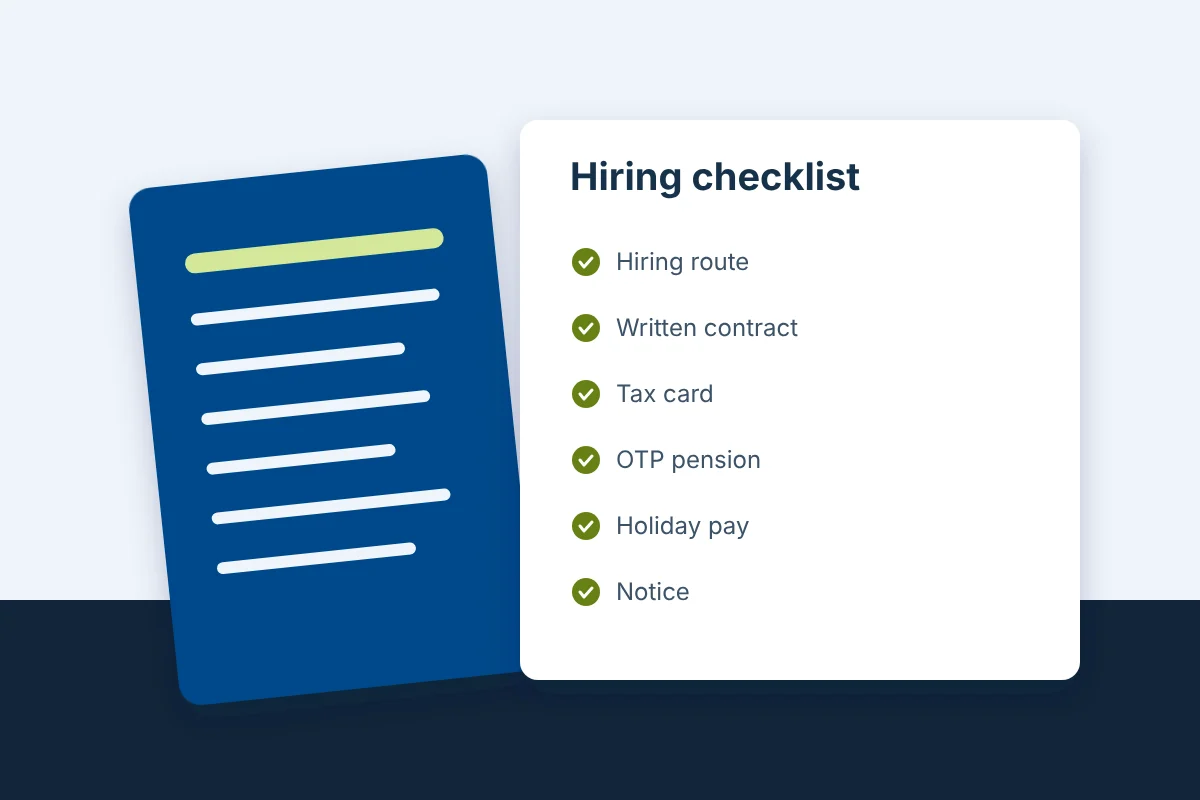
Ways to get people working in Norway
| Route | Who employs and directs the person | Best for |
|---|---|---|
| Norwegian company or registered foreign employer | Your Norwegian AS, or your foreign company through the relevant registrations. A NUF is its registered Norwegian branch, not a separate legal entity. | Teams you employ and manage directly |
| Lawful hiring in from an authorised staffing enterprise | The staffing employer employs; the client directs day-to-day work | Only roles and assignments meeting the hiring-in rules |
| Defined service from a Norwegian employer | The service provider, such as our Local Team | A genuine service managed by the provider, which is responsible for delivery |
| Self-employed contractor | An independent business controls its own delivery; the actual relationship must support that status | Projects by genuinely independent professionals |
Limits on hiring in
A temporary workload alone is not enough to justify hiring from a staffing enterprise. A permitted basis is needed, such as replacing an absent employee, a qualifying agreement with employee representatives, or a narrowly defined specialist advisory assignment. The staffing enterprise must be authorised, and regional restrictions can prohibit hiring in for construction work. Equal-treatment and client obligations also apply.
For a managed service, the provider must genuinely direct its personnel and take responsibility for delivery. Calling labour supply a “service contract” does not change its legal character. See Altinn’s hiring-in guidance.
No Norwegian employing entity? NNRoad assesses two possible models with you: lawful client-directed hiring in, or a genuine service delivered under our Local Team’s management. The choice depends on the law, role and actual working arrangements. See Employer of Record in Norway for local employees.
Contracts and pay
Permanent employment is the main rule; a fixed term needs a legal basis. Every employee needs a written contract: normally within seven days for employment exceeding one month, and immediately for shorter employment or hiring out. Written probation is normally limited to six months and, for a fixed term, no more than half the contract period. See the official contract requirements.
Norway has no universal minimum wage, but mandatory sector rates and applicable collective agreements must be checked. Budget employer national insurance by zone (14.1% in Zone I), required pension contributions, injury insurance and holiday-pay settlement. For employers subject to mandatory occupational pension rules, the minimum defined-contribution saving is generally 2% of eligible pay from the first krone up to 12G. See our Norway payroll and tax guide.
Working time and leave
| Rule | What applies |
|---|---|
| Hours | Ordinary statutory limits are normally 9 hours per 24 hours and 40 per 7 days; some shift patterns have lower limits. Agreed averaging and exemptions have separate conditions. |
| Overtime | At least 40% extra. Ordinary limits are 10 hours per 7 days, 25 per 4 consecutive weeks and 200 per 52 weeks; lawful extensions and total-hour limits must also be checked. |
| Annual leave | 25 working days including Saturdays (four weeks and one day), with six extra working days from the year the employee turns 60. Five weeks is common by agreement. |
| Public holidays | Do not assume a fixed number of paid weekdays off. The calendar and work schedule matter; pay rights follow the contract or collective agreement, with specific statutory rules for 1 and 17 May. |
Ending employment
Dismissal needs objective grounds, prior consultation and legally compliant written notice. Statutory notice normally starts at one month, rises to two after five years and three after ten; employer notice can reach four, five or six months at ages 50, 55 or 60 after ten years. Longer agreed terms may apply. Notice normally runs from the next calendar month; written probation usually has a 14-day period running from receipt unless otherwise agreed. There is no general automatic statutory severance payment, but contractual or negotiated amounts and final salary/holiday pay may be due. See official dismissal guidance.
Hiring non-EEA nationals
Check the person’s existing right to work before choosing an immigration route. Many non-EEA nationals need a work-authorising residence permit, such as a skilled-worker permit, before starting; Swiss nationals and some existing permit holders follow different rules. EU/EEA and Swiss workers generally may start work without that permit, with registration requirements for longer stays. See Expat Employment in Norway for foreign employees.
FAQ: hiring employees in Norway
Must the contract be written?
Yes. For employment exceeding one month, it must normally be ready within seven days of starting. For shorter employment or hiring out, it must be concluded immediately.
Is there a minimum wage?
There is no universal statutory rate. Check whether the role falls under a mandatory sector rate and whether a collective agreement applies.
How long can probation last?
Normally up to six months, agreed in writing. For fixed-term employment, it cannot exceed half the employment period. Special rules apply to extensions for absence and repeat probation.
Is a 13th month required?
No general statutory 13th-month bonus applies. Holiday pay normally replaces salary during leave: the statutory rate is generally 10.2% of the previous year’s qualifying earnings, commonly 12% with five weeks’ holiday. Higher rates apply from age 60. Budget the salary offset as well as accrued holiday pay.
Need people working in Norway?
Share the role, location, nationality and who will manage the work. NNRoad will assess the lawful employment model with you. Our Local Team handles the agreed employer responsibilities; clients can view employee information and payroll reports in our Portal, and employees can access their own payslips.
Related
Lawful employment models for local employees.
Contracts, leave, notice and more.