
Is an Employer of Record Legal in Peru? Staffing and Outsourcing Rules Explained
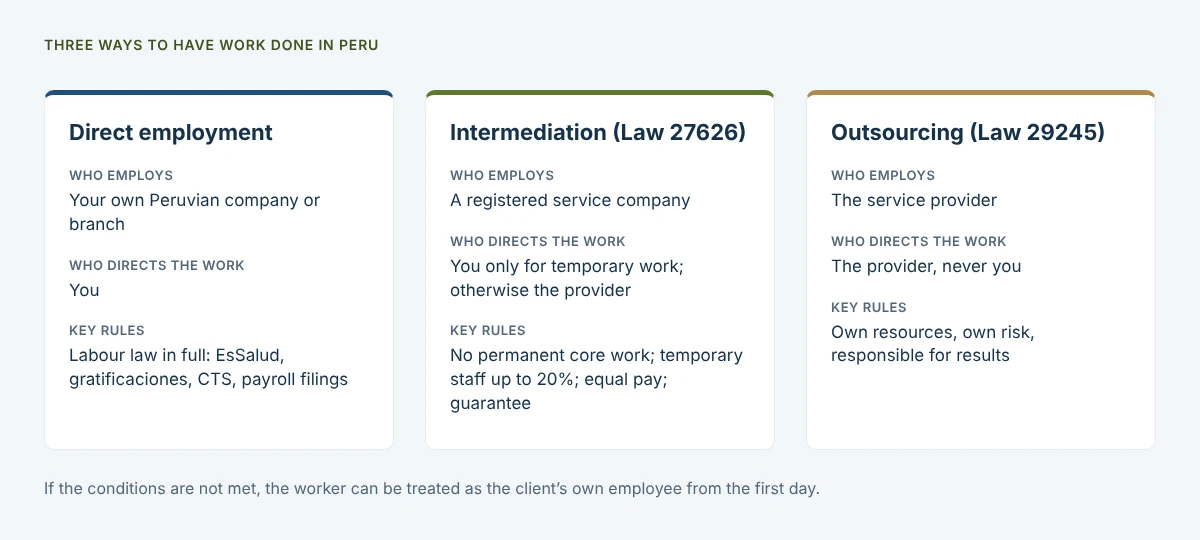
Yes, an employer of record is legal in Peru if it is set up as lawful labour intermediation or outsourcing. Peru has no law written for employers of record, but it regulates the two ways one company’s staff can work for another business: labour intermediation (Law 27626) and outsourcing (Law 29245). Each has conditions on who may provide it, what work it can cover and who directs the staff. If an arrangement does not meet them, the worker can be treated as the client’s own employee from the first day.
Why the name of the service does not matter
Peruvian labour law applies the principle of primacy of reality: courts and SUNAFIL inspectors look at what happens in practice, not at what the contract is called. If a Peruvian company employs a person and your manager assigns and supervises their work, the arrangement is judged by the intermediation rules, whether the contract says “EOR”, “consulting” or “services”.
Labour intermediation: Law 27626
Intermediation is the supply of workers by a service company to a client (the usuaria). Under Law 27626 it is allowed only in three cases:
| Type | What it covers | Who directs the work |
|---|---|---|
| Temporary | Occasional needs outside the client’s usual activity (up to six months a year), or cover for an absent employee | The client |
| Complementary | Support activities not linked to the client’s main business, such as security, cleaning or maintenance | The service company |
| Highly specialised | Services needing a high degree of specialisation | The service company |
- Only companies set up exclusively for intermediation, registered with the Ministry of Labour and with capital of at least 45 tax units, may provide it. They must post a guarantee covering the workers’ pay and social security.
- Workers supplied to a client may not carry out the client’s main activity on a permanent basis.
- Temporary workers may not exceed 20% of the client’s workforce.
- Temporary workers are entitled to the pay and conditions the client gives its own staff.
- If the guarantee does not cover unpaid amounts, the client is jointly liable for them.
- If these rules are broken, the workers are treated as having had an employment contract with the client from the start.
Outsourcing: Law 29245
Outsourcing (tercerización) is different: the client hands a defined part of its activity to a provider, which delivers it with its own staff. Under Law 29245, as upheld by the Constitutional Court in case 00013-2014-PI/TC, the provider must:
- carry out the service at its own account and risk;
- have its own financial, technical or material resources;
- be responsible for the results; and
- keep its workers under its exclusive direction.
Signs of genuine autonomy include serving several clients, using its own equipment, being paid per result and organising the work itself. When the provider’s staff work at the client’s premises on a continuous basis, the provider must be registered, and the client is jointly liable for the workers’ statutory pay and social security for the period, and for one year after. An outsourcing arrangement that lacks autonomy is treated as direct employment by the client.
In 2022 Supreme Decree 001-2022-TR barred the outsourcing of a company’s core business. Indecopi suspended its application, and on 1 April 2026 the Supreme Court annulled it in a popular action, with general effect, as reported by Gestión. Outsourcing of core work is therefore again possible, but only when it is genuine outsourcing with the autonomy described above.
Where a typical employer of record fits
| Your need | Lawful structure | Who directs the work |
|---|---|---|
| Cover for an absent employee, or an occasional need outside your usual business (up to six months a year) | Temporary intermediation, within the 20% limit | You, within the agreed role and period |
| A support or specialised service, such as IT support or back-office processing | Complementary or specialised intermediation, or outsourcing | The provider |
| An ongoing function delivered as a service, with agreed deliverables | Outsourcing (a managed service) | The provider; you agree the deliverables |
| A permanent role on your core business, under your own manager | Your own Peruvian company | You, as the employer |
| A genuinely independent professional on a defined project | A civil services contract | The professional |
The common EOR model, in which a provider employs someone and the client manages them indefinitely on core work, is not permitted under either law: intermediation cannot cover permanent core work, and outsourcing requires the provider to direct its own staff. That is why the structure has to be chosen per role, before the offer.
What this means for your hire
- Describe the role, its duration and how you expect to supervise it when you ask for a proposal.
- Ask the provider which law it relies on for your role, and whether it meets the conditions.
- If you want long-term control of core work, plan for your own entity. While you set up, an EOR can cover roles that fit temporary staffing or a managed service.
- For foreign nationals, the separate foreign-worker rules apply on top. See Expat Employment in Peru.
At NNRoad we review each role and agree the set-up in writing before any offer. See our Peru employer of record service.
Questions about the legality of EOR in Peru
Is an employer of record legal in Peru?
Yes, when it is structured as labour intermediation or outsourcing and meets the conditions of Law 27626 or Law 29245. Peru has no EOR-specific law.
Can my team manage an EOR employee day to day in Peru?
Only in temporary intermediation, for occasional needs or to cover an absence. For complementary, specialised or outsourced services, the provider directs its own staff and you agree the deliverables.
What happens if an EOR arrangement breaks the rules?
The worker can be treated as your own employee from the first day, with the employment obligations that follow, and both sides may face fines.
Can core business activities be outsourced in Peru?
Yes, if the outsourcing is genuine: the provider works at its own account and risk, with its own resources and its own direction of staff. The 2022 rule barring core outsourcing was annulled by the Supreme Court in April 2026.
Want to know which structure fits your role?
Send us the role, how long you need it and how you plan to work with the person. We will tell you the lawful set-up and the full cost.