
Insights
Operating in Denmark Without a Company: Your Options in 2026
Insights · By Chen ChunJie · Published 25 October 2026
A foreign business can do a lot in Denmark without a Danish company. It can sell to Danish customers from abroad, use independent contractors, post its own staff for a defined job after registering in RUT, employ people directly as a foreign employer, or hire through an employer of record. A Danish company (ApS) or a branch becomes the better choice once you have a permanent establishment in Denmark, Danish revenue to book locally, or a team your own managers run there.
Last reviewed in October 2026 against guidance from the Danish Tax Agency (SKAT), the Danish Business Authority and Workplace Denmark. Permanent establishment depends on the facts of each case; take tax advice before you rely on it. General information, not legal or tax advice.
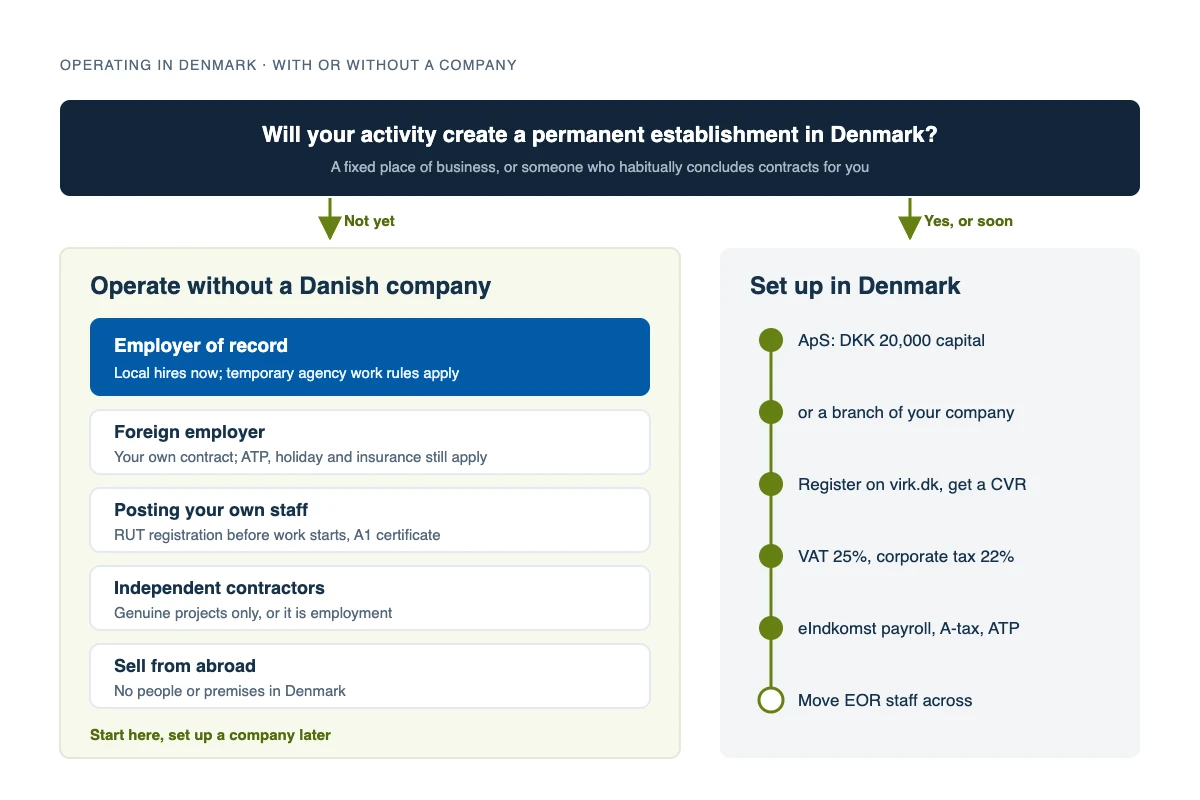
Five ways to operate in Denmark without a Danish company
| Option | What it is for | Main conditions |
|---|---|---|
| Sell from abroad | Selling goods or services to Danish customers | Danish VAT rules still apply to some sales; no people or fixed place of business in Denmark |
| Independent contractors | A defined project delivered by a professional or firm | The contractor must be genuinely independent; otherwise the arrangement is treated as employment |
| Posting your own staff | Sending existing employees to Denmark for a specific job | Registration in the Register of Foreign Service Providers (RUT) before work starts, an A1 certificate for social security, and Danish minimum terms for posted workers |
| Foreign employer | Employing one or a few people living in Denmark on your own contract | Danish labour law, holiday rules, ATP and workers’ compensation insurance apply; tax withholding depends on whether you have a permanent establishment |
| Employer of record | Hiring local employees now, without registering or running Danish payroll | The EOR is the legal employer; when your team directs the work, the Temporary Agency Work Act must be applied |
For a step-by-step view of contracts, pay, holiday and termination, read how to hire employees in Denmark.
The test that decides: permanent establishment
A foreign business is liable to Danish corporate tax on the profit of a permanent establishment (PE) in Denmark. A PE can arise from a fixed place of business, such as an office or site used for your business, or from a person in Denmark who habitually negotiates and concludes contracts on your behalf. Preparatory or auxiliary activity, such as market research or support functions, generally does not create one.
- Without a PE: according to the Danish Tax Agency, a foreign business does not have to withhold A-tax and AM-bidrag for its employees in Denmark. The employees pay their own Danish tax through their preliminary income assessment. ATP, holiday and insurance rules still apply.
- With a PE: the business registers in Denmark, withholds AM-bidrag and A-tax from the first day of work, reports pay in eIndkomst and files Danish corporate tax returns.
- Hiring out labour: a foreign business that places workers with a Danish business must withhold AM-bidrag and A-tax from day one, whether or not it has a PE.
An employer of record carries the payroll and employment obligations, but it does not remove PE risk created by what your business does in Denmark. Keep sales authority and premises in mind when you plan the role.
Hiring in Denmark without a company
If you need people on the ground but not a company, compare the two employment options.
| Foreign employer | Employer of record | |
|---|---|---|
| Who signs the contract | Your foreign company | The EOR’s Danish employer |
| Danish registrations | ATP, holiday and insurance set-up; full payroll registration if you have a PE | Handled by the EOR |
| Payroll, holiday and pension administration | You or a payroll provider | Handled by the EOR |
| Best for | Senior or sales-light roles where you accept the PE analysis and administration | Getting started fast, several hires, or no wish to run Danish payroll |
Under an employer of record, your team usually directs the daily work. Danish law treats that as temporary agency work, so the employee must get equal treatment with comparable staff (unless a nationwide collective agreement applies, with adequate compensating benefits), and the placement must be temporary in nature. There is no fixed maximum length: in June 2026 the Supreme Court confirmed that placements of two years or more can still be temporary when their purpose and each extension are objectively justified and documented. Where they are not, the employee gains the rights of a salaried employee under Funktionærloven. For a permanent role, plan a move to your own entity. See employer of record in Denmark.
Sending your own staff to Denmark
- Register the job in RUT before the work starts, and update it if the details change.
- Get an A1 certificate from the home country, so the employee stays in the home social security system during the posting.
- Apply the Danish terms that protect posted workers, including working time, holiday and health and safety rules, and any pay terms required under Danish collective agreements in the sector.
- Check right to work: Nordic, EU, EEA and Swiss citizens can be posted freely; other nationals need a Danish permit unless a specific exemption applies.
- Check tax: staff who spend more than 183 days in Denmark in 12 months, or who work for a PE, become liable to Danish tax.
Hiring non-EU staff to live and work in Denmark is a different route from posting. See Expat Employment in Denmark.
When to set up a Danish company
Set up an ApS or register a branch when your activity creates a PE anyway, when you will book Danish revenue locally, when you need a local licence, or when you plan a permanent team led from Denmark.
| Structure | Key facts in 2026 |
|---|---|
| Private limited company (ApS) | Minimum share capital of DKK 20,000; registered online with the Danish Business Authority through virk.dk; a CVR number is issued on registration |
| Public limited company (A/S) | Minimum share capital of DKK 400,000; used for larger or listed businesses |
| Branch (filial) | Registered as a branch of the foreign company; the parent stays liable, and the branch is taxed in Denmark as a PE |
| Taxes | Corporate tax 22%; VAT 25%, with VAT registration once taxable sales in Denmark exceed DKK 50,000 in 12 months |
- Choose the structure and the name, and confirm the beneficial owners.
- Prepare the articles of association and pay in the share capital.
- Register online through virk.dk; foreign founders without MitID can use the Danish Business Authority’s procedure for foreign applicants.
- Register for VAT and as an employer as soon as you need them.
- Open a Danish bank account, set up bookkeeping and plan the annual report.
- Register for payroll before the first employee starts.
Once you have the company, you can transfer employees from an employer of record. Our Denmark payroll service can then run payroll for your own entity.
FAQ: operating in Denmark without a company
Can a foreign company employ someone in Denmark directly?
Yes. A foreign company can employ a person in Denmark on its own contract. Danish labour law, holiday rules, ATP and workers’ compensation insurance apply. Whether it must withhold Danish tax depends on whether it has a permanent establishment in Denmark.
Does an employer of record create a permanent establishment?
The EOR is the legal employer, which reduces the employment and payroll exposure. A PE can still arise from what the employee does for your business, for example habitually concluding contracts on your behalf or working from premises at your disposal.
What is RUT?
RUT is the Danish Register of Foreign Service Providers. Foreign businesses that post workers to Denmark, or provide services there without a Danish company, register in RUT before the work begins.
How much capital do I need to start an ApS?
The minimum share capital for an ApS is DKK 20,000. An A/S requires DKK 400,000.
Is an umbrella company the same as an employer of record?
No. An umbrella company usually employs contractors who find their own assignments. An employer of record employs a person in a role you define, while your team usually directs the daily work. If the person is really your employee, use an EOR or your own entity; if the work is a genuine independent project, see On-Demand Talent.
Need people in Denmark before you have a company?
Tell us the role, the location and when you want to start. We confirm whether an employer of record fits, and what to watch for permanent establishment, before an offer is made.
Related
Routes, contracts, pay, holiday and termination in 2026.
The rules every employer in Denmark applies.