
Insights
Salary Tax in Tunisia: IRPP Brackets, CNSS and a Worked Example
Insights · By Chen ChunJie · Published 8 November 2026
Tunisian payroll separates employee deductions from employer costs. This guide covers the general non-agricultural scheme, the progressive income-tax schedule and an illustrative salary calculation. Applicable bases, exemptions, worker status and payment timing can change the result.
Reviewed in November 2026 against the 2026 income-tax code, the official tax-bracket guidance and 2026 solidarity-contribution guidance. Confirm the current rules and employee-specific inputs before processing payroll.
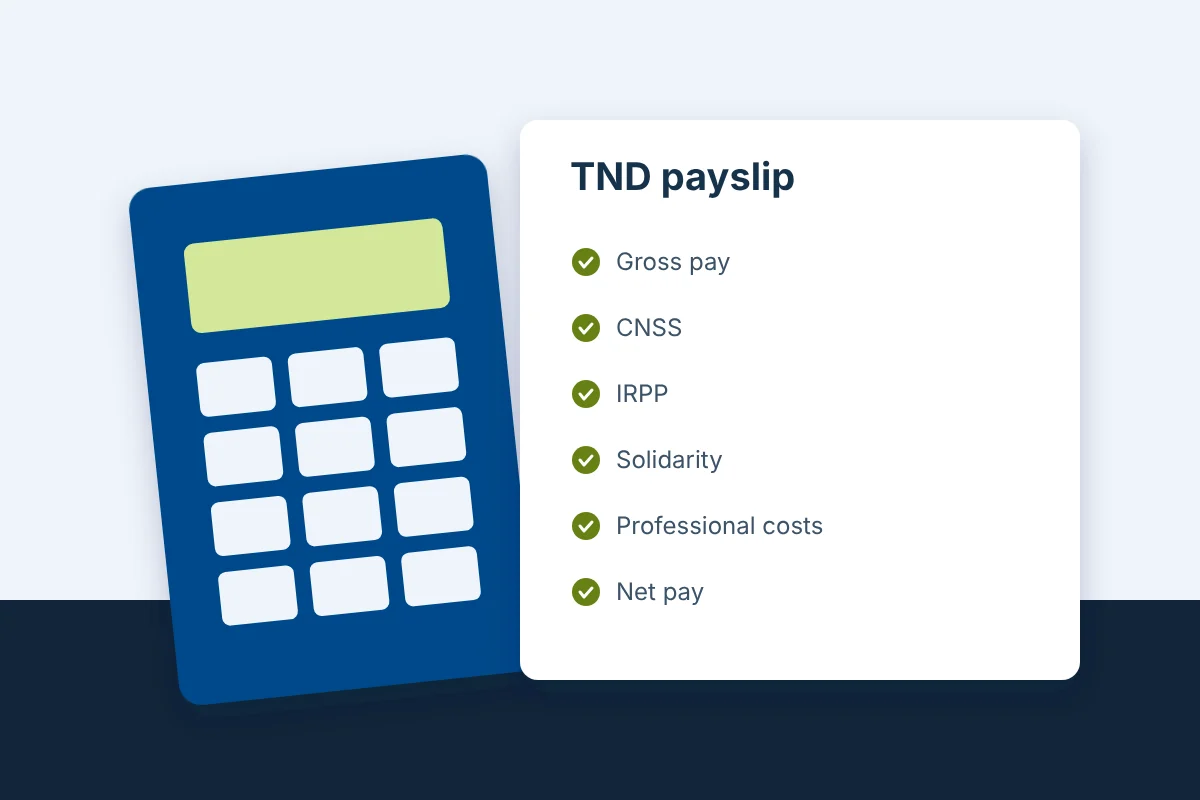
IRPP brackets for 2026
| Annual taxable income (TND) | Rate |
|---|---|
| Up to 5,000 | 0% |
| Over 5,000 up to 10,000 | 15% |
| Over 10,000 up to 20,000 | 25% |
| Over 20,000 up to 30,000 | 30% |
| Over 30,000 up to 40,000 | 33% |
| Over 40,000 up to 50,000 | 36% |
| Over 50,000 up to 70,000 | 38% |
| Above 70,000 | 40% |
The schedule is progressive: each rate applies only to its income band. For salary payments in 2026, the social solidarity contribution generally uses a 0.5-percentage-point uplift to the bracket rates, subject to the separate exemption rules. Do not assume that the zero-rate IRPP band always means zero solidarity contribution. Review eligible family deductions and verify the law again for later years.
How the calculation works
Identify taxable remuneration and benefits, allowable exclusions and the applicable social-security base. Under the general scheme, deduct the employee contribution at 9.68%, then the salary professional-expense allowance of 10%, capped at TND 2,000 annually, and eligible personal deductions. Apply the annual brackets and statutory rounding. A stable full-year salary can be illustrated by dividing annual tax by 12; bonuses, joining or leaving and adjustments require the appropriate withholding calculation. Calculate the solidarity contribution separately.
Employer contributions and levies
| Item | Rate |
|---|---|
| CNSS, employer | General scheme: 17.07% of the applicable base |
| CNSS, employee | General scheme: 9.68% of the applicable base |
| Work-accident insurance | 0.4% to 4%, according to the applicable risk classification |
| TFP training tax | Generally 1% for manufacturing and 2% otherwise, subject to scope and exemptions |
| FOPROLOS housing levy | Generally 1%, subject to scope, base and exemptions |
Have a Tunisian company and want this done every month? See Payroll Outsourcing in Tunisia.
Worked example: TND 3,000 a month
| Line | TND |
|---|---|
| Gross salary | 3,000.00 |
| Employee CNSS (9.68%) | 290.40 |
| Annual income after CNSS | 32,515.20 |
| Professional expenses (capped) | 2,000.00 |
| Annual taxable base, after statutory rounding | 30,516.00 |
| Annual IRPP | 6,420.28 |
| Monthly IRPP | 535.02 |
| Monthly net pay, before the solidarity contribution | 2,174.58 |
This illustration assumes 12 equal monthly payments, all salary subject to the general contribution scheme, and no family deductions, exempt benefits or other relief. Article 44 rounds the annual taxable base up to a whole dinar: TND 30,515.20 becomes TND 30,516. The displayed monthly amounts are rounded to two decimals. The solidarity contribution is still to be deducted; this is not a final payslip. The Tunisia salary calculator provides a separate planning estimate whose assumptions must also be checked.
Filing
The employer remains responsible for withholding, returns and payment deadlines. Include IRPP and the solidarity contribution, plus TFP and FOPROLOS where applicable, in the relevant tax filings. Declare and pay social contributions on the schedule for the employer’s regime, and complete annual employer reporting and withholding certificates. Confirm deadlines for the filing method and any official extensions.
FAQ: salary tax in Tunisia
What is the top income tax rate in Tunisia?
The top marginal rate is 40% on the portion of annual taxable income above TND 70,000. The solidarity contribution is separate, and the tax base depends on applicable deductions and exemptions.
What are the CNSS rates in 2026?
Under the general non-agricultural scheme, the rates are 17.07% for the employer and 9.68% for the employee on the applicable contribution base. Other regimes, exemptions, accident insurance and additional levies require separate checks.
Is there a tax-free amount?
The first TND 5,000 of annual taxable income falls in the 0% IRPP band. This is not a gross-pay exemption, and the solidarity contribution has its own exemption conditions.
Who withholds income tax?
The employer generally withholds payroll income tax and the solidarity contribution when paying salary, remits them and completes the required reporting. Outsourcing payroll calculations does not remove the employer’s legal obligations.
Need a team in Tunisia without opening a company?
If you do not have a local employer, ask us to review your work scope. A managed service is available only where the article 30 conditions are met; it is not a route for supplying workers under your direction and control.
Related
Assess whether an article 30 managed service fits your work.
Contracts, leave, termination and more.