
Expatriate Management: The Employer's Compliance and Payroll Guide
An expatriate employee is someone your company sends to work in another country for a defined period, while remaining connected to the home organisation. Expatriate management is the set of decisions that makes that arrangement work, and most of it is not about cultural adjustment.
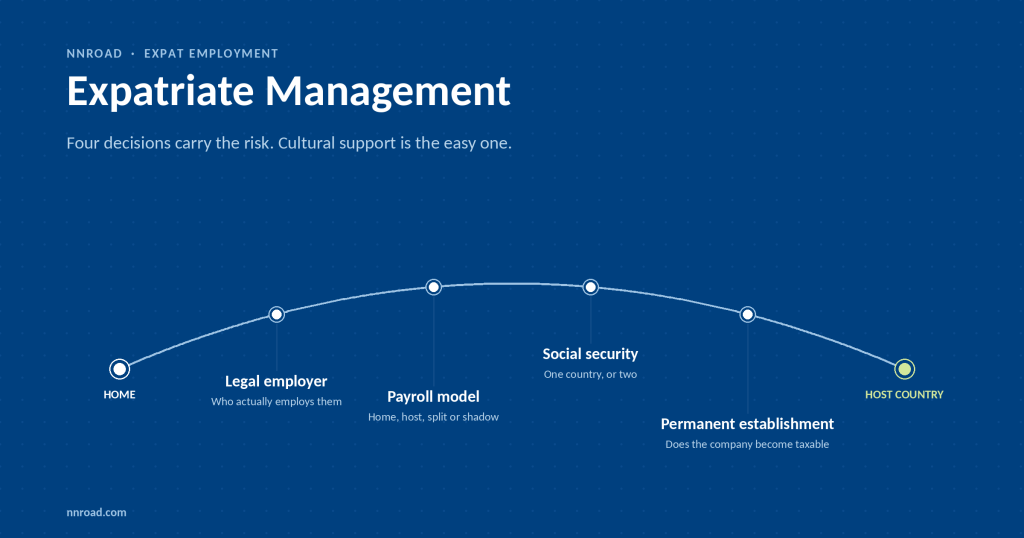
Four structural decisions carry almost all of the risk: who legally employs the person, where payroll runs, whether social security gets paid twice, and whether the assignment creates a taxable presence for your company in the host country.
Reviewed 26 August 2026. Treatment varies by country pair and by treaty. Please check the source linked beside any rule, and take advice on your specific assignment.
Who Legally Employs the Assignee
Everything else follows from this, and it is the decision most often left implicit. “We’re sending Anna to Singapore for two years” does not say who employs Anna while she is there, and the answer changes her contract, her payroll, her benefits and your exposure.
| Structure | How it works | Watch for |
|---|---|---|
| Home entity keeps the contract | The assignee stays employed at home and is seconded abroad, usually with an assignment letter attached to the existing contract | Host-country employment protections may apply anyway, and this is the structure most likely to raise a permanent establishment question |
| Host entity employs locally | The assignee transfers onto a local contract with your subsidiary in the host country | Requires an entity there. Home-country benefits and pension continuity usually break |
| Dual or split contract | Two contracts, home and host, each covering part of the role and the pay | Administratively heavy and scrutinised by tax authorities. Needs a genuine commercial rationale |
| Employer of Record | A local provider becomes the legal employer and you direct the work | Fits where no entity exists or the assignment predates one. Suits a small local headcount rather than a growing team |
Where no host entity exists and setting one up would delay the assignment past the point of usefulness, an Employer of Record arrangement puts a legal employer in place without one. Where the assignment is genuinely a secondment from the home business, the home-entity route is usually right, provided section 6 below has been considered.
Where Payroll Runs: Four Models
These are arrangements rather than legal categories. No statute defines “shadow payroll”; it is a practice that developed because home-country payroll and host-country reporting obligations rarely line up.
| Model | Who pays | Typically used when |
|---|---|---|
| Home payroll | Home entity pays the whole salary into the home account | Short assignments where host-country tax residency is not triggered |
| Host payroll | Host entity pays locally, in local currency | The assignee has transferred onto a local contract |
| Split payroll | Part paid at home, part in the host country | The assignee has commitments in both countries, or exchange or remittance rules make one-sided payment impractical |
| Shadow payroll | Home entity pays; a parallel host-country payroll reports the same earnings without paying them again | The assignee becomes taxable in the host country but continues to be paid from home. The most common long-assignment arrangement |
Shadow payroll, since almost nobody defines it. The assignee keeps receiving their salary from the home entity, into their home account, exactly as before. Separately, a host-country payroll is run that reports those same earnings to the host authorities and settles whatever local withholding and contributions are due. No second payment reaches the employee. It exists purely to make a real tax obligation visible and payable in a country where the money never lands. Set it up late and you are reconstructing months of earnings retrospectively, usually with interest attached.
Tax: Residency, Withholding and Equalisation
Tax residency is not a status the employer assigns. It follows from days present, ties to each country and the relevant treaty, and it can change partway through an assignment without anyone doing anything. That is the point most programmes are unprepared for: the payroll arrangement that was correct in month three can be wrong by month eight.
Two policies commonly sit on top, and both are contractual commitments rather than legal requirements. Under tax equalisation, the employer undertakes that the assignee ends up no better and no worse off than they would have been at home; the company absorbs the difference either way. Under tax protection, the assignee keeps any windfall if the host country is cheaper, and the employer covers the shortfall if it is dearer.
Equalisation is the more common and considerably the more expensive, because the company also picks up the tax on the tax it pays. Whichever you adopt, put it in writing before departure. It is a promise about someone’s net pay, and it is not a conversation to be having a year later when a host-country bill arrives.
Social Security and the Certificate of Coverage
Without an agreement between the two countries, an assignee can be liable to social security contributions in both at once, on the same earnings, with the employer paying its share twice. On a senior salary that is a substantial and entirely avoidable cost.
Totalization agreements exist to prevent it. As the Social Security Administration puts it, the agreements assign coverage to just one country and exempt the employer and employee from paying into the other. The United States has concluded agreements with 28 countries; other countries maintain their own networks, so the question is always about the specific pair rather than about one country in isolation.
Where an agreement applies, the mechanism is a certificate of coverage, obtained from the social security agency of the country that retains coverage and presented to the employer in the other. It is the document that evidences the exemption. The current list of agreements is maintained by the SSA and is worth checking directly rather than relying on a summary, because it changes.
Apply for it before departure, not after. Certificates are usually issued for the assignment period from the date coverage is claimed, and retrospective relief is harder to obtain than prospective. An assignment that starts without one can involve paying twice for months and then arguing for a refund, in a foreign system, in a foreign language.
Immigration Sets the Timeline
The start date follows the work permit, not the offer letter. That sounds obvious and is routinely got wrong, because the commercial decision is made first and the immigration question is asked afterwards.
Most countries separate the right to work from the right to reside, so an assignment usually needs both, often obtained in sequence rather than together. Some require a local sponsoring entity, which loops back to the legal employer decision in section 1. Some tie eligibility to the role title, the salary level or the assignee’s qualifications, so a job description written loosely for internal purposes can fail an immigration test it was never drafted to pass.
Work backwards from the date the person must be productive, allow for the permit and then the residence process, and treat the offer as conditional until both are in hand.
Permanent Establishment: The Risk You Should be Aware
This is in fact a corporate tax question, even though it appears to be HR decision at first sight. If an assignment creates a permanent establishment, the sending company can become liable to corporate tax in the host country on profits attributable to that presence, along with registration and filing obligations it never anticipated.
Two routes matter for assignments.
A fixed place of business. Broadly, a place through which the business is carried on, with enough permanence not to be merely temporary. HMRC’s guidance notes that a permanent establishment has generally not been found where a fixed place of business was maintained for less than six months. That six-month marker is a useful planning signal rather than a safe harbour, and it is one reason assignment length is a tax decision as well as a business one.
A dependent agent. This is the one that catches people, because it has nothing to do with premises. Where a person who is not an independent agent habitually exercises authority to conclude contracts in the name of the enterprise, that activity can itself create a permanent establishment. HMRC’s guidance on dependent agent permanent establishments makes the point that what matters is whether the contracts concluded relate to the essential business operations of the enterprise rather than ancillary activities.
Which is why the assignee’s job matters more than their desk. Send an engineer abroad to work on an internal project and the question is usually manageable. Send a salesperson who negotiates and closes deals in the host country, working from home with no office at all, and you may have created a taxable presence without renting a square metre. The OECD revised the dependent-agent test in 2017 and several countries have since aligned their domestic law with it, so guidance written before that is not a reliable guide.
Thresholds and outcomes turn on the specific treaty between the two countries and on what the person actually does day to day. The practical response is not to resolve this from an article. It is to establish, before the assignment begins, whether the role involves concluding contracts or generating revenue locally, and if it does, to get the position confirmed by someone qualified in the host jurisdiction.
The Assignment Letter
Most disputes at the end of an assignment trace back to something never written down at the start. The letter should cover, at minimum:
- Role, location and reporting line in the host country, and who conducts the performance review.
- Duration, and what happens if it is extended or curtailed.
- Compensation, including currency, which entity pays, and how any allowances are treated.
- Tax policy, stated explicitly as equalisation, protection or neither.
- Benefits continuity: health cover, pension, life insurance, and whether home-country schemes continue.
- Relocation and home leave, including family support and schooling if offered.
- Repatriation terms, covered below, and what happens if no suitable role exists on return.
Planning Repatriation at the Start
Repatriation is the stage most programmes handle worst, and the reason is structural rather than careless: the people who authorised the assignment have often moved on by the time it ends, and nobody owns the return.
Settle four things before departure. What role the assignee returns to, or what happens if none exists. Whether the home contract resumes unchanged or is renegotiated. Who pays for the move back, and within what window. And how the final payroll is handled, including any host-country tax filing that outlives the assignment, since obligations frequently do not end on the last working day.
An assignment that ends well is also the strongest argument for the next person to accept one. Companies that lose returning assignees within a year usually lose them to an absence of planning rather than to a competitor.
How NNRoad Supports This
NNRoad’s expatriate employment service supports the structural side of an assignment: acting as the local employer where you have no entity, running host-country payroll including shadow arrangements, and handling the local registrations, contributions and reporting that follow.
Where the assignment raises a permanent establishment question, that needs a tax adviser in the host jurisdiction rather than a payroll provider. NNRoad can tell you which structures tend to raise it and what a host-country payroll looks like under each, but the determination itself is not ours to give.
Planning an assignment?
Send the destination, the intended duration, whether you have an entity there, and what the person will actually be doing. Those four answers determine the structure, and the fourth is the one most companies leave out.
Frequently Asked Questions
What is expatriate management?
The set of decisions and processes involved in sending an employee to work in another country: who legally employs them, where payroll runs, how tax and social security are handled, immigration, and the terms of the assignment and the return. Cultural preparation is part of it, but the structural decisions carry the risk.
What is shadow payroll?
A parallel payroll run in the host country that reports an assignee’s earnings and settles local withholding and contributions, while the employee continues to be paid from the home country. No second payment reaches the employee. It exists to make a real host-country tax obligation payable where the money never lands.
How do we avoid paying social security twice?
Through a totalization agreement between the two countries, if one exists. The agreements assign coverage to a single country and exempt the employer and employee from paying into the other. The mechanism is a certificate of coverage, obtained from the agency of the country retaining coverage. The United States has agreements with 28 countries; check the specific country pair, and apply before departure.
Can sending an employee abroad create a tax presence for the company?
Yes. A permanent establishment can arise through a fixed place of business, or through a dependent agent who habitually concludes contracts in the company’s name, which requires no premises at all. It turns on the treaty between the two countries and on what the assignee actually does. Establish this before the assignment starts if the role involves concluding contracts or generating revenue locally.
Do we need an entity in the host country to send someone there?
Not necessarily. The assignee can remain employed by the home entity and be seconded, or an Employer of Record can act as the local legal employer. Each has different implications for contract, payroll and permanent establishment risk, so the choice should be deliberate rather than inherited from how the last assignment was handled.