
Insights
How to Hire Employees in Greece: A Step-by-Step Guide (2026)
Insights · By Chen ChunJie · Updated 27 October 2026
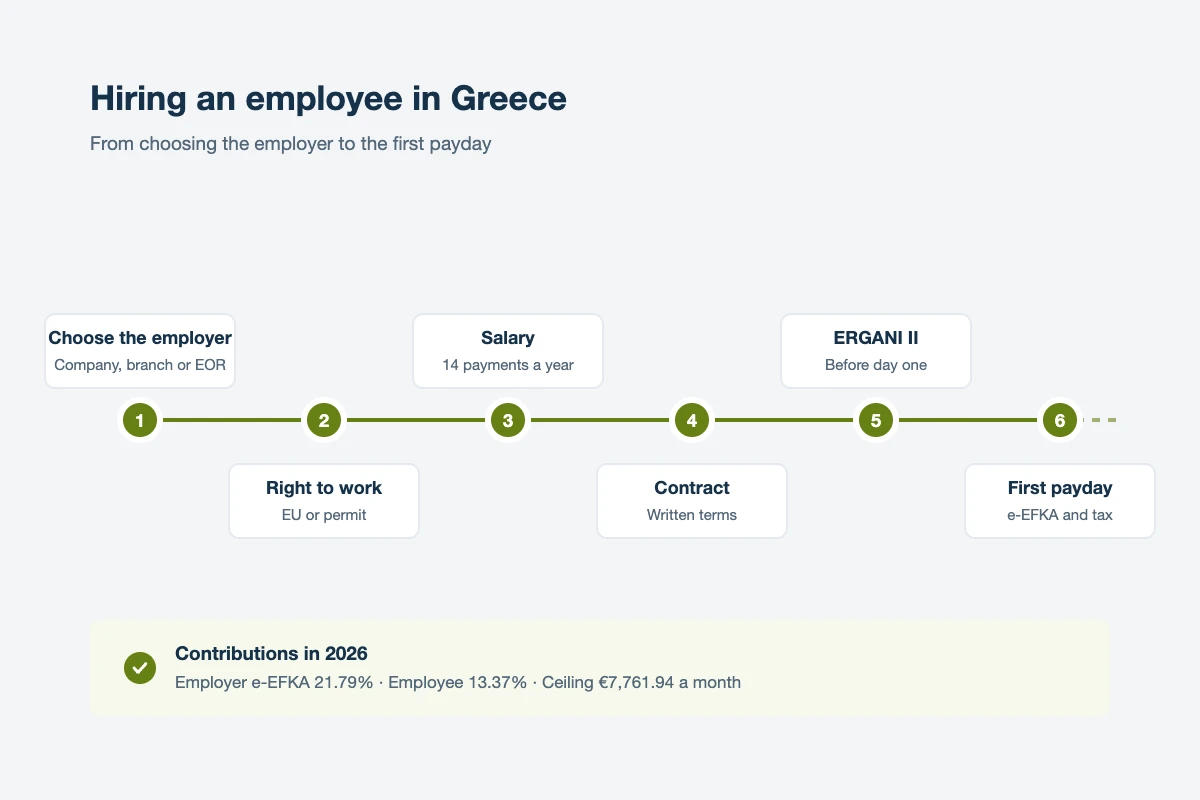
To hire an employee in Greece you need an employer registered with e-EFKA, a written contract that meets the minimum wage and any collective agreement, and an ERGANI II hiring declaration filed before the first working day. Plan the salary for 14 payments a year, not 12. If your company has no Greek entity, an employer of record can employ the person for you. These are the steps in the order they happen.
Last reviewed in October 2026 against the minimum wage from 1 April 2026, the 2026 e-EFKA contribution ceiling, ERGANI II and the Ministry of Labour guidance on working time, bonuses and sick pay. General information, not legal advice.
Step 1: Decide who will employ the person
| Option | When it fits | What to know |
|---|---|---|
| Your own Greek company or branch | A growing team, local customers or local invoicing | Registration with GEMI, a tax number, a bank account and employer registration with e-EFKA and ERGANI come first |
| Employer of record | One or a few employees, or a first hire before a company | The person is employed locally on your behalf and you direct the work. How NNRoad’s Greece EOR works |
| Freelancer | A defined project delivered independently | If you set the hours and direct the work, it is employment, with back contributions and fines |
For a closer comparison, read how to start a business in Greece: IKE, AE, branch or EOR.
Step 2: Check the right to work
Citizens of the EU, EEA and Switzerland can work in Greece without a work permit and register their residence after three months. Non-EU nationals need a residence permit that allows the job, such as a permit for dependent employment, an EU Blue Card for highly qualified roles or an intra-corporate transfer permit. Many of these routes take months and depend on the employer sponsoring the application. Source: Ministry of Labour: work for third-country nationals.
An employer of record is the simplest route for EU citizens and for people who already hold a Greek permit that allows them to work. If the person needs a visa or a new permit, see Expat Employment in Greece.
Step 3: Set the salary
The statutory minimum wage is €920 a month for salaried employees and €41.09 a day for wage earners from 1 April 2026. Employees on the minimum receive seniority increments, and many sectors have collective agreements with higher pay scales.
Greek candidates usually discuss a monthly gross salary, paid 14 times a year: 12 monthly salaries, a Christmas bonus of one month, an Easter bonus of half a month and a holiday allowance of up to half a month. Make the 14 payments clear in the offer so the annual figure is not misunderstood.
Step 4: Budget for the costs on top of salary
The employer pays e-EFKA contributions of 21.79% on each salary and bonus payment, up to €7,761.94 a month in 2026; the employee pays 13.37%. Over a full year, salary and employer contributions come to about 42% more than 12 monthly salaries.
See Greece EOR cost for worked examples, or try the Greece labor cost calculator.
Step 5: Write the employment contract
Contracts are open-ended unless there is a reason for a fixed term. Successive fixed-term contracts without an objective reason can turn into open-ended employment. On an open-ended contract a probation period of up to six months can be agreed; on a fixed-term contract it can be no longer than a quarter of the term. The employee must receive the essential terms in writing.
The contract or written terms should state at least:
- the employer, the job and the place of work, including any remote work
- the salary, the 14 payments and the pay dates
- the working hours and the weekly schedule
- the start date, the term and any probation period
- annual leave, notice and any applicable collective agreement
- confidentiality and intellectual property terms
Step 6: Declare the hire and set up payroll
The employee needs a Greek tax number (AFM) and a social security number (AMKA). Before the first working day, the employer files the hiring declaration on ERGANI II, which replaced the old ERGANI forms on 16 February 2026; employees confirm certain changes through the myErgani app. Source: Ministry of Labour: ERGANI II in full operation (in Greek).
Each month the employer pays the salary, files the e-EFKA contribution declaration (APD) and pays contributions, and withholds income tax and pays it to AADE within its deadlines. Income tax runs from 9% to 44% under the 2026 scale, with reductions for young employees and employees with children.
Step 7: Working hours, leave and absence
| Topic | The rule |
|---|---|
| Hours | 40 hours a week is the norm. Hours 41 to 45 on a five-day week are paid at +20%; overtime beyond that at +40%, up to 150 hours a year and 4 hours a day. A break of 15 to 30 minutes is due when the day exceeds 4 hours. |
| Time recording | Many sectors must use the digital work card, which records start and end times in real time; the rollout is by sector. |
| Annual leave | 20 working days on a five-day week, rising with service; it accrues from the start of employment and comes with a holiday allowance. |
| Public holidays | Nine mandatory days, including Epiphany, 25 March, Easter Monday, 1 May, 15 August, 28 October and Christmas; other days depend on the sector and local custom. |
| Sick pay | Half pay for the first three days; the employer then tops up the e-EFKA benefit for up to half a month, or one month after a year of service. |
| Family leave | Maternity leave of 17 weeks, paternity leave of 14 working days and parental leave, with benefits paid partly by the state. |
Step 8: If the employee works remotely
Agree remote work in writing. The employer provides or pays for the equipment and the telecommunication costs the work needs, working time limits still apply, and the employee has the right to disconnect outside working hours.
Step 9: Ending the employment
During the first 12 months an open-ended contract can usually be ended without notice or severance, unless agreed otherwise. After that, the employer either gives written notice of one to four months, depending on length of service, and pays half the statutory severance, or ends the contract without notice and pays full severance, from two months’ salary after one year to twelve months’ salary after 16 years. A dismissal is valid only if it is in writing, the severance is paid and it is declared on ERGANI.
Hiring checklist for Greece
- Employer chosen: your own Greek company, an employer of record or, for a true project, a freelancer
- Right to work confirmed for the role
- Salary at or above the minimum wage and any collective agreement, quoted as 14 payments
- Annual cost budgeted, including contributions on every payment
- Contract and written terms signed, including any probation
- AFM and AMKA received; ERGANI II hiring declaration filed before day one
- e-EFKA registration and payroll set up
- Working schedule, digital work card and remote work terms agreed
Questions about hiring in Greece
Can a foreign company hire an employee in Greece?
Yes. It can set up a Greek company or branch and register as an employer, or use an employer of record that employs the person on its behalf.
Can I hire employees in Greece without an entity?
Yes, through an employer of record, which signs the Greek contract, files the ERGANI declaration and runs payroll and contributions for you.
Can I hire someone in Greece as a freelancer instead?
Only for genuinely independent work. If the person follows your instructions on hours and methods and works only for you, it is employment, and back contributions and fines can follow. Our On-Demand Talent service covers genuine project engagements.
What is the minimum wage in Greece in 2026?
€920 a month for salaried employees and €41.09 a day for wage earners, from 1 April 2026. Collective agreements often set higher pay.
How long does it take to hire someone in Greece?
Allow for the candidate’s notice with their current employer, often a few weeks to two months. A non-EU hire who needs a permit takes longer.
Hiring your first employee in Greece?
If you do not have a Greek company, we can employ the person for you and run payroll from the first month. Tell us about the role and we will reply with the annual cost and a realistic start date.
Related
How to start operating and hiring in Greece.
What a hire costs each year and each month.
Official sources: Ministry of Labour: minimum wage from 1 April 2026; Ministry of Labour: Christmas and Easter bonuses; Ministry of Labour: working time, overtime and public holidays; Ministry of Labour: pay during illness; Ministry of Labour: ERGANI II in full operation (in Greek); e-EFKA Circular 4/2026: 2026 contribution ceiling (in Greek); Ministry of Labour: work for third-country nationals; Ministry of Finance: income taxation. Reviewed October 2026; general information, not legal or tax advice.