
Guide · Greece
Greece EOR Cost: What a Hire Costs Each Year and Each Month
Guide · Updated 27 October 2026
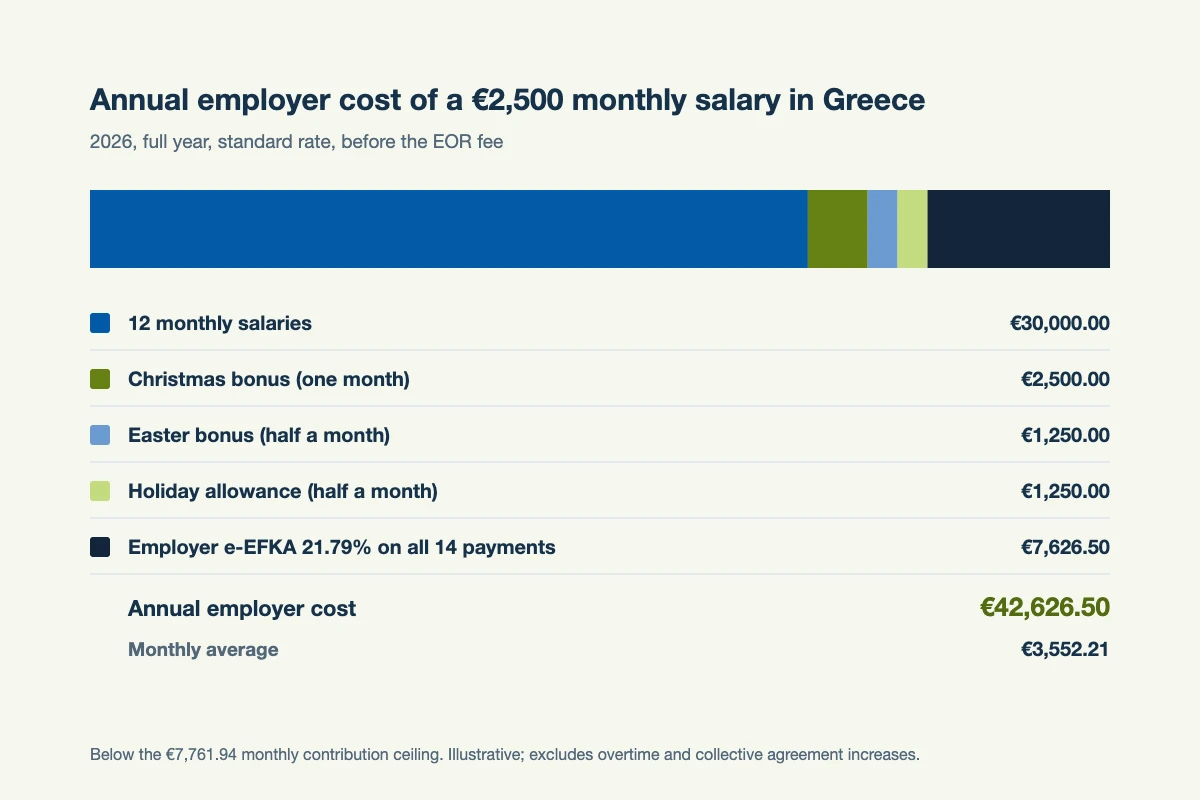
An employee hired through an employer of record in Greece costs you three things: 14 salary payments a year, employer e-EFKA contributions of 21.79% on each payment, and the EOR service fee. Over a full year below the contribution ceiling, salary and contributions come to about 42% more than 12 monthly salaries. A €2,500 monthly salary costs about €42,626.50 a year, or €3,552.21 a month on average, before the service fee.
Last reviewed in October 2026 against the minimum wage from 1 April 2026, the 2026 e-EFKA contribution ceiling and the Ministry of Labour rules on bonuses. General information, not legal or tax advice.
The three parts of a Greece EOR bill
Salary and statutory bonuses. The gross monthly salary you agree with the employee, in euros, paid 12 times, plus a Christmas bonus, an Easter bonus and a holiday allowance. The salary must be at least the minimum wage of €920 a month for a full-time salaried employee, or higher where a collective agreement or seniority applies.
Employer contributions. e-EFKA social insurance of 21.79% on each salary and bonus payment, passed through at cost.
The EOR service fee. The provider’s charge for employing and paying the person, shown as its own line, plus any one-time item and any deposit.
Why a Greek salary is paid 14 times
| Payment | Amount for a full period | Earned over | Paid |
|---|---|---|---|
| Monthly salary | One month’s salary, 12 times | Each month | On the agreed payday |
| Christmas bonus | One month’s salary | 1 May to 31 December | By 21 December |
| Easter bonus | Half a month’s salary | 1 January to 30 April | Before Easter |
| Holiday allowance | Up to half a month’s salary | The leave year | With annual leave, often in summer |
Each bonus is prorated when the employee has worked only part of the period, so a hire who starts in September receives a partial Christmas bonus in December. Source: Ministry of Labour: Christmas and Easter bonuses.
Social insurance contributions in 2026
| Contribution | Rate | Notes |
|---|---|---|
| Employer e-EFKA | 21.79% | Covers pension, supplementary pension, health and unemployment for most private-sector employees |
| Employee e-EFKA | 13.37% | Withheld from the employee’s pay |
| Monthly ceiling | €7,761.94 | Earnings above this amount carry no contributions |
| Special categories | Different rates | Heavy and unhealthy occupations and some professions use other rates |
The ceiling rose 2.5% on 1 January 2026. Source: e-EFKA Circular 4/2026: 2026 contribution ceiling (in Greek). Income tax is withheld from the employee’s pay at rates from 9% to 44% under the 2026 scale, with reductions for young employees and employees with children; it is not an employer cost.
Three worked examples
The examples assume a full year of service, the standard contribution rate and a salary below the ceiling. They exclude the EOR service fee, overtime and any collective agreement increases.
| Role | Monthly salary | Annual pay (14 payments) | Employer contributions (21.79%) | Annual employer cost | Monthly average |
|---|---|---|---|---|---|
| Customer support specialist, Thessaloniki | €1,500 | €21,000.00 | €4,575.90 | €25,575.90 | €2,131.33 |
| Customer success manager, Athens | €2,500 | €35,000.00 | €7,626.50 | €42,626.50 | €3,552.21 |
| Software engineer, Athens | €4,000 | €56,000.00 | €12,202.40 | €68,202.40 | €5,683.53 |
In each case the monthly average is about 42.1% above the monthly salary: 14 payments instead of 12 add 16.7%, and contributions add 21.79% to everything. The cash cost in an ordinary month is lower; it rises in the bonus months. To test your own figures, use the Greece labor cost calculator.
Other costs to plan for
- Extra hours and overtime. Hours 41 to 45 on a five-day week are paid at +20%, and overtime beyond that at +40%.
- Night, Sunday and public holiday work. These carry their own premiums.
- Seniority and collective agreements. Employees paid the minimum wage receive seniority increments, and many sectors have agreed pay scales.
- Benefits. Private health insurance, meal vouchers and equipment for remote work are common.
- Salary reviews. The minimum wage is reviewed each year, usually from 1 April.
How to read an EOR quote for Greece
Ask to see the annual cost, not only an ordinary month: all 14 payments, the contributions on each and the months in which the bonuses fall. A good quote also shows the service fee as its own line, states whether there is a deposit and when it is returned, and gives the dates on which you will be invoiced each month.
NNRoad does not publish a standard price for Greece. We review the role, the salary, the candidate’s right to work and the work location first, then send a written proposal that shows:
- the full employment cost, line by line, for a full year
- NNRoad’s service fee and any one-time item, listed separately
- any deposit and when it is returned
- the working calendar for invoices, paydays and bonus months
The yearly view: when the money is paid
| When | What is paid or filed |
|---|---|
| Every payday | Net salary and payslip |
| Every month | e-EFKA contribution declaration (APD) and payment for the previous month; income tax withheld and remitted within the AADE deadlines |
| Before Easter | Easter bonus |
| With annual leave, often in summer | Holiday allowance |
| By 21 December | Christmas bonus |
| 1 January and 1 April | New contribution ceiling; minimum wage review |
What it costs to end an employment
During the first 12 months, an open-ended contract can usually be ended without notice or severance, unless agreed otherwise. The employee still receives salary to the last day, prorated bonuses and any untaken leave.
After 12 months, the employer either gives written notice of one to four months, depending on length of service, and pays half the statutory severance, or ends the contract without notice and pays full severance. Full severance rises from two months’ salary after one year to twelve months’ salary after 16 years. A dismissal is valid only if it is in writing, the severance is paid and it is declared on ERGANI. We review the options with you before any conversation with the employee.
EOR or your own Greek company?
An IKE or a branch needs registration with the General Commercial Registry (GEMI), a tax number, a bank account, an accountant and monthly payroll, VAT and myDATA filings. That fixed cost makes sense for a long-term team or when you invoice Greek customers. For one to a few employees, or while you decide, an employer of record is faster and avoids the cost of setting up and running a company. Compare IKE, AE, branch and employer of record.
Questions about Greece EOR cost
How much does an employer of record cost in Greece?
You pay the employment cost at cost plus the EOR service fee. Salary and employer contributions come to about 42% more than 12 monthly salaries over a full year, because of the 14 payments and the 21.79% employer rate. NNRoad quotes each hire after reviewing the role, with every line shown.
What are employer social security contributions in Greece in 2026?
21.79% for most private-sector employees, on each salary and bonus payment, up to €7,761.94 a month. Employees pay 13.37%, which is withheld from their pay.
What is the minimum wage in Greece in 2026?
€920 a month for salaried employees and €41.09 a day for wage earners, from 1 April 2026.
Are the 13th and 14th salaries mandatory in Greece?
Yes. The Christmas bonus, Easter bonus and holiday allowance are statutory for private-sector employees and are prorated for shorter service.
Why is the cost higher in some months?
Because the Easter bonus, holiday allowance and Christmas bonus are paid in specific months. Your working calendar shows those months in advance.
Want the numbers for your own hire?
Send us the role, the salary and the work location and we will reply with a line-by-line annual estimate.
Related
How NNRoad employs and pays your Greek hire.
The hiring process step by step.
Official sources: Ministry of Labour: minimum wage from 1 April 2026; Ministry of Labour: Christmas and Easter bonuses; Ministry of Labour: working time, overtime and public holidays; Ministry of Labour: pay during illness; Ministry of Labour: ERGANI II in full operation (in Greek); e-EFKA Circular 4/2026: 2026 contribution ceiling (in Greek); Ministry of Labour: work for third-country nationals; Ministry of Finance: income taxation. Reviewed October 2026; general information, not legal or tax advice.