
Choosing an Employer of Record in Japan: 10 Checks Before You Sign
The best employer of record in Japan is not the one with the longest country list. It is the one that can show you which Japanese company will employ your hire, how the arrangement meets the Worker Dispatching Act, and what happens when the role changes or ends. Use these ten checks to compare any Japanese employer of record service provider, local or global, whatever it calls the service.
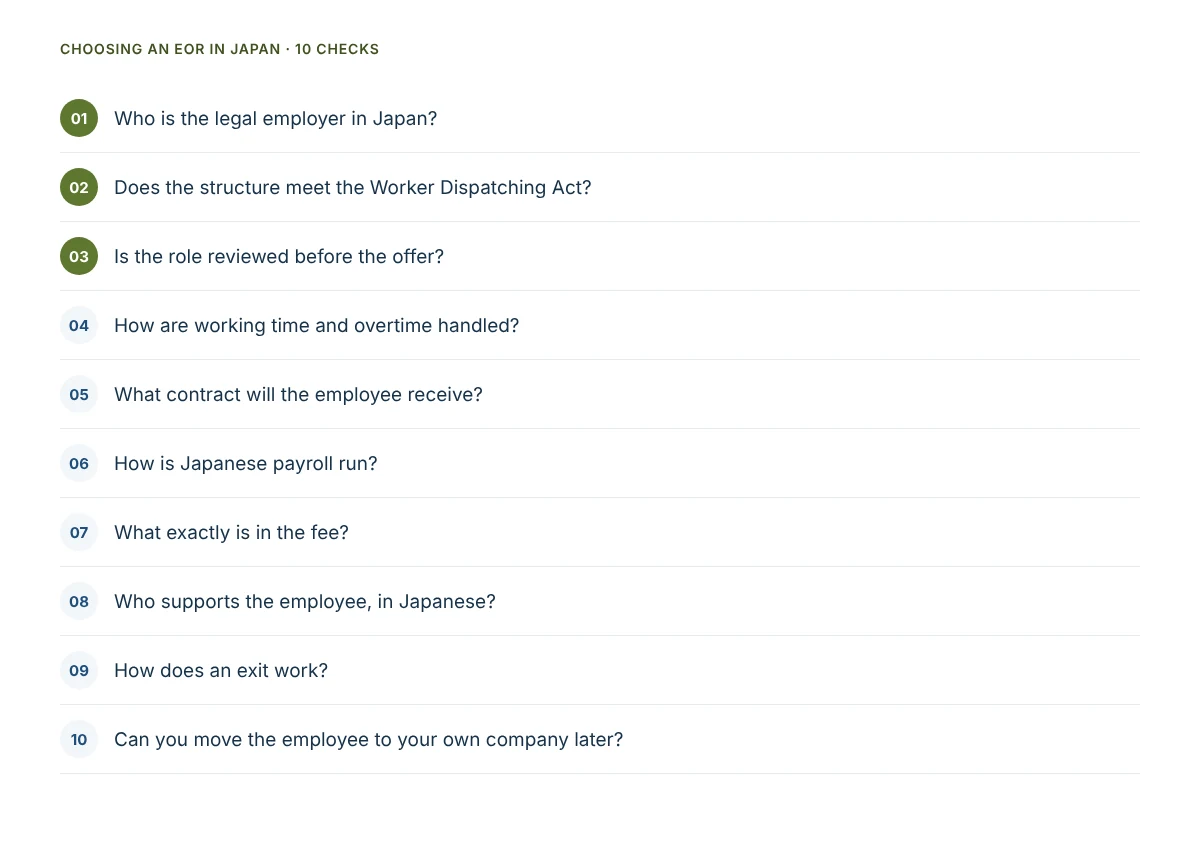
1. Who is the legal employer in Japan?
Ask for the name of the Japanese company that will sign the employment contract and enroll your employee in social insurance. Some providers own a Japanese entity; many work through a local partner. Either can work, but you should know which, and who answers for mistakes.
2. Does the structure meet the Worker Dispatching Act?
If your team will direct the work, the arrangement is worker dispatch and the employing company needs a dispatch licence. Ask for the licence number and check it on the ministry’s public register. Be wary of answers that call it “consulting” or “outsourcing” instead.
3. Will they review the role before the offer?
A careful provider checks the job category, whether the person was your employee in the past year, the three-year period limits, pay under the equal-treatment rules and whether the person will conclude contracts for you. A provider that says yes to every role without questions is taking a risk with your name on it.
4. How will working time and overtime be handled?
Overtime is only lawful within a filed 36 Agreement, and your manager must keep the employee within it. Ask how hours are recorded, who approves overtime and how premiums are calculated.
5. What contract will the employee receive?
Ask to see a sample: Japanese working conditions with the items required since April 2024, indefinite or fixed-term, probation, bonus wording and the commuting allowance. Unclear bonus terms are a common source of disputes.
6. How is payroll run?
Japanese payroll has steps foreign systems miss: standard monthly remuneration bands, resident tax from June, bonus contributions and the December year-end adjustment. Ask who runs it, in which system, and how errors are corrected.
7. What exactly is in the fee?
Ask for a line-by-line proposal: the monthly fee, the employment cost passed through, the deposit, exchange-rate handling, and charges for onboarding, offboarding, expenses or amendments.
8. Who supports the employee, in Japanese?
Your employee will have questions about pay, leave and insurance. Ask who answers them, in what language and how fast.
9. How does an exit work?
Dismissal is strictly limited in Japan, and most endings are agreed. Ask how the provider handles a resignation, a performance problem and the end of a fixed term, and what you will be charged.
10. Can you move the employee to your own company later?
Ask how a transfer to your own KK or GK works, whether any fee applies, and what records and data you receive when the service ends.
Good answers and warning signs
| You ask | A good answer | A warning sign |
|---|---|---|
| Who employs my hire? | A named Japanese company, with its role in the contract chain explained | “Our platform” or “our global entity” |
| Is this legal under the dispatch rules? | An explanation of the structure and the licence, which you can check | “It is a service contract, so the dispatch rules do not apply” |
| Can you hire for this role? | Questions about the job, the location and how your team will work with the person | An instant yes for any role |
| What will it cost? | A line-by-line proposal after a role review | A headline rate with extras appearing later |
| What if it does not work out? | A clear explanation of Japanese dismissal rules and agreed endings | “You can terminate any time with notice” |
How NNRoad answers these questions
NNRoad employs your Japanese hire through our Japanese employing partner. Before any offer we review the role under the Worker Dispatching Act, and your proposal names the employing company and lists every charge. You get one contract and one US dollar invoice per payroll month, and the employee is paid in yen and supported in Japanese. See how the service works on our employer of record in Japan page, or read about what a Japan EOR costs.
Questions about choosing an EOR in Japan
What is the best employer of record in Japan?
The one whose legal structure, payroll and support you can verify. Compare providers on the ten checks above rather than on headline price or the number of countries they cover.
How do I check a provider’s dispatch licence?
Ask for the licence number of the Japanese employing company and look it up on the Ministry of Health, Labour and Welfare’s public register of dispatch businesses.
Is a global EOR better than a local Japanese provider?
Not necessarily. A global provider gives you one contract across countries; a local provider may know Japanese practice better. What matters is who the employer in Japan is and how well they run payroll and compliance.
Is a PEO in Japan different from an EOR?
Japan has no co-employment PEO model. Providers selling “PEO” in Japan are usually offering an employer of record service, so apply the same checks.
Put these questions to us
Tell us about your Japanese hire. Your proposal names the employing company and lists every charge.