
For companies hiring in Japan without a local entity
Employer of Record in Japan
Subject to role and arrangement eligibility, our licensed Local Team in Japan is the legal employer and handles the employment contract, yen payroll, applicable social insurance, tax withholding and year-end administration. Your team directs daily work within the lawful dispatch arrangement and retains its client-side duties. NNRoad HQ coordinates delivery.
Reviewed 9 November 2026 against official labour, dispatch, insurance and minimum-wage sources. Application depends on the role and working arrangement; general information, not individual legal advice.
Can you hire in Japan without your own company?
An eligible role may be employed through a Japanese provider without establishing your own KK, GK or branch. The provider signs the employment contract and handles the applicable insurance, payroll and withholding duties. Client direction generally brings worker-dispatch rules into scope, so we confirm the licensed employer, role, workplace and client obligations before proceeding. An EOR arrangement does not itself resolve your company’s business-registration or tax obligations.
Our Japan EOR service covers Japanese nationals working in Japan. Foreign nationals, including those already living in Japan, are handled through our separate Expat Employment service.
A good fit
A Japanese employee, a role your team will direct, and no Japanese company of your own yet.
Hiring a foreign national
Foreign employees need a status of residence that allows the work and, usually, a sponsoring employer in Japan. See Expat Employment in Japan.
Another route is simpler
How an employer of record works under Japanese law
Japan has no law written for employers of record. What decides the legal treatment is who employs the person and who directs the work. When a Japanese company employs someone and your company directs their daily work, the Worker Dispatching Act treats the arrangement as worker dispatch (rōdōsha haken). Dispatch may only be provided by a business licensed by the Ministry of Health, Labour and Welfare, and it comes with rules for both sides.
Labelling the arrangement as a service or consulting contract does not change this. If the client directs the work in practice, Japanese authorities treat it as dispatch, and disguised contracting (gisō ukeoi) can lead to penalties and to the client being deemed to have offered the employee a direct job.
What we check before an offer
- Which Japanese company will employ the person, and the legal basis for your arrangement
- That the job is not in a category closed to dispatch, such as construction, port transport, security or most medical work
- That the person has not been your direct employee in the past 12 months, which would bar a dispatch arrangement unless they are 60 or over and retired at your mandatory age
- Indefinite or fixed-term contract, and how the three-year period limits apply to your role
- Pay that meets the equal-treatment rules for dispatched workers, and the minimum wage where the person will work
- Whether the person will negotiate or conclude contracts for you, which raises tax questions
Period limits. A fixed-term dispatched employee can normally work in the same organisational unit of your business for up to three years. Your workplace can also use dispatched staff for three years, extendable after hearing your majority union or employee representative. The individual limit does not apply to employees on indefinite contracts with the employing company or to employees aged 60 and over. We plan the contract type with this in mind.
If a role does not fit, we say so and suggest a lawful alternative: your own Japanese company with our payroll service, a genuine independent contractor arrangement, or Expat Employment for a foreign national.
EOR, PEO or GEO: which do you need in Japan?
Employer of record (EOR), professional employer organization (PEO) and global employment organization (GEO) are often used as names for the same service: a local company that employs your staff so you do not have to set one up. Japan has no co-employment model like the US PEO, and Japanese law uses none of these labels. What matters is which Japanese company signs the employment contract and enrolls the employee in social insurance, and whether the arrangement is a lawful worker dispatch. With NNRoad, the employer is our Japanese employing partner.
| Your situation | Better fit |
|---|---|
| You have no Japanese company and need to employ a Japanese national | Employer of record (this page) |
| You already have a KK, GK or branch and need payroll run for you | Japan payroll outsourcing |
| You need an independent professional for a defined project, who invoices you | Independent contractors in Japan |
| You need to employ a foreign national, in Japan or abroad | Expat Employment in Japan |
| You will sign contracts with and invoice Japanese customers continuously, or build a larger team | Your own KK or GK, or a registered branch. See doing business in Japan without a company |
What NNRoad handles and what stays with you
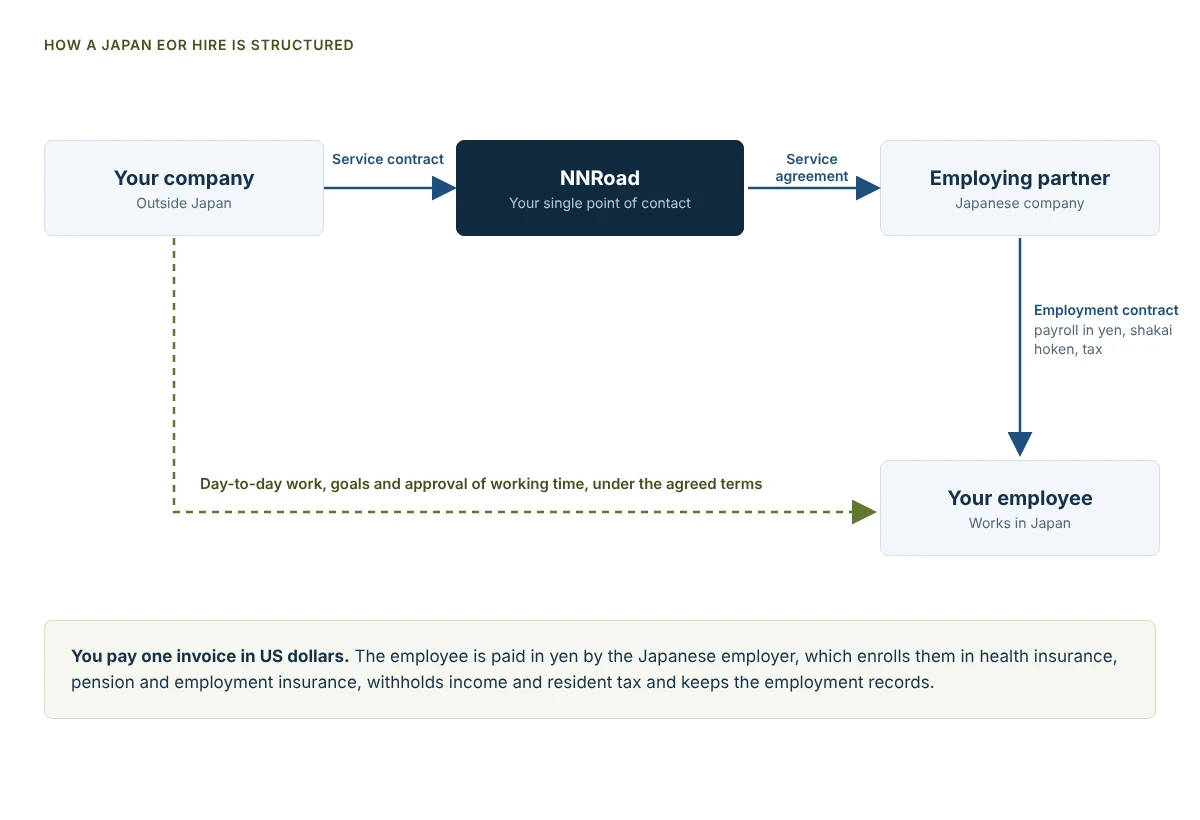
NNRoad and our employing partner
- Employment contract and written working conditions in Japanese, with the items Japanese law requires since April 2024
- The written terms of your arrangement and the notice of those terms to the employee
- Enrollment in health insurance, employees’ pension and employment insurance, and the monthly contributions
- Monthly payroll in yen, payslips, income tax withholding and resident tax deductions
- The 36 Agreement for overtime, leave records, the December year-end adjustment and annual tax slips
- Notice, final pay, social insurance closure and the separation documents when employment ends
You, as the company the employee works for
- Defining the role and package requirements within the lawful selection process; ordinary dispatch restricts client pre-interviews and worker designation
- Day-to-day work, goals and performance, through a named supervisor on your side
- Approving working hours and overtime within the 36 Agreement limits, plus leave and expenses by the payroll cut-off
- Equipment, system access and a safe way of working, including at home
- Telling us before the role changes or ends, and before the employee is told
Planning your Japan employment arrangement
We review the role, work location, contract type and package before confirming scope. Your proposal identifies the licensed employing Local Team, the lawful delivery model and each party’s responsibilities, with employment costs based on the actual package.
What your proposal shows
Every line, before you sign
- The licensed employing company and each party’s responsibilities
- Gross salary, bonus and allowances, in yen
- Employer social insurance and labour insurance contributions
- The payroll approval and funding process
- Optional services, such as recruitment or equipment purchase, only if you need them
| Planning item | How it works |
|---|---|
| Service scope | Confirm the licensed employing company, contracts, payroll, applicable insurance, withholding, year-end support and client-side duties. |
| Employment cost | Salary, applicable employer contributions, bonuses, commuting allowance and agreed benefits, based on the actual package. |
| Readiness | Confirm lawful role eligibility, complete employment information, approvals and funding before the agreed start. |
| Records | Monthly payroll and engagement records are available to authorised clients and employees through the Portal. |
What a Japanese hire costs on top of salary
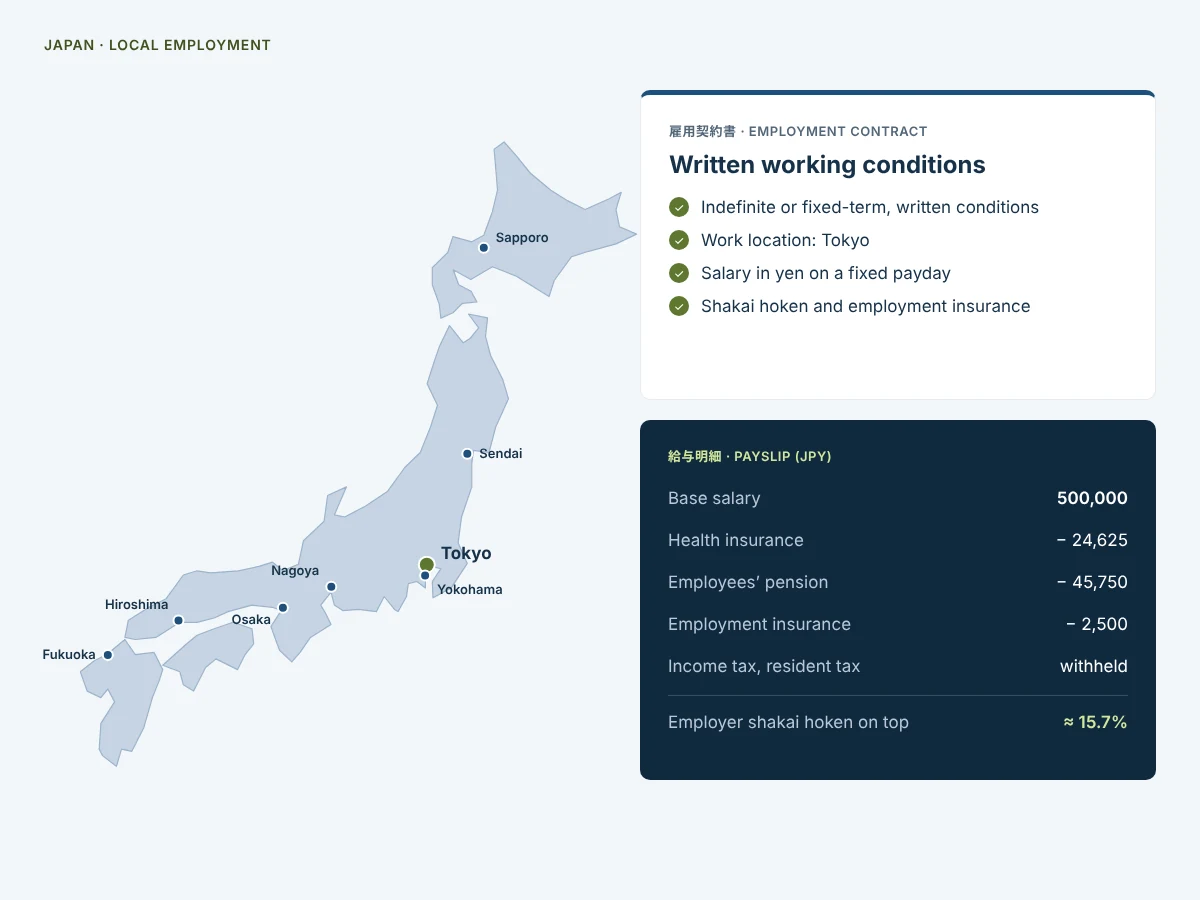
For an illustration using FY2026 Tokyo Kyokai Kenpo rates and 0.3% office-work accident insurance, selected employer rates total about 15.7% for a covered employee under 40, or 16.5% at ages 40–64. This is not a flat percentage of every salary: insurance bands, caps, eligibility and the actual industry affect the calculation. Agreed bonuses and commuting benefits also need to be budgeted.
| Contribution (2026) | Employer | Employee | Notes |
|---|---|---|---|
| Health insurance (Kyokai Kenpo, Tokyo) | 4.925% | 4.925% | Rate varies by prefecture and insurer; capped at a standard monthly pay of ¥1.39 million |
| Long-term care insurance | 0.81% | 0.81% | Ages 40 to 64 only |
| Child support levy (kodomo kosodate shienkin) | 0.115% | 0.115% | New from April 2026 pay, collected with health insurance |
| Employees’ pension | 9.15% | 9.15% | Capped at a standard monthly pay of ¥650,000 |
| Child-rearing contribution (kodomo kosodate kyoshutsukin) | 0.36% | – | Employer only |
| Employment insurance | 0.85% | 0.5% | FY2026 rate for general businesses |
| Workers’ accident insurance | 0.25%–8.8% | – | Employer only; about 0.3% for most office work |
Health and pension-related contributions use standard remuneration bands and separate bonus rules; employment and accident insurance use their applicable wage bases. These are not all calculated on one identical base. Employee contributions, income tax and resident tax are withheld from gross pay, not added to your cost. Sources: Japan Health Insurance Association, Japan Pension Service, MHLW.

Also budget for
- Bonuses: not required by law, but most Japanese employees expect summer and winter bonuses, and contributions apply to them.
- Commuting allowance: customary; free of income tax up to ¥150,000 a month for public transport, but counted for social insurance.
- Overtime: at least 25% extra, 50% beyond 60 hours a month, with night and holiday premiums.
- End of employment: Japan has no statutory severance, but ending employment is usually done by agreement, often with a separation payment.
Japanese employment rules to plan around
Private-sector employment is governed mainly by the Labor Standards Act and the Labor Contracts Act, with separate laws for social insurance, tax and worker dispatch. The summary below assumes a full-time employee.
| Topic | The rule in 2026 |
|---|---|
| Minimum wage | Check the higher applicable prefectural or industry-specific rate. FY2026 prefectural rates take effect between 1 October and 2 December 2026: national weighted average ¥1,177 an hour; Tokyo ¥1,280 and Osaka ¥1,231 from 1 October 2026. |
| Contract | Key terms must be given in writing at hiring, including the scope of possible changes to workplace and duties. A fixed-term contract normally runs for up to three years at a time; after more than five years of renewals the employee can ask for an indefinite contract. |
| Probation | No statutory length; three to six months is common. The 30-day notice rule applies after the first 14 days, and a dismissal must be objectively reasonable from day one, although courts allow a little more latitude during probation. |
| Working hours | 8 hours a day and 40 a week. Overtime needs a signed and filed 36 Agreement and is capped at 45 hours a month and 360 a year, with a higher ceiling only under a special clause. |
| Annual leave | Generally 10 days after six months with at least 80% attendance, rising to 20 after six and a half years. Proportionate rules apply to some part-time schedules. For employees granted at least 10 days, the employer must ensure at least 5 are taken each year. |
| Pay | In yen, in full, at least once a month on a fixed date. Applicable income and resident taxes are withheld. Year-end adjustment applies to eligible employees; others may need their own tax return. |
| Ending employment | 30 days’ notice or pay in lieu, but notice alone does not make a dismissal valid: it must be objectively reasonable and socially acceptable. An employee on an indefinite contract can resign with two weeks’ notice. |
How a Japan EOR hire works with NNRoad
NNRoad HQ coordinates the six processes below with our licensed Local Team. Clients and employees use the Portal for relevant payroll records, payslips and tasks. Start and first-payroll readiness depend on the legal review, documents, approvals and funding. Risk management relies on accurate information and following adviser guidance; statutory client duties remain.
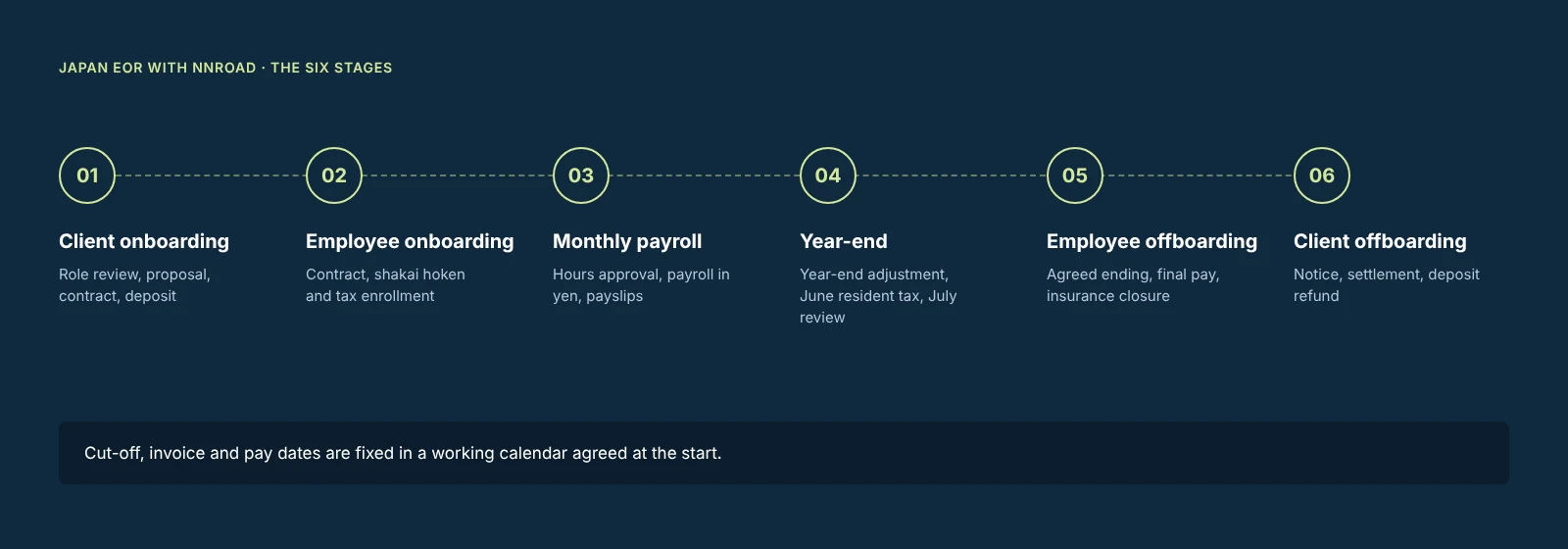
01
Client onboarding
Once, before your first hire
- You share the role, work location, salary range and start date. We review the role, licensed provider and client obligations under the dispatch rules and confirm the service scope.
- Both sides complete due diligence. We run a background check on your company, and you are welcome to check ours.
- You sign the service agreement, complete the agreed funding arrangements and establish Portal access and a working calendar for cut-off, invoice and pay dates.
- You name the supervisor who will direct the employee’s work and approve working time.
02
Employee onboarding
For each hire, before the start date
- You confirm the role, salary, bonus, start date, work location and benefits in an employee confirmation letter.
- We collect the employee’s My Number, pension number, bank account in Japan and previous employer’s tax slip, if any.
- Our employing partner issues the employment contract and the written terms of the arrangement.
- Health insurance and pension enrollment is filed within 5 days of the start date, employment insurance by the 10th of the following month.
03
Monthly payroll cycle
Every month, on the dates in the calendar
- By the cut-off you approve working hours, overtime, leave, new starters, pay changes and expenses.
- We calculate gross-to-net pay, social insurance, income tax and resident tax, and send one invoice in US dollars.
- You fund payroll by the due date. Salaries are paid in yen on the agreed payday once the funds arrive, with a payslip.
- Withheld income tax and resident tax are paid by the 10th of the following month, social insurance by the end of the following month.
04
Year-end
Through the year
- The employer performs year-end adjustment for eligible employees and issues withholding slips within the applicable deadline. Employees outside the adjustment rules may need an individual return.
- Resident tax changes each June, standard pay is reviewed for social insurance in July, and labour insurance is renewed by 10 July.
- We apply new minimum wages and contribution rates when they change, and renew the 36 Agreement.
- We track paid leave, including the five-day requirement for employees granted at least ten days, and flag contracts and period limits that are coming up.
05
Employee offboarding
When a job ends
- You tell us the decision in writing before anything is said to the employee.
- For a resignation we confirm the notice and last day. For an employer-initiated ending we review the grounds and agree the lawful route, usually a negotiated agreement, before anyone speaks to the employee.
- We pay final salary and any agreed separation payment, close social and employment insurance, and issue the separation certificate.
- The employee returns equipment and confidential information.
06
Client offboarding
When you end the service or move to your own entity
- You give us written notice under the service contract, and we agree the timetable with you.
- We agree the lawful arrangement for each employee: an orderly end of employment, or a move to your own Japanese company with the employee’s agreement.
- HQ coordinates final payroll, agreed account reconciliation and any outstanding employment obligations.
- We hand over the records you are entitled to and coordinate the applicable employee insurance and tax notifications. The employing company’s shared accounts are not automatically closed for one client; Portal access closes at the agreed point, with required records retained.
When you are ready for your own Japanese company
An EOR suits your first hires while you test the market. Your own kabushiki kaisha (KK) or godo kaisha (GK) makes sense once you have a growing team, sign contracts with and invoice Japanese customers, or need a licence for your activity. Both can be formed with minimal capital, and since 2015 its representative (a director of a KK, or a member of a GK) no longer has to live in Japan. In practice, opening a corporate bank account and registering for tax, social insurance and labour insurance take longer than the registration itself.
Moving an employee to your own company needs the employee’s agreement and a clear position on service, leave balances and pay. Our payroll service can support your new entity.
Get a proposal
Tell us about your Japanese hire
Share the role, work location and package. We aim to reply within 24 hours on business days and provide a proposal within 3 business days after receiving sufficient information. These response times are indicative; country procedures and individual cases vary. We confirm the lawful employment model before committing to onboarding.
- No-obligation enquiry; your information is handled under our Privacy Policy
- A role review under the Worker Dispatching Act before any offer
- If EOR is not the right route, we will say so
Japan EOR questions
Is an employer of record legal in Japan?
Yes, when it is structured lawfully. Japan has no EOR-specific law. When a Japanese company employs the person and your company directs the work, the arrangement is worker dispatch under the Worker Dispatching Act, which may only be provided under a licence from the Ministry of Health, Labour and Welfare and comes with job and period limits. We review every role before an offer. How the dispatch rules apply
Who is the legal employer, and who signs the employment contract?
The licensed Japanese Local Team entity identified for your eligible arrangement is the legal employer. It signs the employment contract and handles applicable insurance and payroll duties. NNRoad HQ coordinates the service, while your company retains the client-side obligations imposed by the dispatch rules.
Who can I hire through NNRoad’s Japan EOR?
Japanese nationals working in Japan, in roles that can lawfully be filled through worker dispatch. Foreign nationals, including those already living in Japan, are assessed through our separate Expat Employment service.
How much does an employer of record cost in Japan?
Budget for the agreed salary and benefits plus the applicable employer insurance contributions. The amount depends on prefecture, insurer, age, industry, remuneration bands and caps; a headline percentage is only an illustration. We review the actual employment package and lawful arrangement before preparing a proposal.
Is there a PEO in Japan? Is an EOR the same as a PEO or a global employment organization?
Japan has no co-employment model like the US PEO, so providers offering “PEO” or “GEO” in Japan usually provide an employer of record service. Ask which Japanese company signs the employment contract, enrolls the employee in social insurance and under which legal structure. Compare the options
Can our team direct the employee’s day-to-day work?
Where a lawful dispatch arrangement is confirmed, your named supervisor directs the work within the employment conditions, safety requirements and the employing company’s filed overtime agreement. Employment decisions and contract changes go through the legal employer. Ordinary dispatch also restricts client pre-interviews and acts intended to select a specific dispatched worker; any exception requires review.
What kind of employment contract does the employee get?
A Japanese employment contract with written working conditions, either indefinite or fixed-term depending on the role and the expected length of the assignment. A fixed-term dispatched employee can normally stay in the same unit of your business for up to three years, so we agree the contract type with you at the start.
How long does it take before the employee can start?
It depends mainly on how quickly the role review is completed and the employee’s documents, such as their My Number and pension number, are ready. Once we have complete information the employment documents can be prepared quickly. We confirm a realistic start date in the proposal.
Can the employee be paid in US dollars?
No. Wages in Japan are paid in yen. You can benchmark the salary in US dollars, and we invoice you in US dollars, but the employee receives yen.
Can we end the employment if it does not work out?
A client request or assignment ending does not automatically end the employment contract. Dismissal requires legally sufficient grounds and procedure, with notice or pay in lieu unless a lawful exception applies. Fixed-term employment has additional protections. Tell us early so the employer can assess the lawful route; any negotiated separation must be voluntary.
Does an employer of record create a permanent establishment for my company?
An EOR removes the need for a Japanese entity to employ someone, but your tax position depends on what the employee does. If they habitually conclude contracts for you, or play the principal role leading to them, your company may have a permanent establishment in Japan. We flag this when we review the role; take tax advice for your case.
Can we move the employee to our own Japanese company later?
Yes, with the employee’s agreement. Your company makes a new employment offer, and the documents should deal with service, leave balances and pay. If your KK or GK becomes the employer, our payroll service can support it.