
How to Do Business in Vietnam Without Setting Up a Company
A foreign company can do a good deal in Vietnam without its own Vietnamese company. It can sell to Vietnamese customers from abroad, work through a distributor or agent, research the market through a representative office, and put staff on the ground through an employer of record. What it cannot do without its own company is trade and invoice in Vietnam in its own name. And whatever route it takes, it needs to watch whether its activities create a taxable presence.
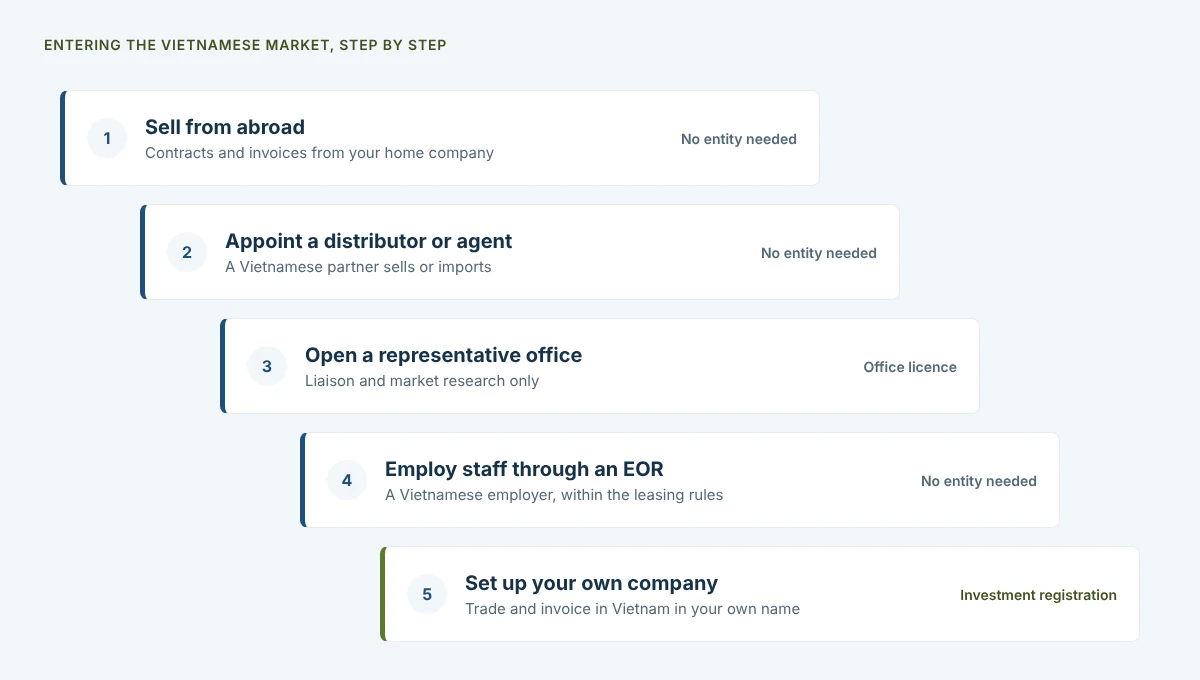
1. Sell from abroad
Your home company can sign contracts with and invoice Vietnamese customers directly. For goods, the customer or an importer handles customs. For services, the Vietnamese customer often has to withhold foreign contractor tax, a mix of VAT and corporate income tax, from its payments to you. Check how a tax treaty between your country and Vietnam applies.
2. Appoint a distributor or agent
A Vietnamese distributor buys and resells your products; a commercial agent sells your goods or services in its own name, for your account, for a commission. Both let you reach customers without your own entity. Write clear terms on territory, exclusivity and termination, and check whether a dependent agent could create a taxable presence for you.
3. Open a representative office
A representative office lets your company have an address, a head of office and local staff in Vietnam. It needs a licence from the provincial Department of Industry and Trade, usually for five years, and your company must have operated for at least a year. It may only carry out liaison, market research and promotion: it cannot trade or earn revenue, and contracts are signed by your company, not by the office.
4. Put staff on the ground through an employer of record
An employer of record employs people in Vietnam for you, so you can cover a temporary peak in work, an absence or a specialist need in a listed role, such as sales support, project support or administration, without a Vietnamese company. Vietnamese law treats this as labour leasing, so it is limited to 20 types of work and 12 months per assignment. It does not license your business: your staff can support your sales, but contracts with Vietnamese customers are still signed by your home company. How a Vietnam EOR works
5. Set up your own company
When you need to trade, invoice, hold licences or employ people without the leasing limits, set up a Vietnamese company. Since 1 March 2026 a foreign investor that meets the market-access conditions can register the company first and obtain the investment registration certificate before carrying out the project, then opens a capital account and registers for tax, insurance and the trade union fee. Some business lines need extra licences. Compare the routes
Watch for a taxable presence
Under most of Vietnam’s tax treaties, a foreign company can be taxed in Vietnam if it has a fixed place of business there, a person who habitually concludes contracts on its behalf, or, under many treaties, staff providing services in Vietnam for more than a set period. Local staff who only research, promote or support sales concluded abroad are less likely to create one than a salesperson who negotiates and signs. Take tax advice before your local team starts closing deals.
Which route fits your stage?
| Your goal | Route |
|---|---|
| Test demand with a few customers | Sell from abroad, or a distributor |
| Build relationships and research the market | Representative office |
| Cover a temporary peak in work, an absence or a specialist need for up to a year | Employee through an EOR, in a role on the leasing list |
| Sell, invoice and grow a team in Vietnam | Your own Vietnamese company, with payroll outsourcing |
Questions about doing business in Vietnam without a company
Can a foreign company do business in Vietnam without registering a company?
It can sell to Vietnamese customers from abroad, use a distributor or agent, open a representative office for non-commercial work, and employ staff through an employer of record. It cannot trade and invoice in Vietnam in its own name without its own company or branch.
Can a representative office in Vietnam sign contracts or earn revenue?
It cannot earn revenue or sign contracts in its own name. It is limited to liaison, market research and promotion; contracts are signed by the foreign company, which may authorise the head of the office in writing to sign on its behalf.
Can I hire employees in Vietnam without a company?
Yes, through an employer of record for roles that fit the labour leasing rules, up to 12 months per assignment, or through genuine independent contractors.
Does having an employee in Vietnam create a permanent establishment?
It can, depending on what the person does. Someone who habitually concludes contracts for you is the main risk. Take tax advice for your case.
Want people in Vietnam before you set up?
Tell us about the role and how long you need it. We will review it under the leasing rules and suggest the right route.