
Guide · Vietnam
EOR vs PEO vs GEO in Vietnam: How to Hire Without a Local Entity
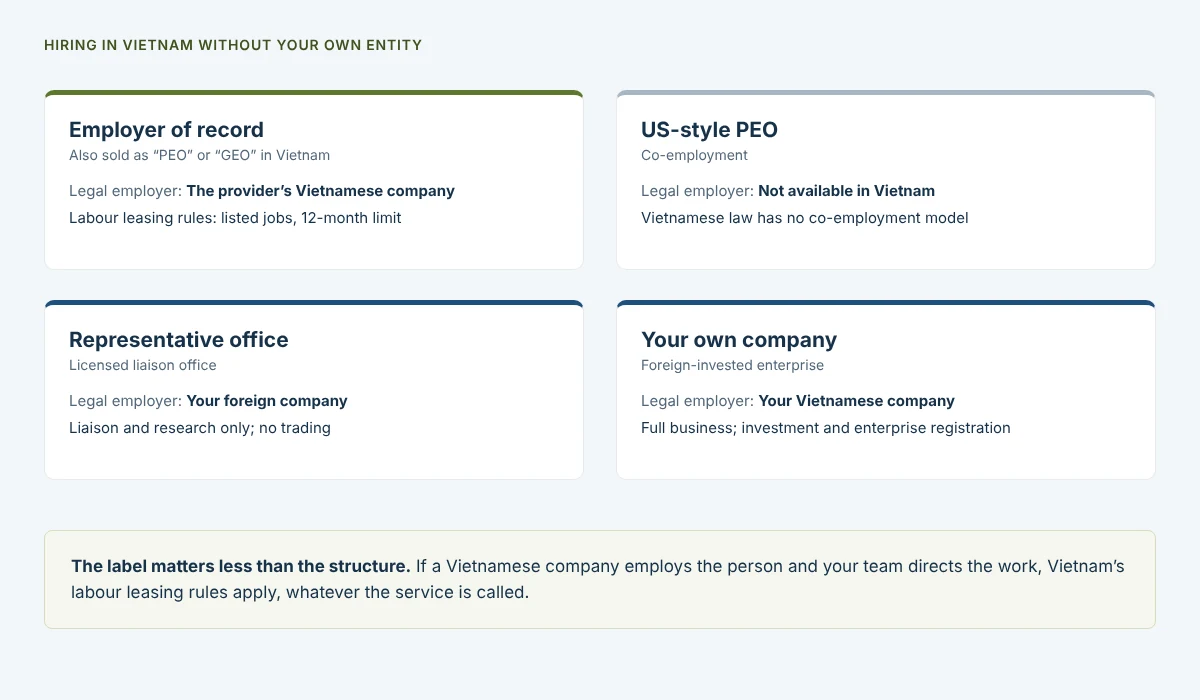
A foreign company without a Vietnamese entity can employ staff in Vietnam through an employer of record (EOR): a Vietnamese company that employs the person, runs payroll, pays social insurance and withholds tax, while the work is done for you. “PEO” and “GEO” are other names used for similar services. In Vietnam the label matters less than one legal question: when another company employs the person and you direct the work, the labour leasing rules apply.
Six ways to employ or engage people in Vietnam
| Route | Who employs | Good for | Watch out for |
|---|---|---|---|
| Your own Vietnamese company | Your subsidiary | A growing team, local sales, roles of any type and length | Investment and enterprise registration, a bank account, tax, insurance and union registrations, annual reporting |
| Representative office | Your foreign company, through its licensed office | Liaison, market research and promotion | Cannot trade or earn revenue; contracts are signed by your company, not by the office |
| Employer of record (labour leasing) | The provider’s Vietnamese company | A temporary need in a listed role: a surge in work, cover for an absence or a specialist | Only listed types of work, up to 12 months per assignment, equal pay with your own staff |
| Managed service | The service provider | A defined scope of work the provider delivers and supervises | You set deliverables, not daily tasks; otherwise it is leasing |
| Payroll outsourcing | Your own Vietnamese company | Companies that already employ staff in Vietnam | You remain the employer and carry the obligations |
| Independent contractor | No one: a services contract | A defined project by a genuinely independent professional | Treated as employment if there is work, pay and supervision, whatever the contract is called |
Why EOR, PEO and GEO get mixed up
Employer of record (EOR) means a provider that is the legal employer of your staff in another country. Professional employer organization (PEO) comes from the US, where it describes co-employment: the client stays an employer and the PEO shares HR and payroll duties. Vietnam has no co-employment model, so a provider that calls itself a “PEO in Vietnam” is usually offering an EOR-type service. Global employment organization (GEO) usually means a multinational’s own employing company for staff it sends abroad; some providers use the term loosely for an EOR service.
Vietnamese law uses none of these terms. It knows the employer, the employment contract, labour leasing (cho thuê lại lao động) and services contracts. So whatever a provider calls itself, ask three questions:
- Which Vietnamese company signs the employment contract and pays social, health and unemployment insurance?
- Under which legal structure does your team direct the work, and does that structure meet the leasing conditions?
- Is the role on the list of work open to leasing, and how long can the assignment last?
Is an employer of record legal in Vietnam?
Yes, when it is set up as what it really is. Under Article 52 of the Labour Code 2019, a company that recruits a worker and then sends them to work under another employer’s direction is leasing labour. An EOR in which your team directs the employee’s work is therefore a leasing arrangement, and the rules below apply.
| What the law requires | What it means for you |
|---|---|
| Only enterprises that meet the leasing conditions, including a VND 2 billion deposit, may lease labour | Ask your provider which company employs the person and on what legal basis |
| Leasing is allowed only for 20 types of work listed in Decree 145/2020 | Interpreting, administrative assistance, sales support, project support and finance and tax processing are on the list; general software development is not |
| It may be used for a temporary peak in work, to cover an absent employee, or for highly qualified specialists | Explain the purpose of the role when you ask for a proposal |
| One assignment lasts up to 12 months | Agree at the start what happens when the period ends |
| Pay must be at least equal to your own staff doing the same or similar work | Share how you pay comparable staff, if you have any in Vietnam |
| A leased worker may not replace strikers or staff dismissed for restructuring, or be passed on to another business | Use the person only for the agreed role in your own business |
Calling the arrangement a consulting or service contract does not avoid these rules if your team supervises the work in practice. The full picture is in our article on EOR and labour leasing in Vietnam.
When an EOR fits, and when it does not
An EOR fits when
- You need one or a few Vietnamese employees for a temporary need: a surge in work, cover for an absence or a specialist
- The role is on the leasing list, such as sales support, project support or administration
- You want one Vietnamese employer for that period rather than setting up first
- You want one contract and one invoice for payroll, insurance and tax
Look at other routes when
- You will sell and invoice in Vietnam on a continuing basis
- The role is not on the list, for example general software development
- You need the role for longer than 12 months, or expect a larger team
- The person is a foreign national, whether or not they already live in Vietnam
Six risks to manage, whichever route you choose
| Risk | How to manage it |
|---|---|
| Leasing outside the rules | Check the role, the purpose and the period before the start date, and keep the arrangement within them |
| A services contract that is really employment | If you set hours, supervise the work and pay a monthly fee, Vietnamese law treats it as employment |
| Working-time breaches | Keep overtime within 40 hours a month and 200 a year, with the employee’s consent, and record hours |
| Losing track of the end date | Diarise the end of each assignment and decide the next step well before it arrives |
| Tax presence for your company | Do not let local staff habitually conclude contracts for you; take tax advice |
| A difficult exit | An employer needs a legal ground to end a contract; agree in advance how an ending or a move to your own company would work |
Setting up your own Vietnamese company
Most foreign-owned companies in Vietnam are limited liability companies. Since 1 March 2026 a foreign investor that meets the market-access conditions can register the company first and obtain the investment registration certificate before carrying out the project, followed by a capital account, tax registration and social insurance and trade union registration. Some business lines, such as distribution or education, need extra licences, so confirm the order and timing for your case. Allow a few months in total; the registrations are only part of the work.
A representative office is lighter but limited: it can research the market, liaise and promote your business, and employ local staff for that work, but it cannot trade or earn revenue. Some companies start with an employer of record for a temporary need in a listed role, then move the person to their own company once the business case is proven. Moving an employee needs their agreement and a clear position on leave balances and pay.
Questions about hiring without an entity in Vietnam
Is an employer of record the same as a PEO in Vietnam?
Not formally. A PEO, in the US sense, shares employer duties with the client. Vietnam has no co-employment model, so a provider offering “PEO” in Vietnam is usually acting as the legal employer, like an EOR. Ask which company signs the employment contract and under which legal structure.
What is a global employment organization?
GEO usually means a multinational’s own employing company for staff it sends abroad. Some providers use it loosely for an employer of record service, so ask who the legal employer in Vietnam will be.
Can a foreign company hire in Vietnam without a local entity?
Yes, through an employer of record for roles that fit the labour leasing rules, through a managed service, or through genuine independent contractors. A representative office can also employ local staff, but only for liaison, market research and promotion.
How long can an EOR employee work for us in Vietnam?
Under the leasing rules, one assignment lasts up to 12 months. What happens after that depends on the role, so agree it at the start: a move to your own company, a different structure, or the end of the assignment.
When should I move from an EOR to my own entity?
When you start selling and invoicing in Vietnam on a continuing basis, need roles outside the leasing list or for longer periods, or the team grows to the point where running your own company is justified.
Not sure which route fits your hire?
Tell us about the role, how long you need it and where the person will work. We will review it under the leasing rules and tell you whether an employer of record, your own entity or another route fits better.