
Insights
How to Hire Employees in Bulgaria: A 2026 Guide for Overseas Companies
Insights · By Chen ChunJie · Updated 24 October 2026
To hire an employee in Bulgaria you need an employer registered in Bulgaria, a written employment contract signed before work starts, a notification to the National Revenue Agency (NRA) before the first working day, and monthly payroll in euro with social security, health insurance and 10% income tax. If your company has no Bulgarian entity, an employer of record can employ the person for you.
Last reviewed in October 2026 against the Labour Code, the Social Insurance Code, the Personal Income Taxes Act and current NRA and NSSI guidance. General information, not legal or tax advice.
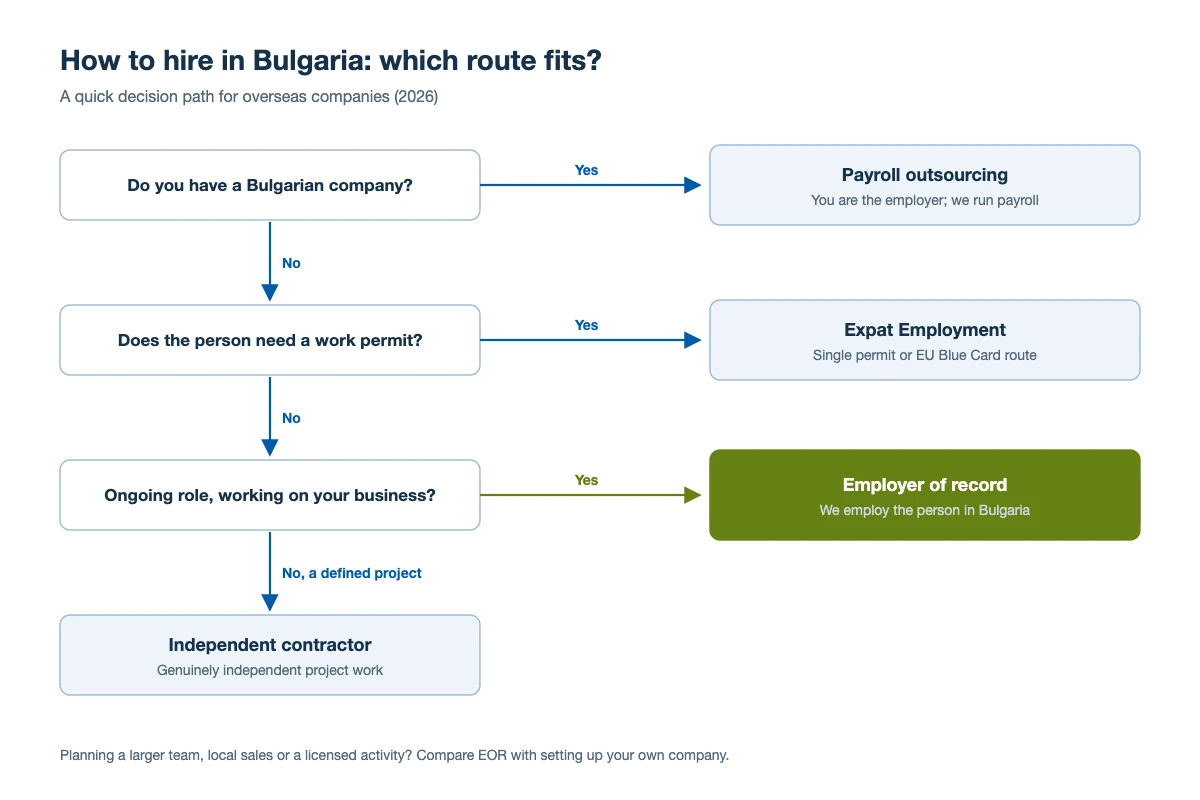
Step 1: Decide who will employ the person
A company abroad cannot simply put someone living and working in Bulgaria on its home payroll. A Bulgarian employer has to sign the contract, register the employment with the NRA, withhold tax and contributions every month and meet Labour Code duties. You have four practical options.
| Option | When it fits |
|---|---|
| Your own Bulgarian company or branch | A growing team, Bulgarian customers to invoice, stock to hold or a licensed activity |
| Register your foreign company with the NRA as an employer | No local sales, and you have the people to run Bulgarian payroll, filings and HR in-house |
| Employer of record | You want to hire now, without a local entity or payroll set-up |
| Independent contractor | Genuinely independent project work, not an ongoing role under your direction |
For a closer comparison of the labels providers use, read EOR, PEO or GEO in Bulgaria. If you are weighing a company of your own, see start a business in Bulgaria or operate without one.
Step 2: Check the right to work
Bulgarian, EU, EEA and Swiss citizens can work in Bulgaria without a permit. Most other nationals need a single permit (residence and work) or an EU Blue Card. The Bulgarian employer applies, the Employment Agency checks access to the labour market, and the person cannot start until the permit is issued.
NNRoad’s Bulgaria EOR covers people who can already work in Bulgaria. If the person still needs a permit, see Expat Employment in Bulgaria.
Step 3: Set the pay
Bulgaria adopted the euro on 1 January 2026, so salaries are agreed and paid in euro. The national minimum wage is EUR 620.20 a month (EUR 3.74 an hour) for full-time work. Contributions are due on at least the minimum insurable income for the occupation and economic activity, which is often higher than the minimum wage, so check it before you make an offer.
Every employee also earns a seniority bonus of at least 0.6% of base pay for each year of service and professional experience, including qualifying experience with previous employers. A 13th salary is not required by law.
Step 4: Budget for the costs on top of salary
Employer contributions add 18.92% to 19.62% of gross pay, depending on the work-accident rate for the activity. They stop growing above the maximum insurable income of EUR 2,300 a month (from 1 August 2026). The employee pays 13.78% in contributions plus 10% income tax, both withheld by the employer.
On a EUR 2,000 monthly salary the employer pays about EUR 378 in contributions, for a total of EUR 2,378 a month. See Bulgaria EOR cost for worked examples, or model a salary in the Bulgaria labor cost calculator.
Step 5: Write the contract
The default is a written, indefinite-term employment contract, signed before the person starts. Fixed-term contracts are allowed only for the cases the Labour Code lists. The contract should set out at least:
- Place of work, job title and the nature of the work
- Start date and duration
- Basic salary, supplements and how often pay is made
- Working day and week, and paid annual leave
- Notice period, the same for both sides
- Probation of up to 6 months, if you agree one
Before the first day, give the employee a job description, a copy of the signed contract and a copy of the NRA notification.
Step 6: Register the employee and set up payroll
The employer notifies the NRA within 3 days of signing the contract and before the employee starts work. Since 1 June 2025 the NRA also keeps an electronic employment record, which the employer updates when the contract is concluded, changed or ended. Employers must also use an occupational health service, assess workplace risks and give a health-and-safety induction before work begins.
Each month the employer calculates gross-to-net pay, files Declarations 1 and 6 with the NRA and pays contributions and withheld tax by the 25th of the following month. After year-end the employer runs the annual tax reconciliation for employees and files an annual statement of income paid.
Step 7: Working hours, leave and holidays
| Topic | The rule |
|---|---|
| Hours | 8 a day and 40 a week |
| Overtime | Only in the cases the Labour Code allows, up to 150 hours a year, paid at least 50% extra on working days, 75% on rest days and 100% on public holidays |
| Annual leave | At least 20 working days a year |
| Sick leave | The employer pays the first 2 working days at 70% of average daily pay; the National Social Security Institute (NSSI) pays from day 3 |
| Maternity | 410 days of pregnancy and childbirth leave, 45 of them before the birth, paid by the NSSI |
| Public holidays | 1 January, 3 March, Orthodox Easter (Good Friday to Easter Monday), 1, 6 and 24 May, 6 and 22 September, and 24 to 26 December. Holidays that fall at the weekend usually move to the next working day. |
Step 8: If the employee works remotely
Remote work has to be agreed in writing, in the employment contract or an annex. It should cover where the work is done, how working time is recorded, and who provides and pays for equipment and communications. The employee remains fully covered by Bulgarian employment law, contributions and income tax, so someone working from Bulgaria for your company abroad still needs a Bulgarian employer set-up.
Step 9: Ending the employment
Employment can end only on the grounds listed in the Labour Code. On an indefinite contract, notice is 30 days unless a longer period of up to 3 months is agreed. Depending on the ground, the employer pays compensation in lieu of notice, up to one month’s pay while the former employee is unemployed (for example after staff cuts or a closure), and all unused annual leave.
Some employees, including pregnant women and mothers of young children, have extra protection, and dismissing them may need Labour Inspectorate approval. An unlawful dismissal can cost up to 6 months’ pay and reinstatement. The employer records the termination with the NRA within 7 days.
Hiring checklist for Bulgaria
- Employer chosen: your own company, NRA registration or an employer of record
- Right to work confirmed, or a permit route planned
- Salary checked against the minimum wage and the minimum insurable income
- Contract and job description signed before day one
- NRA notified and the electronic employment record updated
- Occupational health service and safety induction in place
- Payroll calendar set, with filings and payments by the 25th
- Leave, remote work and data protection terms in writing
Questions about hiring in Bulgaria
Can a foreign company hire employees in Bulgaria without a local entity?
Yes. It can register with the NRA as an employer and run Bulgarian payroll itself, or use an employer of record, which employs the person in Bulgaria and handles the contract, payroll and filings. Non-EU hires who still need a permit require a Bulgarian employer to apply.
How long does it take to hire an employee in Bulgaria?
For someone who can already work in Bulgaria, the legal steps are quick: sign the contract, notify the NRA and complete the safety induction before the first day. The timeline is usually set by the candidate’s notice period with their current employer, often 30 days or more.
What is the minimum salary in Bulgaria in 2026?
EUR 620.20 a month, or EUR 3.74 an hour, for full-time work from 1 January 2026. Contributions may be due on a higher minimum insurable income for the occupation.
Do employees in Bulgaria get a 13th salary?
Not by law. A 13th salary or annual bonus is owed only if the contract, a collective agreement or your pay rules provide it. The seniority bonus of at least 0.6% of base pay per year of service is mandatory.
Can I hire someone in Bulgaria as a freelancer instead?
Only for genuinely independent work. Paid work done under someone else’s direction has to be done under an employment contract, and the Labour Inspectorate can treat a civil contract as employment. See On-Demand Talent in Bulgaria for project work.
Hiring your first employee in Bulgaria?
If you do not have a Bulgarian company yet, NNRoad can employ your hire in Bulgaria and run payroll, contributions and compliance for you.
Related
What an employee costs each month, with worked examples.
Ten checks to make before you sign.