
Guide
Bulgaria EOR Cost 2026: Employer Contributions and Worked Examples
Guide · By Chen ChunJie · Updated 24 October 2026
Through an employer of record, a Bulgarian employee costs their gross salary plus employer contributions of 18.92% to 19.62% (up to a monthly ceiling of EUR 2,300), any benefits you offer, and the provider’s service fee. Bulgaria has no mandatory 13th salary, so the annual cost is easy to forecast.
Rates and thresholds as of October 2026, from the Social Insurance Code, the 2026 state social security budget and NRA guidance. Examples are illustrative; your proposal reflects the actual role. General information, not tax advice.
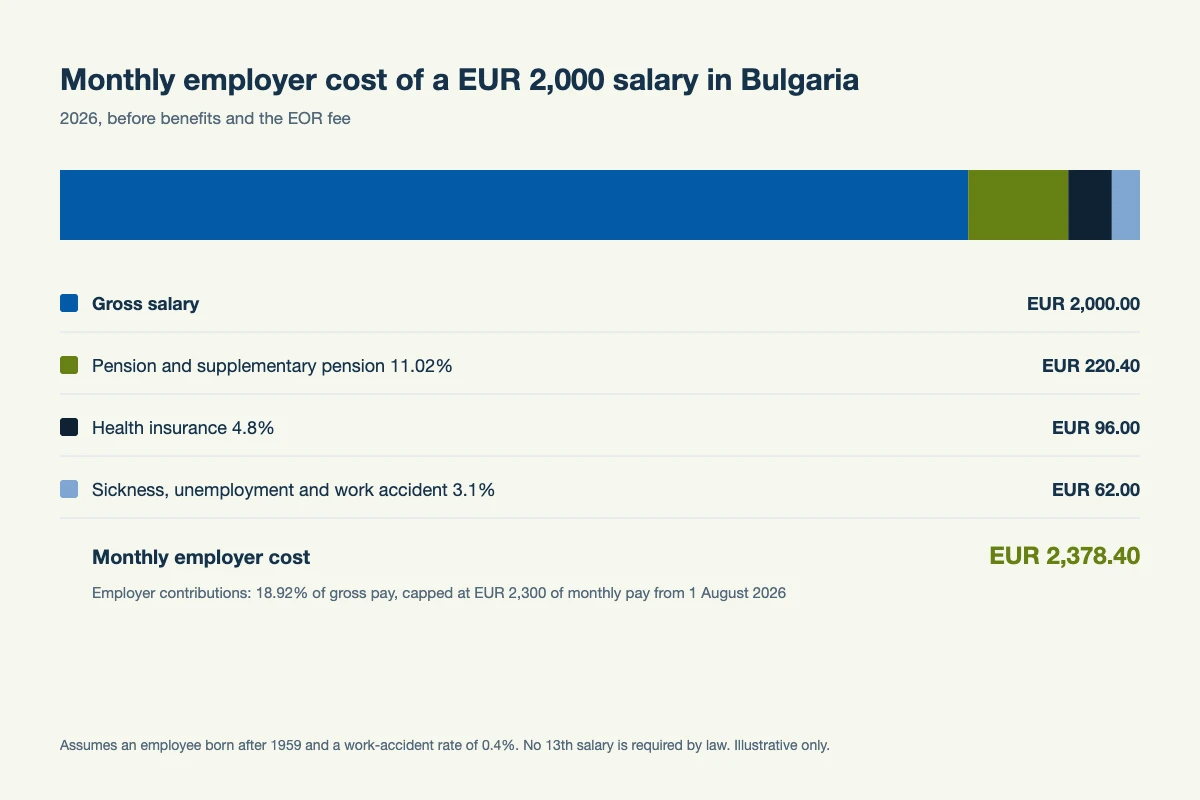
What you pay each month
| Line | What it covers | Who sets it |
|---|---|---|
| Gross salary | Agreed base pay plus the seniority bonus and any supplements | You and the employee, at least the minimum wage |
| Employer contributions | Pension, supplementary pension, sickness and maternity, unemployment, health insurance and work accident | The law: 18.92%–19.62% |
| Benefits | For example additional health insurance, food vouchers or a home-office allowance | You |
| EOR service fee | Employment, payroll, filings and HR administration | Your proposal |
| One-time items and deposit | Set-up where needed, and a refundable deposit | Your proposal |
Contribution rates in 2026
Contributions are split between employer and employee and calculated on gross pay. The table shows the rates for an employee born after 1959, who also pays into the universal supplementary pension fund.
| Fund | Employer | Employee |
|---|---|---|
| Pension, including supplementary pension | 11.02% | 8.78% |
| Sickness and maternity | 2.10% | 1.40% |
| Unemployment | 0.60% | 0.40% |
| Health insurance | 4.80% | 3.20% |
| Work accident and occupational disease | 0.4%–1.1%, by economic activity | None |
| Total | 18.92%–19.62% | 13.78% |
Contributions are due on gross pay between the minimum insurable income for the occupation and the maximum insurable income: EUR 2,111.64 a month from January to July 2026 and EUR 2,300 from 1 August 2026. Income tax is a flat 10% of gross pay after the employee’s contributions.
Worked examples
Three monthly salaries from August 2026, assuming a work-accident rate of 0.4%, no seniority bonus and no benefits. The EOR fee is not included.
| Monthly gross salary | EUR 1,500 | EUR 2,000 | EUR 4,000 |
|---|---|---|---|
| Employer contributions | EUR 283.80 | EUR 378.40 | EUR 435.16 (capped) |
| Monthly employer cost | EUR 1,783.80 | EUR 2,378.40 | EUR 4,435.16 |
| Annual employer cost | EUR 21,405.60 | EUR 28,540.80 | EUR 53,221.92 |
| Employee contributions | EUR 206.70 | EUR 275.60 | EUR 316.94 |
| Income tax (10%) | EUR 129.33 | EUR 172.44 | EUR 368.31 |
| Net pay to the employee | EUR 1,163.97 | EUR 1,551.96 | EUR 3,314.75 |
Above EUR 2,300 a month, contributions stop growing, so the employer’s percentage on top of salary falls for senior roles. To model another salary, use the Bulgaria labor cost calculator.
Costs that are easy to miss
- Seniority bonus. At least 0.6% of base pay for each year of service and professional experience. A hire with 10 years’ experience costs at least 6% more than the base salary.
- Minimum insurable income. For some occupations and activities, contributions are due on a base higher than the salary you agree.
- Sick pay. The employer pays the first 2 working days of sick leave at 70% of average daily pay.
- Overtime and night work. Supplements of at least 50% to 100% for overtime, plus a night-work supplement.
- Ending the employment. Unused leave is paid out, and some termination grounds add compensation in lieu of notice or up to a month’s pay.
- Remote set-up. Equipment and communication costs agreed for remote employees.
How EOR providers price Bulgaria
Most providers charge a monthly fee per employee on top of the employment cost. When you compare proposals, check:
- whether salary and contributions are passed through at cost or marked up
- what is in the fee: contract, NRA filings, payroll, leave and sick-leave administration, termination support
- one-time set-up items, and whether a deposit is required and when it is refunded
- the invoice currency and how the exchange rate is set
- what happens when the minimum wage, the contribution ceiling or rates change
NNRoad quotes each hire after reviewing the role and lists every line separately: employment cost at cost, our monthly service fee, any one-time item and a refundable deposit. See how it works on our Bulgaria employer of record page.
EOR or your own company: the cost view
A Bulgarian company of your own avoids the EOR fee but brings fixed costs from the first month: registration, a registered address, accounting, payroll and annual financial statements, plus management time. For one to a few employees, an EOR is usually simpler and quicker. As the team grows, or once you invoice Bulgarian customers, a company of your own becomes worth pricing. Read start a business in Bulgaria or operate without one.
Questions about EOR cost in Bulgaria
How much does an employee cost in Bulgaria on top of salary?
Employer contributions add 18.92% to 19.62% of gross pay, up to a monthly base of EUR 2,300 from 1 August 2026. On a EUR 2,000 salary that is about EUR 378 a month. Add the seniority bonus, any benefits and the EOR service fee.
Is there a 13th salary in Bulgaria?
No. Bulgarian law does not require a 13th salary. Bonuses are owed only if the contract, a collective agreement or your pay rules provide them.
What is the maximum insurable income in Bulgaria in 2026?
EUR 2,111.64 a month from January to July 2026 and EUR 2,300 from 1 August 2026. Pay above that level carries no further social security or health contributions, but income tax still applies.
Does NNRoad publish a fixed EOR price for Bulgaria?
No. We quote each hire after reviewing the role, the salary and the benefits, so the proposal shows the real employment cost and our fee as separate lines.
Want a cost estimate for your Bulgarian hire?
Tell us the role and salary and we will send the total employment cost, our fee and a realistic start date.
Related
The full process, from offer to final pay.
Ten checks to make before you sign.