
Insights
How to Hire Employees in Cambodia: A 2026 Guide for Overseas Companies
Insights · By Chen ChunJie · Updated 25 October 2026
To hire an employee in Cambodia you need an employer registered in Cambodia, a written employment contract, a declaration of the hire to the Ministry of Labour through LACMS, registration with the National Social Security Fund (NSSF), and payroll that pays wages twice a month and withholds Tax on Salary. If your company has no Cambodian entity, an employer of record can employ the person for you.
Last reviewed in October 2026 against the Labour Law, the Law on Social Security Schemes, the Law on Taxation and current Ministry of Labour Prakas. General information, not legal or tax advice.
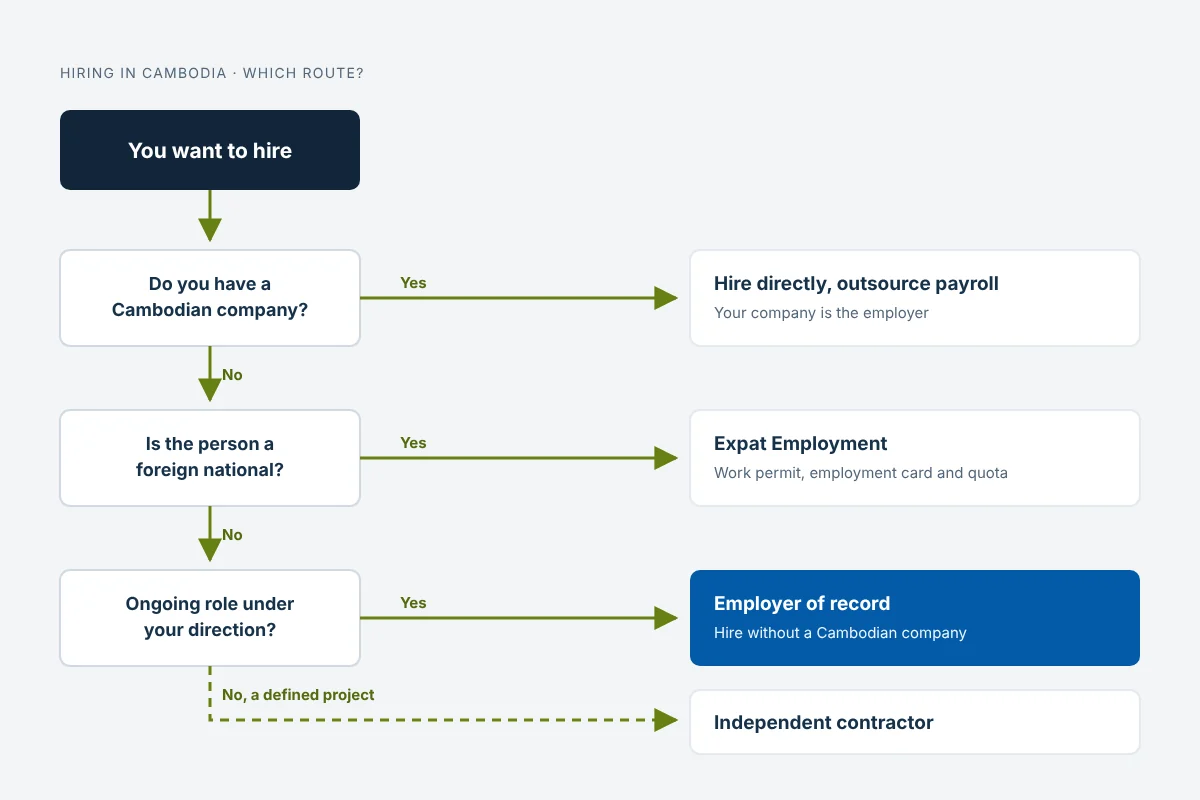
Step 1: Decide who will employ the person
A company abroad cannot simply put someone living and working in Cambodia on its home payroll. A Cambodian employer has to sign the contract, declare the hire to the Ministry of Labour and Vocational Training (MLVT), register the employee with the NSSF, withhold Tax on Salary and meet Labour Law duties. You have four practical options.
| Option | When it fits |
|---|---|
| Your own Cambodian company or branch | A growing team, Cambodian customers to invoice, goods to import or a licensed activity |
| A representative office | Liaison and market research only: it can employ local staff but cannot trade or earn income in Cambodia |
| Employer of record | You want to hire now, without registering a company or setting up payroll in Cambodia |
| Independent contractor | Genuinely independent project work, not an ongoing role under your direction |
If you are deciding whether to register a company at all, read start a business in Cambodia or operate without one. To hire without a Cambodian company, see employer of record in Cambodia.
Step 2: Check the right to work
Cambodian nationals can be hired directly. Foreign nationals need a work permit and an employment card issued by the Ministry of Labour through its online Foreign Workers Centralized Management System (FWCMS), and an employment visa extension from the Immigration Department. Each employer also applies once a year for a foreign-worker quota, generally up to 10% of its Cambodian workforce. Applications for the 2027 quota close on 30 November 2026.
NNRoad’s Cambodia EOR covers local hires. If the person is a foreign national, see Expat Employment in Cambodia.
Step 3: Set the pay
Salaries in Cambodia are usually agreed and paid in US dollars, while Tax on Salary and NSSF contributions are calculated in riel at the official monthly exchange rate. There is no general minimum wage: a statutory minimum applies only in the garment, textile, footwear, travel-goods and bag sectors, at USD 210 a month in 2026 and USD 212 from 1 January 2027. For office and professional roles, pay is what the market and the contract set.
Wages are paid twice a month, about half in the second week and the balance in the fourth week (Prakas 442/18). There is no statutory 13th-month salary, but staff on undetermined-duration contracts earn seniority indemnity: 15 days’ wages a year, paid as 7.5 days each June and December.
Step 4: Budget for the costs on top of salary
The employer pays NSSF contributions of 0.8% for occupational risk, 2.6% for health care and 2% for pension, and the employee pays 2% for pension. All are calculated on a contributory wage capped at KHR 1,200,000 a month, so for most professional salaries the employer’s share is about USD 16 a month. Add seniority indemnity of about 4.2% of salary on an undetermined-duration contract, or the end-of-contract payment of at least 5% of total wages on a fixed-duration contract.
On a USD 1,000 monthly salary on an undetermined-duration contract, the employer pays about USD 16 in NSSF and accrues about USD 42 of seniority indemnity, for a total of about USD 1,058 a month. Model other salaries in the Cambodia labor cost calculator.
Step 5: Write the contract
Most roles use an undetermined-duration contract (UDC). A fixed-duration contract (FDC) must be in writing with a precise end date; the limits on its length and renewals have been interpreted differently over time, so check the current position before offering one. Put the contract in Khmer, with an English version if your managers need it. It should set out at least:
- Job title, duties and place of work
- Contract type, start date and, for an FDC, the end date
- Probation: up to 3 months for regular employees, 2 months for specialised workers, 1 month for non-specialised workers
- Salary, allowances and the twice-monthly pay dates
- Working hours, weekly rest and paid annual leave
- Notice periods and how the contract can end
Companies with 8 or more workers must also adopt internal work rules registered with the Ministry of Labour and hold shop steward elections.
Step 6: Register the employee and set up payroll
The employer declares each hire and each departure to the Ministry of Labour through LACMS, the Labour Automated Central Management System, and registers the employee with the NSSF before work starts. Payroll details are reported monthly through LACMS, and the payroll book follows the Ministry’s template (Prakas 113/25).
Each month the employer calculates gross-to-net pay, withholds Tax on Salary, pays NSSF contributions by the 15th of the following month and files the monthly tax return with the General Department of Taxation (GDT). Overtime, work on public holidays and any suspension of the weekly rest day must be filed in LACMS at least three working days in advance, with staff consent (Prakas 112/25).
Step 7: Working hours, leave and holidays
| Topic | The rule |
|---|---|
| Hours | 8 a day and 48 a week, with at least 24 consecutive hours of weekly rest, normally on Sunday |
| Overtime | 150% of normal pay, or 200% between 10 p.m. and 5 a.m. and on the weekly rest day; filed in LACMS in advance |
| Annual leave | 1.5 working days per month of service, plus 1 day for every 3 years of service |
| Public holidays | Fixed each year by Ministry of Labour Prakas, including Khmer New Year, Pchum Ben and the Water Festival; work on a holiday is paid double |
| Sick leave | Certified illness suspends the contract for up to 6 months; the law sets no number of paid sick days, so most employers have a policy |
| Maternity | 90 days; the employer pays half wages to employees with at least one year of service, and NSSF health care provides a maternity allowance |
Step 8: If the employee works remotely
Remote or hybrid work should be agreed in writing, in the contract or an annex, covering where the work is done, how working time is recorded and who provides and pays for equipment. The employee remains fully covered by Cambodian employment law, NSSF and Tax on Salary, so someone working from Cambodia for your company abroad still needs a Cambodian employer.
Step 9: Ending the employment
A UDC can be ended only for a valid reason linked to the employee’s conduct or ability or to the needs of the business, with written notice: 7 days for under 6 months of service, 15 days up to 2 years, 1 month up to 5 years, 2 months up to 10 years and 3 months beyond. During notice the employee gets two paid days off a week to look for work. Serious misconduct allows dismissal without notice.
On exit, settle unused leave and any outstanding seniority indemnity, or the end-of-contract payment for an FDC. Ending an FDC early without serious misconduct can mean paying the wages for the rest of the term. Disputes go to the labour inspectorate and then to the Arbitration Council or the courts, so keep written records. The Cambodia employment law guide has more detail.
Hiring checklist for Cambodia
- Employer chosen: your own company, a representative office or an employer of record
- Right to work confirmed, or a work permit and quota plan in place
- Salary set in USD and checked against any sector minimum wage
- Contract type chosen and the contract signed in Khmer, with English if needed
- Hire declared in LACMS and employee registered with the NSSF
- Twice-monthly pay calendar, Tax on Salary and NSSF payments set up
- Seniority indemnity scheduled for June and December
- Leave, overtime and remote-work terms in writing
Questions about hiring in Cambodia
Can a foreign company hire employees in Cambodia without a local entity?
Not directly. Declaring hires to the Ministry of Labour, registering with the NSSF and withholding Tax on Salary require an employer registered in Cambodia. Without a company, branch or representative office, you can hire through an employer of record in Cambodia, which employs the person and runs payroll for you.
How long does it take to hire an employee in Cambodia?
Once a candidate accepts, the main timing factors are their notice period with a current employer and how quickly documents are ready. The contract must be signed, the hire declared in LACMS and the employee registered with the NSSF before the first day. Setting up your own company first adds the time needed for business, tax and labour registrations.
What is the minimum wage in Cambodia in 2026?
Cambodia has no general minimum wage. A statutory minimum of USD 210 a month applies in 2026 to the garment, textile, footwear, travel-goods and bag sectors, rising to USD 212 from 1 January 2027. Other salaries are set by contract.
Do employees in Cambodia get a 13th-month salary?
No, it is not required by law. Staff on undetermined-duration contracts receive seniority indemnity instead: 15 days’ wages a year, paid in June and December.
Can I hire someone in Cambodia as a freelancer instead?
Only if the work is genuinely independent. The Labour Law applies to anyone working for pay under an employer’s direction, and a contract can become employment by conduct. See On-Demand Talent in Cambodia for project work done by independent professionals.
Hiring your first employee in Cambodia?
If you do not have a Cambodian company yet, NNRoad can employ your hire in Cambodia and run the contract, payroll, NSSF and Tax on Salary for you.
Related
When you need a Cambodian company, and when you do not.
Contracts, hours, leave, pay and termination rules.