
Insights
How to Hire Employees in Cyprus: A 2026 Guide for Overseas Companies
Insights · By Chen ChunJie · Updated 25 October 2026
To hire an employee in Cyprus you need an employer registered in Cyprus, a written statement of the main employment terms, registration with Social Insurance and the General Healthcare System (GHS, or GeSY), monthly payroll with PAYE income tax withholding, and the employer funds on top of salary. A company without a Cyprus entity can work through an employer of record, a licensed temporary employment agency for short assignments, or genuinely independent contractors. Which route fits depends on who will direct the work and for how long.
Last reviewed in October 2026 against the Termination of Employment Law, the Transparent and Predictable Working Conditions Law of 2023, the Temporary Agency Work Law of 2012, the 2026 minimum wage decree and the 2026 tax reform. General information, not legal or tax advice.
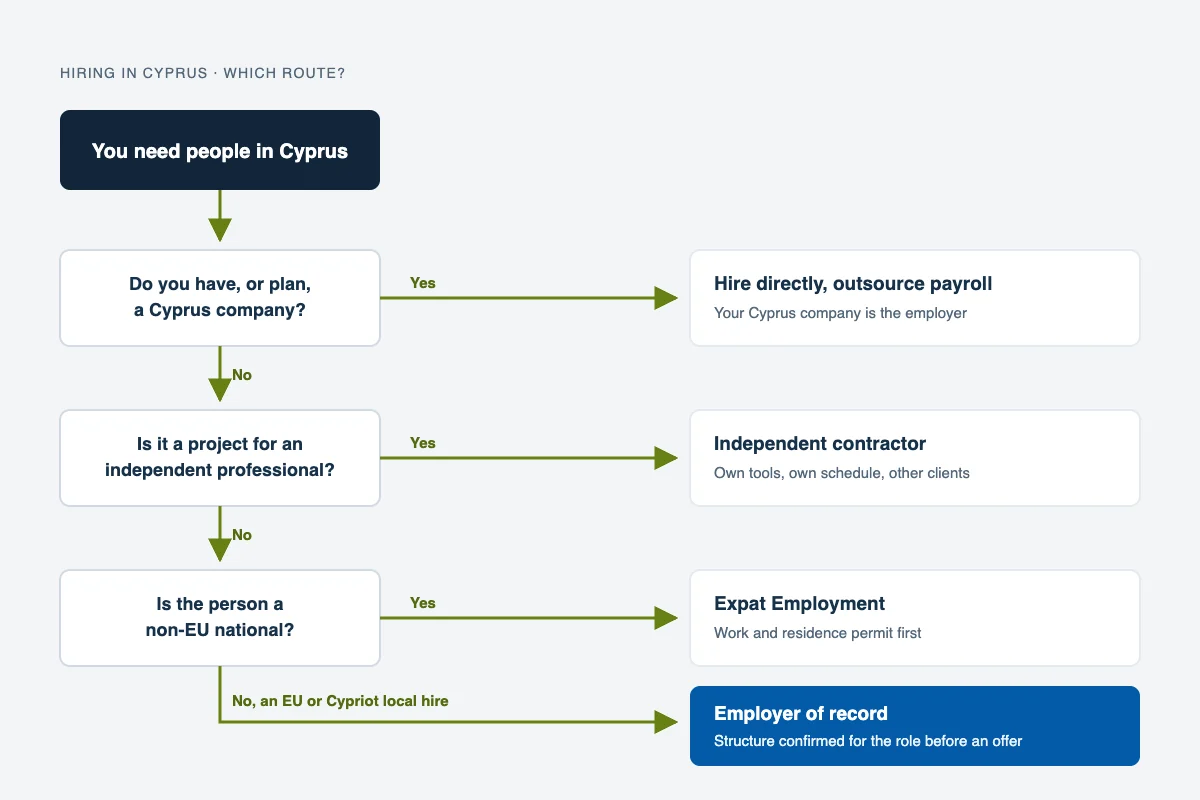
Step 1: Decide who will employ the person
A company abroad cannot simply put someone living and working in Cyprus on its home payroll. A Cyprus employer has to sign the contract, register the employee with Social Insurance and GHS, withhold PAYE and pay the employer funds. These are the practical routes.
| Route | When it fits | Watch out for |
|---|---|---|
| Your own Cyprus company (Ltd) or a branch | A growing team, Cypriot customers to invoice, or a licensed activity | Set-up time, an annual audit and running payroll yourself or through a payroll provider |
| Employer of record | You want to hire now without registering a company | Ask how the provider is structured and licensed, and who directs the work day to day |
| Licensed temporary employment agency | Short assignments under your direction | An assignment with the same client starts at up to 4 months and cannot exceed 12 months in total; not allowed in construction or tourism (Temporary Agency Work Law of 2012) |
| Independent contractor | A genuine project by a professional with their own tools, schedule and other clients | A contract that works like employment is treated as employment, with contributions due |
If you are still deciding whether to set up a company at all, read start a business in Cyprus or operate without one. To hire without your own company, see employer of record in Cyprus.
Step 2: Check the right to work
Cypriot, EU, EEA and Swiss nationals can work in Cyprus without a work permit; EU citizens apply for a registration certificate with the Civil Registry and Migration Department within four months of arrival. Non-EU nationals need a residence and employment permit before they start work. The route depends on the role and the employer: general employment of a non-EU worker usually needs Department of Labour approval, while the faster route for highly paid staff applies to qualifying Cyprus companies of foreign interest, which means your own Cyprus company. An EU Blue Card has its own salary threshold and conditions.
Hiring a non-EU national? Check the permit route before you make an offer. See Expat Employment in Cyprus.
Step 3: Put the terms in writing
- Written terms: under the Transparent and Predictable Working Conditions Law of 2023, the employee must receive the essential terms in writing, including the parties, job, place of work, start date, pay, working time, leave and notice.
- Probation: for most employees, probation cannot exceed six months. On a fixed-term contract it must be proportionate to the length of the contract, and it is not repeated when the same job is renewed.
- Contract type: indefinite contracts are the norm. Successive fixed-term contracts lasting more than 30 months in total generally become indefinite unless an objective reason justifies them, and fixed-term employees are protected against less favourable treatment.
- Language: contracts are usually in English or Greek; a bilingual contract helps both sides.
Step 4: Set the pay
- Minimum wage: EUR 1,088 a month for full-time work from 1 January 2026, or EUR 979 during the first six months with the same employer. Part-time work is paid pro rata, and a few categories of worker follow separate rules.
- 13th salary: not required by law. It is payable only where the contract, a collective agreement or established practice provides it, so decide it before you compare costs.
- Income tax: from 2026, income up to EUR 22,000 a year is tax-free; then 20% to EUR 32,000, 25% to EUR 42,000, 30% to EUR 72,000 and 35% above. The employer withholds PAYE every month.
- Currency and frequency: salaries are agreed and paid in euros, usually monthly.
Model employer costs and net pay for a given salary with our Cyprus employer cost calculator.
Step 5: Register the employee and run payroll
The employer registers with the Social Insurance Services, registers each employee before they start, and every month pays contributions, withholds PAYE and files the returns. These are the main employer costs in 2026.
| Contribution | Employer | Employee | Notes |
|---|---|---|---|
| Social Insurance | 8.8% | 8.8% | On earnings up to EUR 5,742 a month (EUR 68,904 a year) |
| GHS (GeSY) | 2.9% | 2.65% | On income up to EUR 180,000 a year |
| Social Cohesion Fund | 2% | — | On all earnings, with no cap |
| Redundancy Fund | 1.2% | — | Up to the Social Insurance cap |
| Human Resource Development levy | 0.5% | — | Up to the Social Insurance cap |
| Central Holiday Fund | 8% | — | Unless the employer is exempt with its own leave arrangement; it also affects the base for other contributions |
Already have a Cyprus company? Our Cyprus payroll service runs PAYE, Social Insurance and GHS for you. For the full rules, see the Cyprus employment law guide.
Step 6: Plan working time and leave
| Rule | Position in 2026 |
|---|---|
| Working time | Average of no more than 48 hours a week including overtime; full-time is usually 38 to 40 hours |
| Annual leave | 20 working days a year for a five-day week, 24 for a six-day week |
| Public holidays | Around 14 to 17 a year, depending on the sector and the contract |
| Maternity and paternity | 22 weeks of maternity leave for the first and second child; 2 weeks of paternity leave |
| Sickness | Sickness benefit is generally paid by Social Insurance; employer-paid sick days depend on the contract, collective agreements and some sector rules |
Step 7: End employment correctly
After the probation period, an employer can end employment only for a valid reason, such as redundancy, conduct or performance, and must give notice that rises with service, from one week to eight weeks. Unfair dismissal gives a right to compensation. Employees with at least 104 weeks of continuous service who are made redundant receive redundancy pay from the Redundancy Fund. Pregnant employees and employees on maternity or parental leave have special protection.
How to choose an EOR in Cyprus
Lists of the “best EOR in Cyprus” rarely check the questions that matter under Cypriot law. Before you sign with any provider, ask:
- Which Cyprus entity signs the employment contract, and what licence does it hold?
- Who gives the employee day-to-day instructions, and does the set-up fall under the Temporary Agency Work Law, with its 12-month limit per client?
- Is the employer covered by the Central Holiday Fund or exempt, and how does that change the cost?
- Does the proposal show salary, Social Insurance, GHS, each employer fund, any 13th salary and the service fee separately?
- Can the provider support non-EU hires, and what happens if you later move the employee to your own company?
See how we answer them on our Cyprus employer of record page.
FAQ: hiring in Cyprus
Can I hire someone in Cyprus without a Cyprus company?
Yes, through an employer of record or, for short assignments, a licensed temporary employment agency. The right structure depends on who will direct the work and for how long. If you plan a growing team directed by your own managers, consider setting up a Cyprus company.
What is the difference between an EOR and a PEO in Cyprus?
Both are commercial labels, not legal categories in Cyprus. One company is the legal employer and carries the employer’s obligations. For a company with no Cyprus entity, a “PEO” offer is in practice an employer of record arrangement, so ask which entity employs the person and under which licence.
What is the minimum wage in Cyprus in 2026?
EUR 1,088 a month for full-time work, or EUR 979 during the first six months with the same employer, under the decree in force from 1 January 2026.
Is a 13th salary mandatory in Cyprus?
No. It is payable only where the employment contract, a collective agreement or established practice provides for it.
How long can probation last in Cyprus?
For most employees, no more than six months. On fixed-term contracts it must be proportionate to the contract’s length.
Can I hire a contractor instead of an employee?
Only if the work is genuinely independent. A contractor who works under your direction like an employee can be reclassified, with contributions and employment rights due. See On-Demand Talent in Cyprus for genuine project work.
Hiring in Cyprus before you have a company?
Tell us about the role, salary and start date. We confirm the right employment structure for it in writing before an offer is made.
Related
When you need a Cyprus company, and when you do not.
Contracts, leave, contributions, tax and termination.