
Insights
How to Hire Employees in Tunisia
Insights · By Chen ChunJie · Published 8 November 2026
Tunisia changed its hiring rules in May 2025. Law 2025-9 made open-ended contracts the default, restricted fixed-term contracts and banned labour-only subcontracting. This guide explains how a foreign company can hire in Tunisia today, what contracts must say, what payroll costs and how employment ends lawfully.
Reviewed in November 2026 against the Labour Code and Law 2025-9, current minimum-wage rules and official foreign-employment guidance. Confirm sector agreements, worker categories and current payroll parameters before hiring.
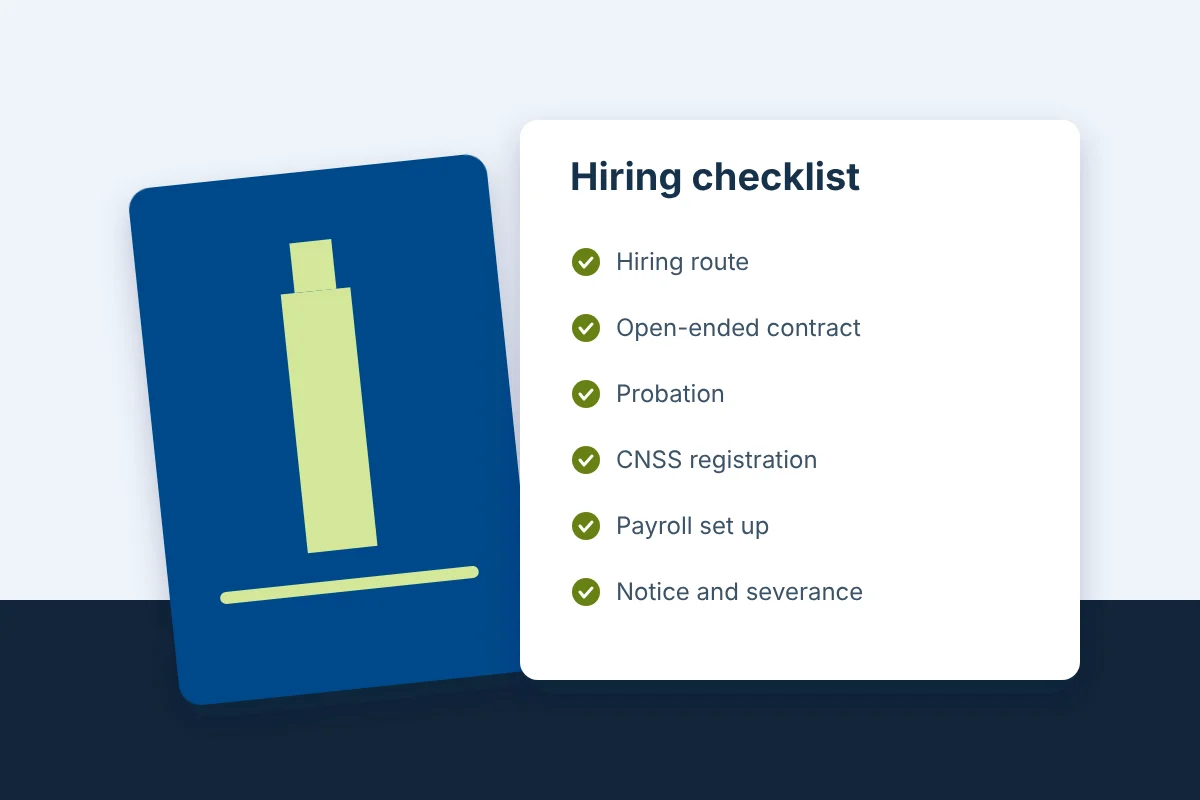
Three ways to get work done in Tunisia
| Route | Who employs the people | Best for |
|---|---|---|
| Your own Tunisian company | Your subsidiary or branch | Long-term teams you direct yourself |
| A service delivered by a Tunisian provider | The provider, which directs its own staff | Eligible specialised work meeting all article 30 conditions |
| Independent contractor | No employer; a commercial contract | Genuinely independent work after a status and activity review |
Labour-only supply is prohibited. An article 30 service requires a written contract and work involving professional expertise or technical specialisation outside the beneficiary’s main and permanent activity, with no beneficiary direction or control of the workers. Client duties and potential joint liability remain.
Contracts and probation after Law 2025-9
Employment is presumed open-ended. Article 6-4 permits fixed terms exceptionally for an extraordinary workload increase, temporary replacement of an absent or suspended permanent employee, seasonal work, or other activities whose nature or established practice is incompatible with an open-ended contract. The written contract must state its duration and permitted exception; otherwise it is treated as open-ended. Fixed-term contracts cannot include probation. For open-ended employment, the statutory probation ceiling is six months, renewable once; check applicable terms and written notice requirements. Record the role, pay and hours and apply sector grade minimums and allowances.
Where article 30 permits the arrangement, NNRoad can undertake the defined service and the Local Team employs and manages its delivery staff. See Employer of Record in Tunisia for the eligibility review.
Pay and payroll
From 1 January 2026, the monthly non-agricultural SMIG for workers aged 18 or over is TND 554.736 for 48 hours and TND 470.251 for 40 hours. Check the applicable year, sector minimums and allowances. Under the general non-agricultural scheme, employer social contributions are 17.07% on the applicable base; work-accident insurance, TFP and FOPROLOS may add costs subject to their own rules and exemptions. Withhold employee contributions and applicable taxes. See our Tunisia salary tax guide.
Working time and leave
| Rule | What applies |
|---|---|
| Hours | General non-agricultural full-time ceiling: 48 hours weekly; applicable collective or regulatory regimes may be shorter. Part-time rules are separate. |
| Overtime | Non-agricultural full-time: 75% in the 48-hour regime; for shorter regimes, 25% up to 48 hours and 50% beyond. Part-time overtime: 50%, subject to separate limits. |
| Annual leave | General non-agricultural adult entitlement: one day per month, within a 15-day period including 12 working days annually. Youth, seniority and more favourable terms can increase leave. |
| Maternity and paternity | Generally three months after birth, with up to 15 prenatal days subject to medical conditions; seven days for fathers. Special cases can extend leave; benefit eligibility and funding must be checked. |
Ending employment
For dismissal from open-ended employment, assess the real and serious reason and required procedure. The general notice rule is one month by registered letter, subject to more favourable terms and lawful exceptions; the employer must state the dismissal reasons. Economic or technological dismissals require the applicable labour-inspectorate procedure. After probation, statutory severance is generally one day’s pay per month of service, capped at three months, unless dismissal is for serious misconduct or more favourable terms apply. Unfair-dismissal compensation is a separate potential liability.
Hiring a foreign national
Determine whether the foreign employee needs an employment-contract endorsement or a certificate of non-submission, together with the appropriate residence status. Eligibility, skills-availability evidence and quotas depend on the category. See Expat Employment in Tunisia.
FAQ: hiring employees in Tunisia
Are fixed-term contracts still allowed in Tunisia?
Yes, only within the statutory exceptions: extraordinary workload increases, temporary replacement, seasonal work or other activities incompatible by nature or established practice with open-ended employment. The written contract must state its duration and the exception. No probation is permitted.
Can a provider supply workers to my company in Tunisia?
No. Law 2025-9 prohibits labour-only supply. A managed service must independently meet article 30, including work outside the beneficiary’s main and permanent activity and no beneficiary direction or control of workers.
How long can probation last?
For open-ended employment, the statutory ceiling is six months, renewable once. Check applicable terms and written notice requirements. Fixed-term employment cannot include probation.
What is the notice period?
The general rule for ending an open-ended contract is one month by registered letter, subject to more favourable terms and lawful exceptions. Dismissal reasons and the applicable procedure must also be addressed.
Need a team in Tunisia without opening a company?
Share the work scope and management needs. We assess whether a lawful article 30 managed service is available and explain the responsibilities that remain with your company.
Related
Assess eligibility for a managed service under article 30.
Contracts, leave, termination and more.