
Choosing an Employer of Record in Peru: 10 Checks Before You Sign
Judge a Peru EOR on three things: who the Peruvian employer is, how your role fits Peru’s staffing and outsourcing rules, and what you will pay in each month of the year. Price matters, but most problems with an EOR in Peru come from the structure, the year-end payments and the exit, not from the monthly fee. These ten checks help you compare providers.
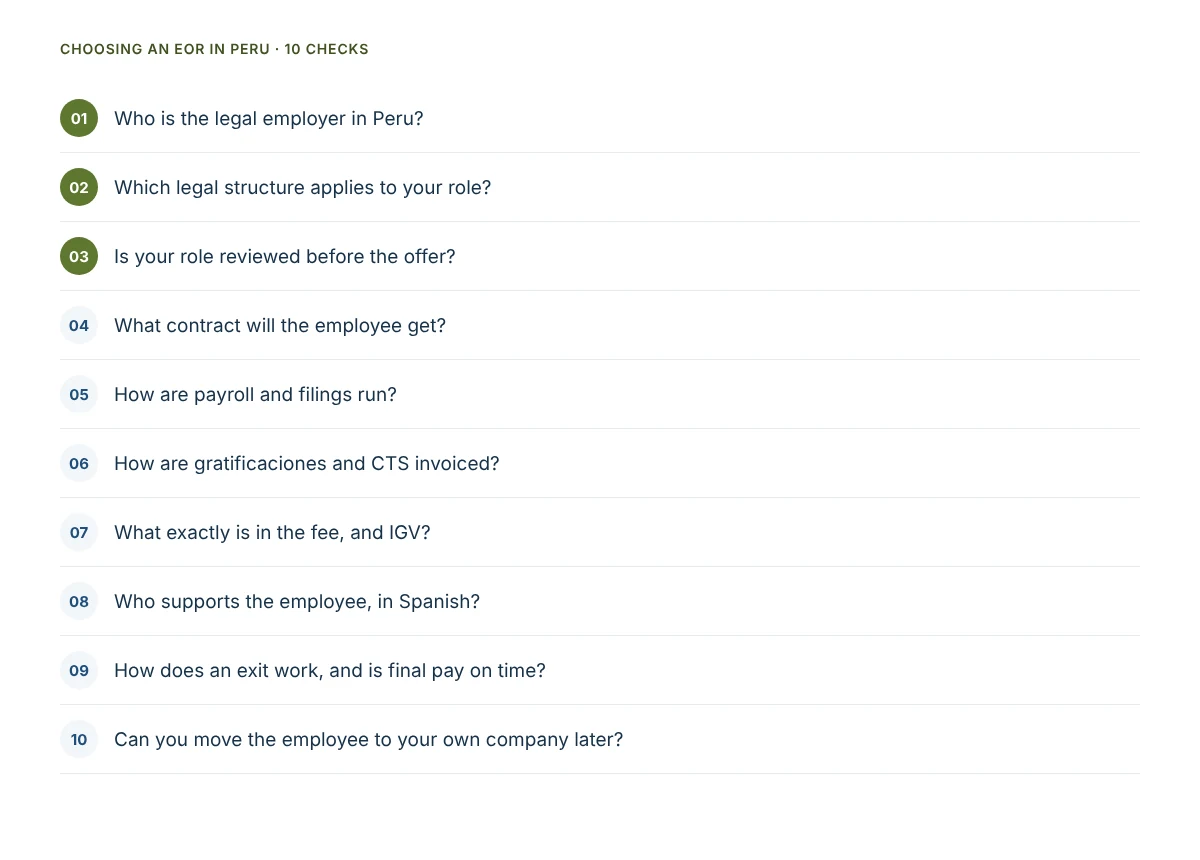
1. Who is the legal employer in Peru?
Ask for the name of the Peruvian company that will sign the employment contract and hold the RUC under which the employee is reported to SUNAT. A provider that cannot tell you before you sign is a risk.
2. Which legal structure will it use for your role?
Peru regulates labour intermediation (Law 27626) and outsourcing (Law 29245). Ask which one applies to your role, who will direct the work day to day, and what the limits are. A provider that calls every role “fully compliant” has not looked at yours.
3. Does it review the role before the offer?
The right answer depends on whether the role is temporary, specialised or ongoing, and whether it is part of your core business. That review should happen before the candidate receives an offer, not after.
4. What contract will the employee get?
Expect a written Spanish contract, a clear reason if it is fixed-term, probation agreed in writing and confidentiality and intellectual property clauses that protect you.
5. How are payroll and filings run?
Check that the provider registers the employee in T-Registro by the first day, files PLAME monthly, pays EsSalud, arranges Vida Ley from the first day and issues payslips on time.
6. How are gratificaciones and CTS handled and invoiced?
These are the biggest items after salary. Ask whether they are invoiced in the months they are paid or accrued monthly, so your budget does not jump in May, July, November and December.
7. What exactly is in the fee?
Ask for a line-by-line proposal: service fee, employment cost, IGV, the deposit and any one-off charges for onboarding, exits or contract changes.
8. Who supports the employee, and in which language?
Your employee will have questions about pay, leave and benefits. Check that someone answers in Spanish, quickly, and that personal data is handled under Peru’s data protection law.
9. How does an exit work?
Ask how the provider handles resignations and dismissals, how it documents a just cause, and whether final benefits are paid within the 48 hours the law requires.
10. Can you move the employee to your own company later?
If you plan to set up in Peru, ask how a transfer works, what happens to vacation and CTS, and whether there are exit fees.
Red flags
- No named Peruvian employer, or a reluctance to say which legal structure applies
- A promise that any role can run indefinitely under your direction, with no review
- A price that leaves out gratificaciones, CTS or IGV
- No written process for dismissals or final settlement
- Advice to put a long-term, full-time worker on a fee-receipt contract to save cost
How NNRoad answers these questions
We review every role before an offer, tell you in writing which structure we will use and who supervises what, confirm the employing entity and its RUC before you sign, and show every cost line in the proposal. Our Peruvian employing entity issues the Spanish contract, runs payroll in soles and handles gratificaciones, CTS and the exit. See our Peru employer of record service, or compare the options in EOR vs PEO vs GEO in Peru.
Questions about choosing a Peru EOR provider
What is the best employer of record in Peru?
There is no single best provider for every role. Look for one that names the Peruvian employer, uses a lawful structure for the work you need, runs payroll and year-end payments correctly and has a clear exit process, and compare on those points before price.
Is a Peru EOR service provider the same as a PEO?
In Peru, yes in practice. Peru has no co-employment PEO model, so “PEO” providers usually offer an employer of record service. EOR vs PEO vs GEO
How much should a Peru EOR cost?
Compare the full annual cost, not only the fee: salary plus about 37% in statutory costs, the service fee, IGV and the deposit. Peru EOR cost
Comparing EOR providers in Peru?
Ask us the same ten questions. We will answer them in writing, for your role, with a full cost proposal.