
Guide · Peru
Peru EOR Cost in 2026: Employer Costs, Bonuses and Worked Examples
Hiring through an employer of record in Peru costs the employee’s salary, the statutory employer costs and the provider’s service fee. The statutory part is larger than in many countries because Peru adds two extra salaries a year (the gratificaciones) and a severance savings deposit (CTS). Spread over a year, these add about 37% to salary.
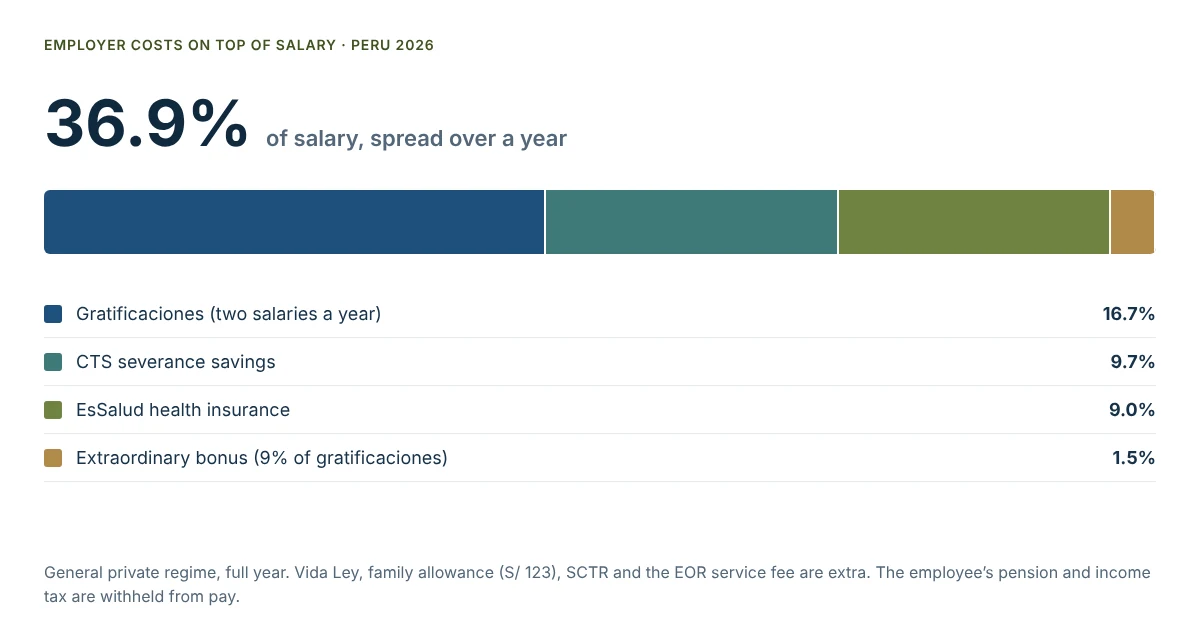
What you pay an EOR in Peru
| Item | What it is |
|---|---|
| Gross salary | The monthly pay agreed with the employee, in soles. At least S/ 1,230 a month from 1 October 2026. |
| Statutory employer costs | EsSalud, the two gratificaciones and their 9% bonus, CTS, Vida Ley life insurance, and the family allowance where it applies. |
| Service fee | The provider’s monthly fee per employee. Ask what it includes: contracts, payroll, filings, support and the exit process. |
| IGV | Peru’s 18% value added tax on the provider’s invoice, where it applies. |
| Deposit | Usually refundable, held until the service ends and final settlement is complete. |
Employer costs on top of salary in 2026
| Item | Rate or amount | Paid |
|---|---|---|
| EsSalud health insurance | 9% of monthly pay; the minimum base is the S/ 1,230 minimum wage, so at least S/ 110.70 | Monthly |
| Gratificaciones | One monthly salary for each full semester worked, in July and December | By 15 July and 15 December |
| Extraordinary bonus | 9% of each gratificación (6.75% where the employer uses a private health provider, EPS), paid to the employee | With each gratificación |
| CTS | Half of (monthly salary + one-sixth of the last gratificación), for each semester | By 15 May and 15 November |
| Vida Ley | Group life insurance premium, from the first day | Monthly |
| Family allowance | S/ 123 a month for employees with children under 18 (or older children in higher education) | Monthly |
| SCTR | Supplementary risk insurance for higher-risk activities | Monthly, where it applies |
Gratificaciones are exempt from EsSalud; the extraordinary bonus is paid to the employee instead. Sources: El Peruano, SUNAT payroll examples.
There is no employer pension contribution in Peru. The employee pays 13% to the ONP or roughly 11% to 13% to a private AFP, and fifth-category income tax, both withheld from gross pay.
Worked examples: annual cost for three salaries
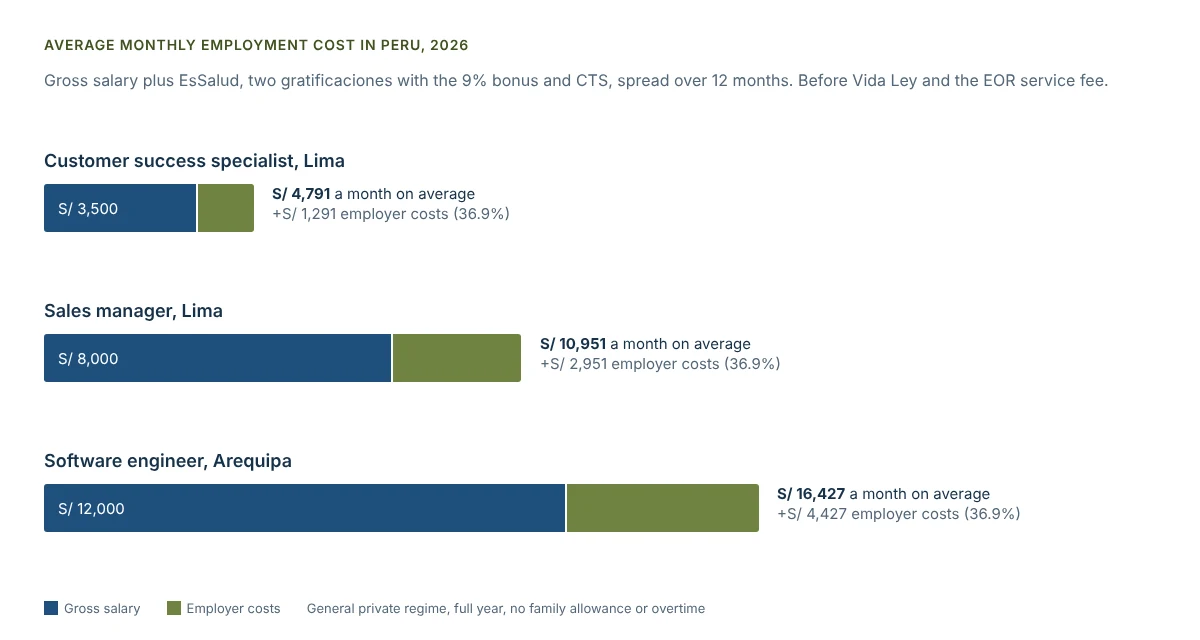
Assumptions: a full year in the general private regime, EsSalud (no EPS), no family allowance, overtime or profit sharing. Vida Ley, SCTR and the EOR service fee are not included.
| Role | Monthly salary | EsSalud (year) | Gratificaciones + 9% | CTS (year) | Total a year | Monthly average |
|---|---|---|---|---|---|---|
| Customer success specialist, Lima | S/ 3,500 | S/ 3,780 | S/ 7,630 | S/ 4,083 | S/ 57,493 | S/ 4,791 |
| Sales manager, Lima | S/ 8,000 | S/ 8,640 | S/ 17,440 | S/ 9,333 | S/ 131,413 | S/ 10,951 |
| Software engineer, Arequipa | S/ 12,000 | S/ 12,960 | S/ 26,160 | S/ 14,000 | S/ 197,120 | S/ 16,427 |
The monthly average is about 36.9% above the monthly salary in each case, because every item is a fixed percentage of pay.
When the money goes out
Peru’s employment cost is lumpy. Budget for four heavier months each year:
| Month | Extra payment on a S/ 8,000 salary |
|---|---|
| May | CTS deposit: about S/ 4,667 ((S/ 8,000 + S/ 1,333) ÷ 2) |
| July | Gratificación and bonus: S/ 8,720 |
| November | CTS deposit: about S/ 4,667 |
| December | Gratificación and bonus: S/ 8,720 |
The first deposits and gratificaciones are pro-rated if the employee joined during the semester.
The employee’s side, for the same S/ 8,000: about S/ 1,040 to the ONP and roughly S/ 740 of income tax withheld a month, leaving net pay of about S/ 6,220. An AFP member’s deduction differs slightly.
Other costs to plan for
- Overtime: at least 25% extra for the first two hours a day and 35% after that. Work on a rest day or holiday without a substitute day off is paid with a 100% surcharge.
- Vacation: 30 calendar days a year are already within the salary. Leave not taken in the year after it is earned costs an extra month’s pay.
- Night work: pay of at least the minimum wage plus 35%, so S/ 1,660.50 a month from October 2026.
- Profit sharing: employers with more than 20 workers share 5% to 10% of pre-tax profit, depending on the activity. Whether it applies depends on the employing company; ask your provider.
- End of employment: after probation, a dismissal without just cause costs 1.5 monthly salaries per year of service, capped at 12, on top of pending CTS, vacation and the pro-rata gratificación, or the employee may sue for reinstatement instead.
- Minimum wage changes: a second rise to S/ 1,300 is planned for 2027. See Peru minimum wage 2026.
EOR or your own company: the cost difference
The statutory employment cost is the same whoever employs the person. The difference is in the overheads. With an EOR you pay a service fee per employee and no set-up cost beyond a refundable deposit. With your own company you pay to incorporate, appoint a legal representative in Peru, keep a bank account, file monthly tax and payroll returns and keep accounts. For one to a few employees, an EOR is usually cheaper and faster; for a larger, permanent team, your own company usually becomes cheaper. See EOR vs PEO vs GEO in Peru.
Questions about EOR costs in Peru
How much does it cost to employ someone in Peru?
For a full-time employee in the general private regime, statutory employer costs add about 37% to salary over a year: EsSalud, two gratificaciones with a 9% bonus, and CTS. Vida Ley, any family allowance and the EOR service fee come on top.
What does an EOR cost in Peru?
You pay the employment cost plus a monthly service fee per employee, with IGV where it applies and usually a refundable deposit. We quote the fee after reviewing the role, with every line shown. Request a proposal
Are gratificaciones the same as a 13th and 14th salary?
In effect, yes. They are two legal bonuses of one monthly salary each, paid by 15 July and 15 December, plus a 9% extraordinary bonus.
Is CTS paid to the employee?
CTS is deposited into a bank account in the employee’s name in May and November. It works as a severance fund; the employee can draw on part of it, and the balance is released when employment ends.
Does the employer pay pension contributions in Peru?
No. Pension contributions to the ONP or an AFP are paid by the employee and withheld by the employer.
Want the full cost of your hire?
Send us the role, location and salary. We will send the annual employment cost in soles and US dollars and our service fee, before you commit.