
Guide · Peru
EOR vs PEO vs GEO in Peru: How to Hire Without a Local Entity
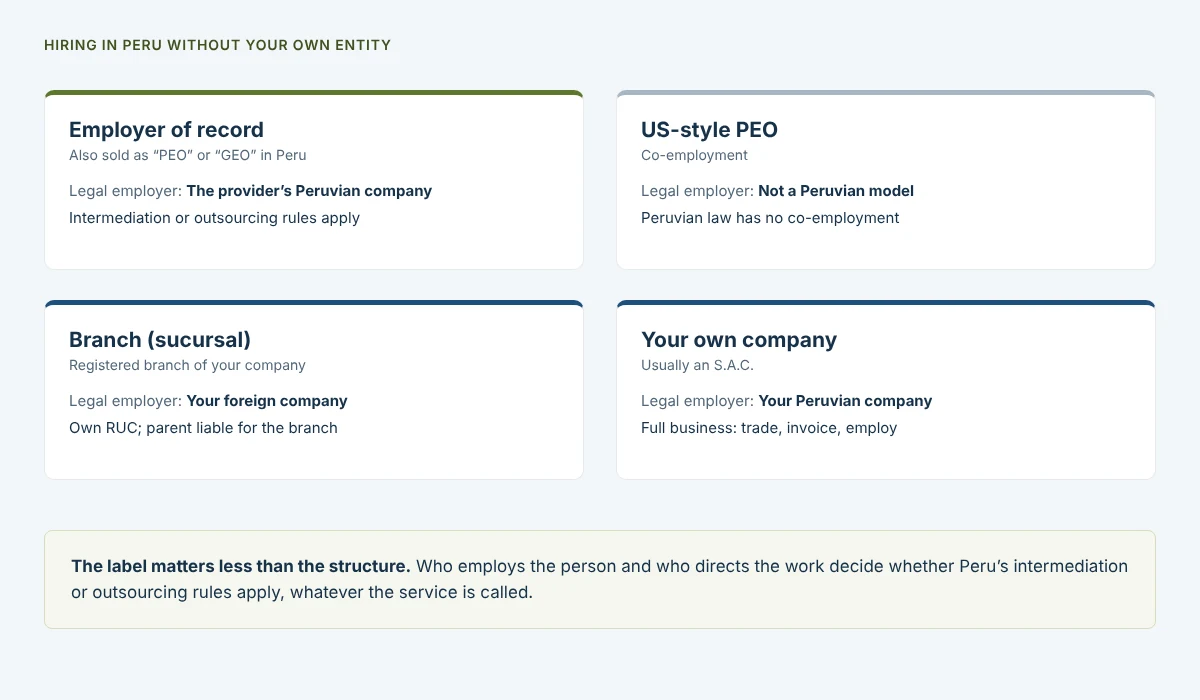
A foreign company without a Peruvian entity can still employ people in Peru through an employer of record (EOR): a Peruvian company that employs the person, runs payroll, pays EsSalud and withholds pension and income tax. “PEO” and “GEO” are other names for similar services. In Peru, two facts decide the legal treatment: which company employs the person, and who directs the work. They decide whether the labour intermediation or the outsourcing rules apply.
Six ways to employ or engage people in Peru
| Route | Who employs | Good for | Watch out for |
|---|---|---|---|
| Your own Peruvian company (usually an S.A.C.) | Your subsidiary | A growing team, local sales, any role for any length of time | SUNARP registration, RUC, a legal representative in Peru, monthly tax and payroll filings |
| Branch of your foreign company | Your foreign company, through the registered branch | Projects or operations run directly by the parent | The parent is liable for the branch; same filing duties as a company |
| EOR: temporary staffing (Law 27626) | The provider’s Peruvian company | Cover for an absent employee, or an occasional need outside your usual business, which you direct | Registered providers only; up to six months a year for occasional needs; no permanent core work; temporary staff capped at 20% of your workforce |
| EOR: managed service (Law 29245) | The provider’s Peruvian company | Ongoing work the provider delivers and supervises, such as a support or back-office function | You agree deliverables, not daily tasks; the provider needs its own resources and responsibility for results |
| Payroll outsourcing | Your own Peruvian company | Companies that already employ staff in Peru | You remain the employer and carry the obligations |
| Independent contractor | No one: a services contract | A defined project by a genuinely independent professional who issues fee receipts | Treated as employment if there is personal service, pay and subordination, whatever the contract says |
Professional employer organization (PEO) and global employment organization (GEO) in Peru
Employer of record (EOR) means a provider that is the legal employer of your staff in another country. Professional employer organization (PEO) comes from the United States, where it describes co-employment: the client stays an employer and the PEO shares HR and payroll duties. Peru has no co-employment model, so a provider that calls itself a “PEO in Peru” is usually offering an EOR-type service. Global employment organization (GEO) usually means a multinational’s own employing company for staff it sends abroad; some providers use the term for an EOR service.
Peruvian law uses none of these terms. It knows the employer, the employment contract, labour intermediation (intermediación laboral), outsourcing (tercerización) and civil services contracts. Courts look at what actually happens, not at the contract’s title. So whatever a provider calls itself, ask three questions:
- Which Peruvian company signs the employment contract and reports the employee to SUNAT?
- Under which legal structure will the work be organised, and who directs it day to day?
- Does your role fit that structure: how long is it needed, and is it part of your core business?
Is an employer of record legal in Peru?
Yes, if it is set up as lawful labour intermediation or outsourcing. Peru regulates these two arrangements in which one company’s staff serve another business, and an EOR has to fit one of them:
| Labour intermediation | Outsourcing | |
|---|---|---|
| Law | Law 27626 | Law 29245 |
| Who directs the work | The client, only for temporary work (cover for an absent employee, or an occasional need outside its usual business, up to six months a year). For complementary or highly specialised services, the provider | The provider, with its own staff under its exclusive direction |
| What it can cover | Occasional needs, cover for absent staff, non-core support services, highly specialised services | A defined part of the client’s activity, delivered at the provider’s own account and risk |
| Main limits | Registered service companies only; no permanent performance of the client’s core activity; temporary staff up to 20% of the client’s workforce; equal pay | Own resources and responsibility for results; registration and joint liability when staff work continuously at the client’s premises |
| If the rules are not met | The worker is treated as the client’s employee from the first day | The worker is treated as the client’s employee from the start |
A label such as “consulting” or “services” does not change the analysis if your team supervises the person in practice. The detail is in our article on whether an employer of record is legal in Peru.
When an EOR fits, and when it does not
An EOR usually fits when
- You need cover for an absent employee, or an occasional task outside your usual business
- The work can be delivered as a defined service, such as support or back-office work, that the provider supervises
- You want a small team in Peru delivering such a service while you decide on an entity
- You want payroll, EsSalud, gratificaciones and CTS handled correctly from the first month
Consider another route when
- You want people on your core business, under your own management, for years: set up a company
- You will sell and invoice in Peru continuously: you need a RUC of your own
- The person is a genuinely independent professional with several clients: a services contract may fit
- The person is a foreign national: the foreign-worker rules apply
Costs and timing compared
| Employer of record | Your own company | |
|---|---|---|
| Time to first hire | Usually about five business days once the role is approved | Several weeks to set up, then employer registration |
| Upfront commitment | A refundable deposit; no company to maintain | Incorporation costs, a legal representative, bank account, accounting |
| Monthly cost | Service fee per employee plus employment cost | Employment cost plus accounting, payroll and company compliance |
| Statutory employment cost | The same in both cases: EsSalud, gratificaciones, CTS and Vida Ley | The same |
| Exit | Notice under the service agreement; employment ended on a lawful ground or transferred | Dismissals, liquidation of the company if you leave Peru |
Questions about EOR, PEO and GEO in Peru
What is a professional employer organization (PEO) in Peru?
In Peru, providers that call themselves a PEO normally offer an employer of record service: their Peruvian company employs your staff. Peru has no co-employment model in which you and the provider are both employers.
What is a global employment organization (GEO) in Peru?
GEO usually means an employing company a multinational sets up to employ staff it sends to other countries. Some providers use GEO as another name for an EOR service. In Peru the legal questions are the same: who employs the person and who directs the work.
Can I hire in Peru without a local entity?
Yes, through an employer of record, within Peru’s intermediation and outsourcing rules, or by engaging a genuinely independent contractor. You cannot employ someone directly from abroad, because an employer needs a RUC and must report the employee to SUNAT.
Do I need a Peruvian entity to sell in Peru?
Not to sell from abroad, but Peruvian customers withhold income tax on payments for services performed in Peru, and for technical assistance or digital services used in Peru even if delivered from abroad. If you sell and invoice in Peru regularly, or your staff conclude contracts for you, you may need your own company or branch. More on doing business in Peru
How do I choose between EOR providers in Peru?
Ask who the employer is, which legal structure the provider uses for your role, and what happens at the end of the year and at exit. Ten checks before you sign
Not sure which route fits your hire?
Tell us the role, where the person will work and how long you need them. We will tell you which structure fits and what it costs.