
Insights
How to Hire Employees in Brazil: A 2026 Guide for Overseas Companies
Insights · By Chen ChunJie · Updated 24 October 2026
To hire an employee in Brazil you need an employer registered in Brazil, a CLT employment contract in Portuguese, an eSocial admission record before the first day, and monthly payroll in reais with INSS, income tax and FGTS. If your company has no Brazilian entity, an employer of record can be that employer for you.
Last reviewed in October 2026 against the CLT, Law 6,019/1974, Constitutional Amendment 141/2026 and official eSocial, INSS and FGTS sources. General information, not legal or tax advice.
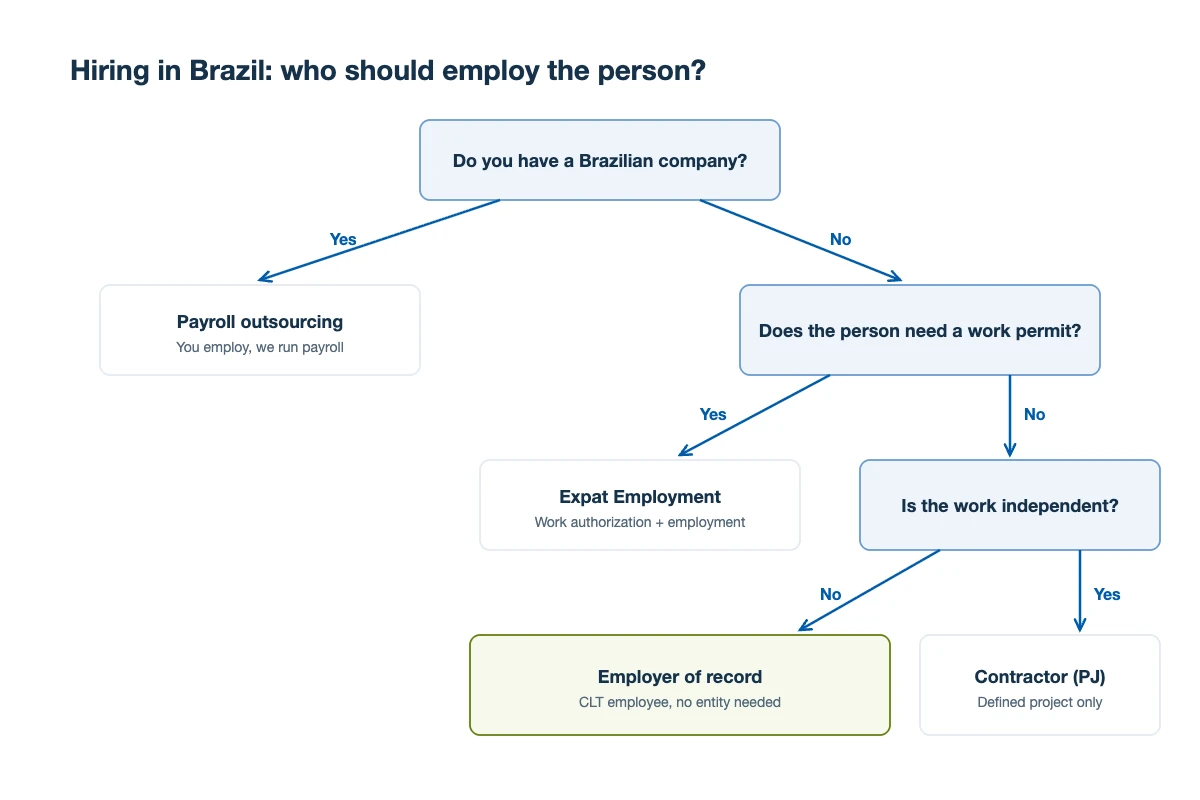
Step 1: Decide who will employ the person
An overseas company cannot put a Brazilian resident on its home payroll. Someone registered in Brazil has to be the employer.
| Option | When it fits |
|---|---|
| Your own Brazilian company | A growing team, local customers to invoice, or a licensed activity |
| An employer of record | One or a few employees, no Brazilian company yet. See Employer of Record in Brazil |
| Payroll outsourcing | You already have an entity. See Brazil payroll |
| An independent contractor (PJ) | Genuinely independent project work. See On-Demand Talent |
For a closer comparison, read EOR vs PEO in Brazil.
Step 2: Check identity and the right to work
Every employee needs a CPF (the individual taxpayer number) and a digital work booklet (CTPS Digital), which is linked to the CPF. Brazilian citizens can work without further permission. Foreign nationals need a residence status that allows work, such as permanent residence or a work-related residence authorization.
NNRoad’s Brazil EOR service covers Brazilian citizens and foreign nationals who already have the right to work. If the person still needs authorization, see Expat Employment in Brazil.
Step 3: Find the collective agreement and set the pay
Most employees are covered by a collective agreement (convenção coletiva, CCT) negotiated by the unions for their category and city. It sets salary floors, an annual adjustment date (data-base) and often benefits such as meal vouchers. Check it before you make an offer.
The national minimum wage is R$1,621 a month in 2026. Salaries must be paid in reais, monthly, by the 5th working day of the following month.
Step 4: Budget for the costs on top of salary
Employer INSS (20%), work-accident insurance (1–3%, adjusted by the FAP factor), third-party contributions (about 5.8%) and FGTS (8%) add roughly 35%–37% to monthly pay. With the 13th salary and the one-third vacation bonus, a typical office role costs about 50% more than twelve months of base salary, before benefits. See Brazil EOR cost or try the Brazil labor cost calculator.
Step 5: Write the contract
The default is an indefinite-term CLT contract, written in Portuguese. Fixed-term contracts are allowed only in limited cases and for up to two years.
- Job title and duties, workplace or remote arrangement, and working hours
- Salary, variable pay and benefits
- Probation: an experience contract of up to 90 days in total
- Confidentiality, data protection (LGPD) and, for technical roles, intellectual property
Step 6: Register the employee and set up payroll
Before the first working day the employer completes an admission medical exam (ASO) and sends the admission record to eSocial, the government’s employment reporting system.
Each month the employer calculates gross-to-net pay, withholds employee INSS (7.5%–14%) and income tax, pays the salary, and files payroll through eSocial and DCTFWeb. FGTS is paid through FGTS Digital by the 20th of the following month. From 2026, monthly income up to R$5,000 is effectively exempt from income tax, with a partial reduction up to R$7,350 (Law 15,270/2025).
Step 7: Working hours, leave and holidays
| Topic | The rule |
|---|---|
| Hours | 8 a day and 44 a week today; 42 from 16 December 2026 and 40 from 16 December 2027 (Constitutional Amendment 141/2026), with two paid rest days a week |
| Overtime | At least 50% extra, usually up to 2 hours a day |
| Vacation | 30 days per year of service, with a one-third bonus |
| 13th salary | One extra month’s pay, in two instalments by 30 November and 20 December |
| Maternity leave | 120 days (180 with the Empresa Cidadã programme) |
| Paternity leave | 5 days today; 10 in 2027, 15 in 2028 and 20 in 2029 (Law 15,371/2026) |
| Holidays | National public holidays plus state and municipal ones, which depend on where the employee works |
Step 8: If the employee works remotely
Remote work (teletrabalho) is regulated by the CLT and must be written into the contract, including who provides and pays for equipment and internet. The employee stays covered by Brazilian law and by the collective agreement for their location. Brazil’s main business hubs are on UTC−3, which gives a full working-day overlap with New York and a morning overlap with Europe.
Step 9: Ending the employment
After probation, the employer gives 30 days’ notice plus 3 days for each full year of service, up to 90 days. Without just cause, the employer also pays a penalty of 40% of the employee’s FGTS balance. Some employees are protected from dismissal for a period, for example during pregnancy and for five months after birth, or for 12 months after returning from a work accident. The final settlement is due within 10 days.
Hiring checklist for Brazil
- Employer chosen: own company, EOR or payroll provider
- Right to work and CPF confirmed
- Collective agreement checked and salary set in reais
- Budget includes charges, 13th salary, vacation bonus and benefits
- CLT contract in Portuguese, with remote-work terms if relevant
- Admission medical exam and eSocial registration before day one
- Payroll calendar and FGTS Digital set up
- Equipment, access and onboarding plan ready
Questions about hiring in Brazil
Can a foreign company hire employees in Brazil without a local entity?
Yes, through an employer of record, which employs the person in Brazil under the CLT. See Employer of Record in Brazil.
How long does it take to hire an employee in Brazil?
Once a candidate accepts, onboarding mostly depends on documents and the admission medical exam. Recruiting the candidate usually takes much longer than the onboarding itself.
Do employment contracts in Brazil have to be in Portuguese?
Yes, the contract the employee signs should be in Portuguese. A bilingual version is common for overseas managers.
Can I pay a Brazilian employee in US dollars?
No. Salaries must be paid in reais.
Can I hire someone in Brazil as a contractor instead?
Only for genuinely independent work. Full-time work under your direction is likely to be treated as employment. See On-Demand Talent in Brazil.
Hiring your first employee in Brazil?
If you do not have a Brazilian company yet, NNRoad can employ your hire in Brazil and run payroll, benefits and compliance for you.
Related
Sell, hire and operate before you incorporate.
Employment options, costs and set-up for technical hires.