
Guide · Brazil
Brazil EOR Cost: What You Pay Each Month
Guide · Updated 24 October 2026
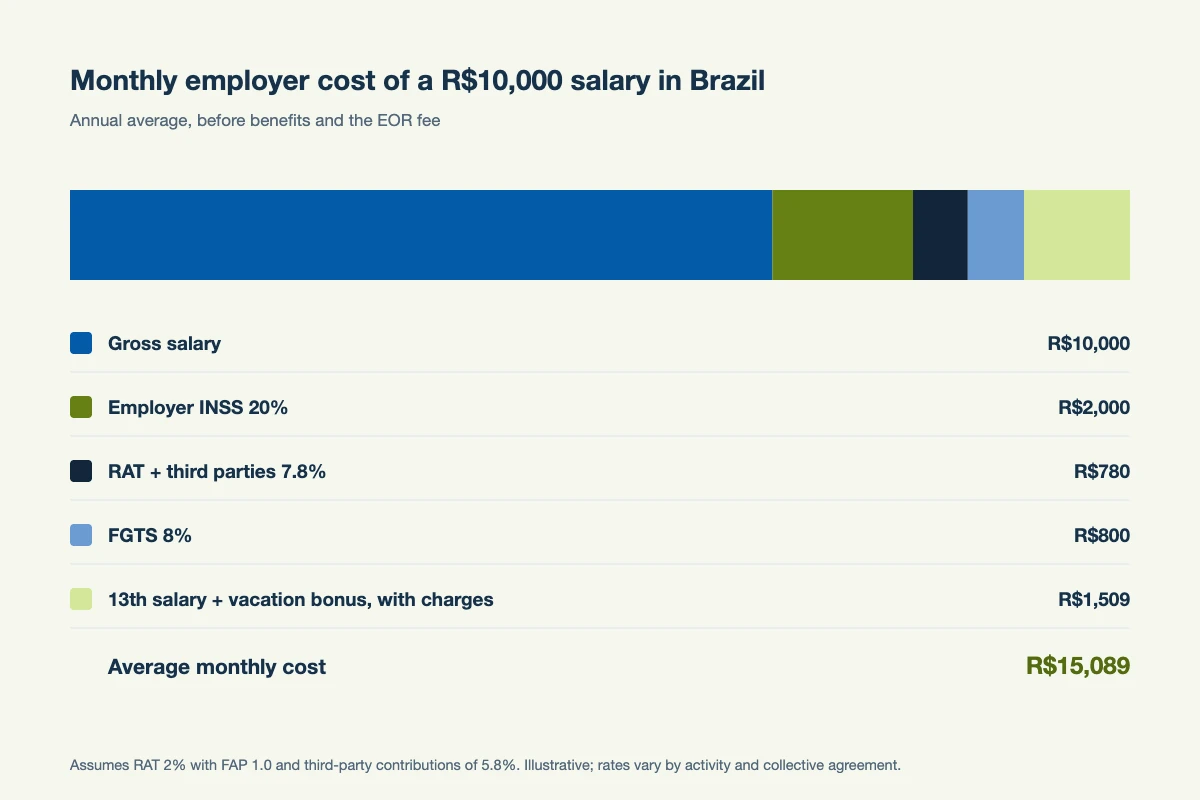
An employee hired through an employer of record in Brazil costs you three things each month: the gross salary, the employer’s statutory charges and accruals, and the EOR service fee. For a typical office role, charges plus the 13th salary and the vacation bonus add about 50% to twelve months of base salary, before benefits and the fee.
Last reviewed in October 2026 against the CLT, Law 6,019/1974, Constitutional Amendment 141/2026 and official eSocial, INSS and FGTS sources. General information, not legal or tax advice.
The three parts of a Brazil EOR bill
- Salary. The gross monthly salary you agree with the employee, paid in reais. It must respect the national minimum wage (R$1,621 a month in 2026) and the floor in the collective agreement for the role.
- Statutory employer costs. Social security, work-accident insurance, third-party contributions and FGTS, plus the 13th salary and the one-third vacation bonus, which the employer accrues every month.
- The EOR service fee. A monthly fee per employee for employing, paying and administering the person in Brazil. NNRoad quotes it after reviewing the role.
Employer contributions in 2026
Employer charges in Brazil have no salary ceiling, so they apply to the full payroll. The rates below assume a company outside the Simples Nacional regime, which is the usual position for an employer of record.
| Contribution | Rate | Notes |
|---|---|---|
| Employer INSS (social security) | 20% | On total pay, including the 13th salary and vacation pay |
| RAT (work-accident insurance) | 1%, 2% or 3% | Set by the activity code, then multiplied by the FAP factor (0.5 to 2.0) |
| Third-party contributions | About 5.8% | Education allowance (2.5%), INCRA and the “S System” bodies; varies by activity |
| FGTS | 8% | Deposited monthly into the employee’s FGTS account through FGTS Digital |
| Total charges | About 35%–37% | Before the 13th salary and vacation bonus accruals |
Sources: Law 8,212/1991, art. 22; Law 8,036/1990, art. 15. The employee also contributes 7.5%–14% to INSS on pay up to R$8,475.55 a month in 2026, and pays income tax withheld at source. These come out of the gross salary, not on top of it.
Three details that change the number
- Activity code and FAP. They set the RAT rate. Office services usually sit at the low end.
- Collective agreement. It can require meal or food vouchers, life insurance or other benefits, and sets the annual pay adjustment date.
- How you pay variable compensation. Commission and most bonuses are salary and attract the same charges.
The 13th salary and the vacation bonus
Every employee in Brazil receives a 13th salary equal to one month’s pay, in two instalments: the first by 30 November and the second by 20 December. Each year of service also earns 30 days of paid vacation, paid with a bonus of one third of a month’s pay. Vacation pay itself is already part of the twelve monthly salaries; the one-third bonus is the extra cost.
Both attract INSS and FGTS. In a monthly invoice they are usually accrued as about 8.33% (13th salary) and 2.78% (vacation bonus) of salary, plus charges on top, so the cash does not land on you all at once in November and December.
Other employer costs in Brazil
- Transport voucher (vale-transporte). The employer pays the cost of commuting by public transport above 6% of the employee’s base salary.
- Meal or food vouchers. Required by many collective agreements and expected in most cities. Paid as vouchers, they do not attract INSS or FGTS.
- Health and dental plans. Not required by law, but standard for professional roles and an important part of a competitive offer.
- Occupational health. Admission, periodic and exit medical exams under the occupational health programme.
- Overtime and allowances. At least 50% extra per overtime hour, and night or hazard allowances where they apply.
How NNRoad quotes a Brazil EOR
We do not publish a standard price list, because the cost of a Brazilian hire depends on the role, the city and the collective agreement. Your proposal shows:
- the full employment cost, line by line, passed through at cost;
- NNRoad’s monthly service fee per employee;
- any one-time set-up item and the refundable deposit;
- how invoices work: one invoice a month in US dollars, on the dates in the working calendar, with the exchange rate shown.
Three worked examples
The examples assume RAT of 2% with a FAP of 1.0, third-party contributions of 5.8% and FGTS of 8% (35.8% in total), with benefits as shown. They exclude the EOR fee, overtime and any termination costs.
| Role | Gross salary | Monthly charges | Benefit assumed | Average monthly cost over a year | Above salary |
|---|---|---|---|---|---|
| Sales manager, São Paulo | R$8,000 | R$2,864 | Meal voucher R$1,000 | R$13,071 | 63% |
| Software engineer, remote | R$15,000 | R$5,370 | Health plan R$900 | R$23,533 | 57% |
| Country manager, São Paulo | R$30,000 | R$10,740 | Health plan R$1,500 | R$46,767 | 56% |
The average monthly cost spreads the 13th salary and the vacation bonus, with their charges, across twelve months. Figures are rounded and for planning only.
The yearly view, and when the money leaves
- Every month: salary by the 5th working day of the following month; INSS and income tax (through DCTFWeb) and FGTS (through FGTS Digital) by the 20th.
- Vacation month: vacation pay plus the one-third bonus, paid two days before the vacation starts.
- November and December: the two 13th-salary instalments.
- On the collective agreement’s date: the annual pay adjustment, often in line with inflation.
What it costs to end an employment
If the employer ends an indefinite contract without cause, it pays notice (30 days plus 3 days per full year, up to 90), the pro-rata 13th salary, accrued vacation with the one-third bonus, and a penalty of 40% of the employee’s FGTS balance. A mutual agreement under CLT article 484-A halves the notice and the FGTS penalty. Resignations and dismissals for just cause cost less. The settlement is due within 10 days of the last day.
EOR or your own Brazilian company?
Opening a Brazilian company (a limitada) means a local administrator, a registered address, an accountant, eSocial and tax registrations, and ongoing bookkeeping, before the first hire. For one to a few employees, or while you test the market, an EOR is usually cheaper and faster. Once you need to invoice Brazilian customers or the team grows, your own entity can make sense. See doing business in Brazil without a company.
Questions about Brazil EOR cost
How much does it cost to employ someone in Brazil?
For a typical office role, about 50% on top of twelve months of base salary once employer charges, the 13th salary and the vacation bonus are included, before benefits and any provider fee.
What is included in NNRoad’s monthly service fee?
Employing the person in Brazil: the CLT contract, eSocial registration, monthly payroll and filings, the 13th salary, vacation and leave administration, employee support in Portuguese and the final settlement when the job ends.
Do I pay in reais or US dollars?
The employee is paid in reais, as Brazilian law requires. You pay NNRoad one monthly invoice in US dollars.
Is there a deposit?
Yes. We hold a refundable deposit, shown in your proposal, which is returned once the final payroll and every obligation have been settled.
How much does it cost to end an employment in Brazil?
Ending without cause means notice, the pro-rata 13th salary, accrued vacation with the bonus, and a 40% FGTS penalty. We calculate it before you decide.
Want the numbers for your own hire?
Send us the role, city and salary and we will reply with a line-by-line estimate in reais and US dollars.
Related
How NNRoad employs and pays your Brazilian hire.
Model employer cost and net pay for any salary.