
Guide · Brazil
EOR vs PEO in Brazil: Hiring Without Your Own Entity
Guide · Updated 24 October 2026
In Brazil, “PEO”, “EOR” and “global employment organization” describe the same commercial service: a Brazilian company employs a person under the CLT and provides their work to an overseas business. The US model of co-employment does not exist in Brazilian law, so the real questions are who signs and registers the employment, and how the service is structured.
Last reviewed in October 2026 against the CLT, Law 6,019/1974, Constitutional Amendment 141/2026 and official eSocial, INSS and FGTS sources. General information, not legal or tax advice.
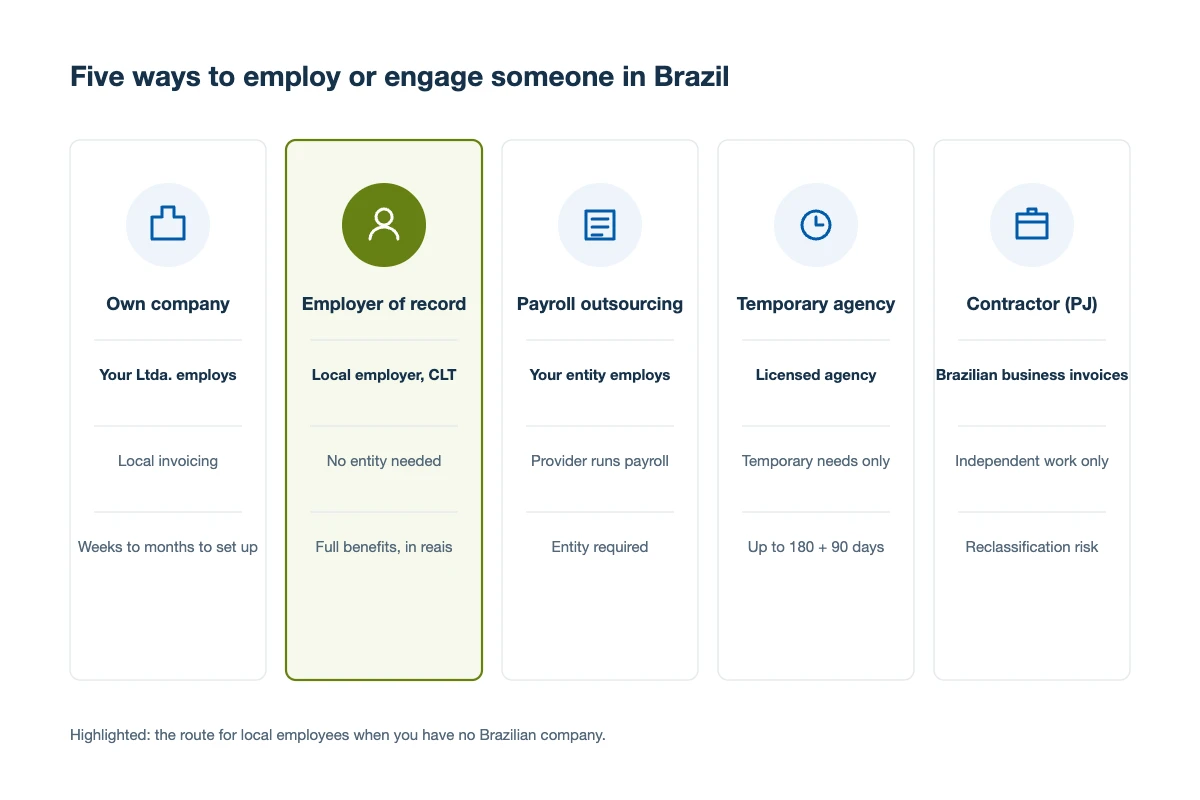
The ways to employ or engage someone in Brazil
| Route | Who employs or contracts | When it fits |
|---|---|---|
| Your own Brazilian company | Your limitada, registered with a CNPJ | A growing team, local customers to invoice, or a licensed activity |
| Employer of record (EOR, “PEO”, “GEO”) | The provider’s Brazilian entity, under the CLT | One or a few employees without your own company; testing the market |
| Payroll outsourcing | Your Brazilian company; the provider only runs payroll | You already have an entity and want payroll and filings handled |
| Temporary staffing agency | A licensed temporary-work agency (Law 6,019/1974) | A temporary need or peak, limited to 180 days plus up to 90 |
| Independent contractor (PJ) | Nobody employs; a Brazilian business invoices you | A defined project, with real autonomy, own tools and other clients |
Why the word “PEO” causes confusion in Brazil
In the US, a professional employer organization (PEO) shares employer duties with a client that already has its own local entity. Brazil has no legal concept of co-employment: there is one employer, registered on eSocial, responsible for the contract, pay and every statutory obligation.
So when overseas companies search for a “Brazil PEO”, a “PEO firm in Brazil” or a “global employment organization in Brazil”, what they are looking for in practice is an employer of record. Ask any provider which Brazilian entity will sign the CLT contract and register the employee, and which responsibilities the service covers.
How an EOR is structured under Brazilian law
Since the 2017 reforms, Law 6,019/1974 allows a company to provide services to another using its own employees, including for the client’s core activity. Three rules shape how an EOR arrangement has to work:
- The provider directs its employees. The service company “hires, pays and directs the work” of its workers (art. 4-A, §1). In practice the provider takes on an agreed scope of work, and the client defines what it needs and receives the results.
- Stay within the agreed scope. The client may not use the workers for activities outside the services contracted (art. 5-A, §1).
- Shared liability. The client is secondarily liable for labour obligations and social security during the service (art. 5-A, §5), so a provider that pays and files correctly every month protects you too.
This is why NNRoad sets up each Brazil hire as a defined scope of work, with approvals and reporting lines agreed at onboarding. See how our Brazil EOR works.
When an EOR fits, and when it does not
EOR usually fits when
- You need one or a handful of employees in Brazil
- You want to test the market before opening a company
- The person should have a CLT contract and full benefits
- You need to start in weeks, not months
Look at another route when
- You will invoice Brazilian customers or import goods
- The employee would sign contracts in your company’s name
- You are building a larger, permanent local operation
- The work is a genuine independent project
Hiring a foreigner instead?
A foreign national who does not yet have the right to work in Brazil needs a work-related residence authorization before starting. That is a separate process with its own documents and timing. See Expat Employment in Brazil.
Who does what under a Brazil EOR
| Task | EOR provider | Your company |
|---|---|---|
| Employment contract and eSocial registration | Yes | — |
| Payroll, INSS, IRRF and FGTS | Yes | Funds the monthly invoice |
| 13th salary, vacation, leave records | Yes | Approves leave requests |
| Defining the work and deliverables | Agrees the scope with you | Yes |
| Working-time records and policies | Yes | Sends approvals by the cut-off |
| Termination and final settlement | Yes | Decides and informs the provider first |
Moving from EOR to your own company
When you open a Brazilian company, employees can move across through an agreed transfer. Plan the date with your provider, so the final payroll, accrued vacation, the 13th salary and FGTS are handled correctly and the employee’s service history is respected.
Questions about EOR and PEO in Brazil
Is PEO legal in Brazil?
Co-employment as it works in the US is not a Brazilian legal concept. A service in which a Brazilian company employs a person and provides their work to your business is legal when it is structured under Law 6,019/1974 and the CLT.
Can a PEO legally employ workers in Brazil or Argentina, or do I need an EOR?
In both countries, what you need is a local, registered employer. Providers may call themselves PEO, EOR or GEO; check which local entity employs the person and how the service is structured under local law.
Is an EOR the same as a staffing agency?
No. A temporary-work agency covers temporary needs for up to 180 days plus 90. An EOR employs people on standard CLT contracts for as long as the service runs.
What is a global employment organization (GEO)?
Another name for an employer of record, used by some providers. In Brazil it works the same way.
How long can we use an EOR in Brazil?
There is no fixed legal limit for a service arrangement. Many companies use an EOR until the team or local revenue justifies their own company.
How much does an EOR cost in Brazil?
Employment cost plus a monthly service fee. See Brazil EOR cost for worked examples.
Not sure which model fits your hire?
Tell us about the role and the person. We will confirm the right route in Brazil and what it costs.
Related
Hire employees in Brazil without opening a company.
Ten checks to make before you sign.