
Insights
How to Hire Employees in Egypt: A 2026 Guide for Overseas Companies
Insights · By Chen ChunJie · Published 25 October 2026
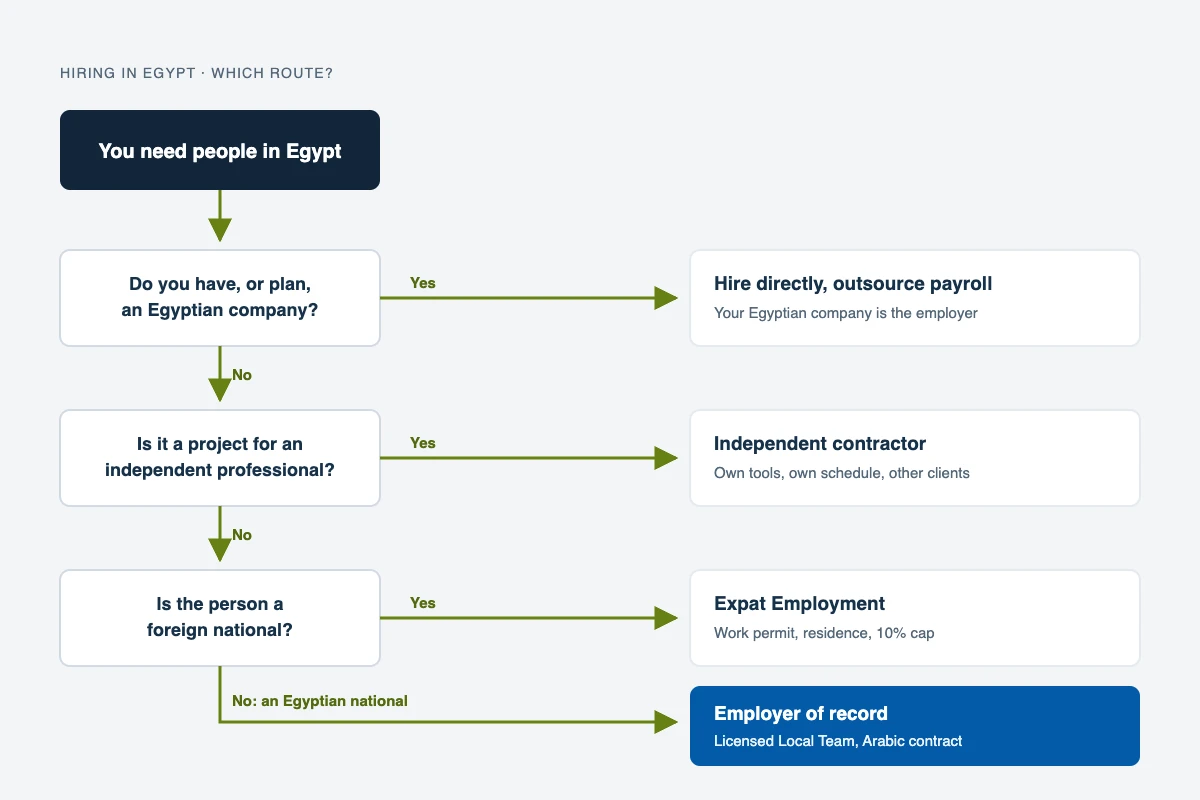
To hire an employee in Egypt you need an employer registered in Egypt, a written Arabic employment contract under Labour Law 14 of 2025, registration with the National Organization for Social Insurance, monthly payroll with salary tax withheld, and a work permit for any foreign national. A company without an Egyptian entity can hire through a licensed employer of record, set up its own company, or engage genuinely independent contractors. Using workers supplied by an unlicensed contractor is not allowed.
Last reviewed in October 2026 against Labour Law 14 of 2025, Social Insurance Law 148 of 2019, Income Tax Law 91 of 2005 as amended, and Ministerial Decree 279 of 2025 on foreign workers. General information, not legal or tax advice.
Step 1: Decide who will employ the person
Employer registration with social insurance and the tax authority requires a registered presence in Egypt, so the first decision is who signs the contract.
| Route | When it fits | Watch out for |
|---|---|---|
| Your own Egyptian company (LLC or branch) | A growing team, Egyptian customers to invoice, or managers based in Egypt | Set-up time, an Egyptian manager for an LLC, bookkeeping and running payroll yourself or through a payroll provider |
| Licensed employer of record | You want to hire now without registering a company | When you direct the work, the provider must hold the licence Labour Law 14 of 2025 requires; ask to see how it is structured |
| Independent contractor | A defined project by a professional with their own business, tools and other clients | Work done personally under your supervision and control for pay is employment under Article 9, whatever the contract says |
Still deciding whether to set up a company? Read operating in Egypt without a company. To hire without your own entity, see employer of record in Egypt.
Step 2: Check the right to work
- Egyptian nationals can be hired once the contract is signed and social insurance registration is done.
- Foreign nationals may not start work until they hold a work permit from the Ministry of Labour and are authorised to reside in Egypt for work.
- The 10% rule: under Ministerial Decree 279 of 2025, foreign workers may make up no more than 10% of an employer’s workforce, with limited exceptions. Short tasks of up to 14 days need separate prior approval.
Hiring a foreign national? Confirm the permit route and the employer’s quota before you make an offer. See Expat Employment in Egypt.
Step 3: Put the contract in writing
- Arabic and in four copies: one each for the employer, the employee, the social insurance office and the labour office. A non-Arabic speaker can receive a bilingual version, but the Arabic text prevails.
- Contract type: indefinite contracts are the norm. A fixed-term contract needs work whose nature justifies it, and a fixed-term contract that continues after it ends without a written renewal becomes indefinite.
- Probation: up to three months, and only once with the same employer.
- Work models: remote, part-time and flexible work are recognised by the new law; write the arrangement into the contract.
Step 4: Set the pay
- Minimum wage: EGP 7,000 a month in the private sector since March 2025.
- Annual increase: at least 3% of the insurable wage every year.
- Payment: salaries are normally paid monthly in Egyptian pounds; bank transfer is expressly allowed.
- Overtime: at least 35% extra by day and 70% at night.
Estimate employer cost and net pay with our Egypt salary calculator.
Step 5: Register the employee and run payroll
| Item | Who pays | Position in 2026 |
|---|---|---|
| Social insurance | Employer 18.75%, employee 11% | On insurable wages between EGP 2,700 and EGP 16,700 a month |
| Salary tax | Employee, withheld by the employer | 0% to 27.5% after a EGP 20,000 personal exemption; see the Egypt salary tax guide |
| Martyrs Fund | Employee, withheld by the employer | 0.05% of gross monthly salary |
| Training fund | Employer with 30 or more workers | 0.25% of the minimum insurable wage per worker, EGP 10 to 30 a month |
Already have an Egyptian company? Our Egypt payroll service runs withholding and filings for you.
Step 6: Plan working time and leave
| Rule | Position in 2026 |
|---|---|
| Working time | 8 hours a day and 48 hours a week, with at least one hour of rest and no more than 5 hours of continuous work |
| Annual leave | 15 days in the first year, 21 days after that, 30 days after 10 years or from age 50; 45 days for employees with disabilities |
| Maternity leave | 4 months of paid leave, up to three times during employment |
| Paternity leave | The day of the child’s birth, up to three times |
| Sick leave | Paid according to the rates and periods of the social insurance law, on certification by the competent medical authority |
Step 7: End employment correctly
For indefinite contracts, the notice period is three months whatever the length of service. Termination needs a legitimate reason; without one, the employer owes at least two months’ pay for each year of service. Ending a fixed-term contract early can also trigger compensation. Resignations are approved through the competent labour authority, and the employee may withdraw a resignation within 10 days of being told it was accepted. Unused annual leave is paid out on exit.
How to choose an EOR in Egypt
Rankings of the “best EOR in Egypt” rarely test the questions that matter under Egyptian law. Before you sign with any employer of record, professional employer organization (PEO) or global employment organization, ask:
- Which Egyptian entity signs the contract, and does it hold the licence the law requires if you direct the work?
- Are contracts and policies written under Labour Law 14 of 2025, not the repealed Law 12 of 2003?
- How does the provider handle the three-month notice period, resignations and the annual increase?
- Does the proposal show salary, social insurance, any statutory funds, benefits and the service fee separately?
- Can the provider support foreign hires within the 10% limit, and what happens if you later move the employee to your own company?
See how we answer them on our Egypt employer of record page.
FAQ: hiring in Egypt
Can I hire someone in Egypt without an Egyptian company?
Yes, through a licensed employer of record, which employs the person and handles social insurance, tax and payroll. For a growing team led from Egypt, consider setting up your own company.
Which labour law applies in Egypt?
Labour Law 14 of 2025, in force since 1 September 2025. It replaced Law 12 of 2003.
What is the minimum wage in Egypt?
EGP 7,000 a month for private-sector employees since March 2025.
What is the difference between an EOR and a PEO in Egypt?
Both are commercial labels. Egypt has no co-employment category: one company is the legal employer. For a company with no Egyptian entity, a “PEO” offer works as an employer of record arrangement, so ask which entity employs the person and under which licence.
Can I hire a contractor instead of an employee?
Only if the work is genuinely independent. Under Article 9 of Labour Law 14 of 2025, personal work under your supervision and control for pay is employment. See On-Demand Talent in Egypt for genuine project work.
How long can probation last in Egypt?
Up to three months, and only once with the same employer.
Hiring in Egypt before you have a company?
Tell us about the role, salary and start date. We confirm the employment structure and costs in writing before an offer is made.
Related
When you need an Egyptian company, and when you do not.
Contracts, leave, contributions, tax and termination.