
How to Hire Employees in Japan: A 2026 Guide for Foreign Companies
To hire an employee in Japan, a foreign company needs a Japanese employer: its own kabushiki kaisha (KK), godo kaisha (GK) or registered branch, or an employer of record that employs the person for it. After that the steps are the same: define the role and pay, find the candidate, put the terms in writing, enroll the employee in social insurance, run payroll and manage working time. This guide walks through each step, including how to hire in Japan without setting up a company.
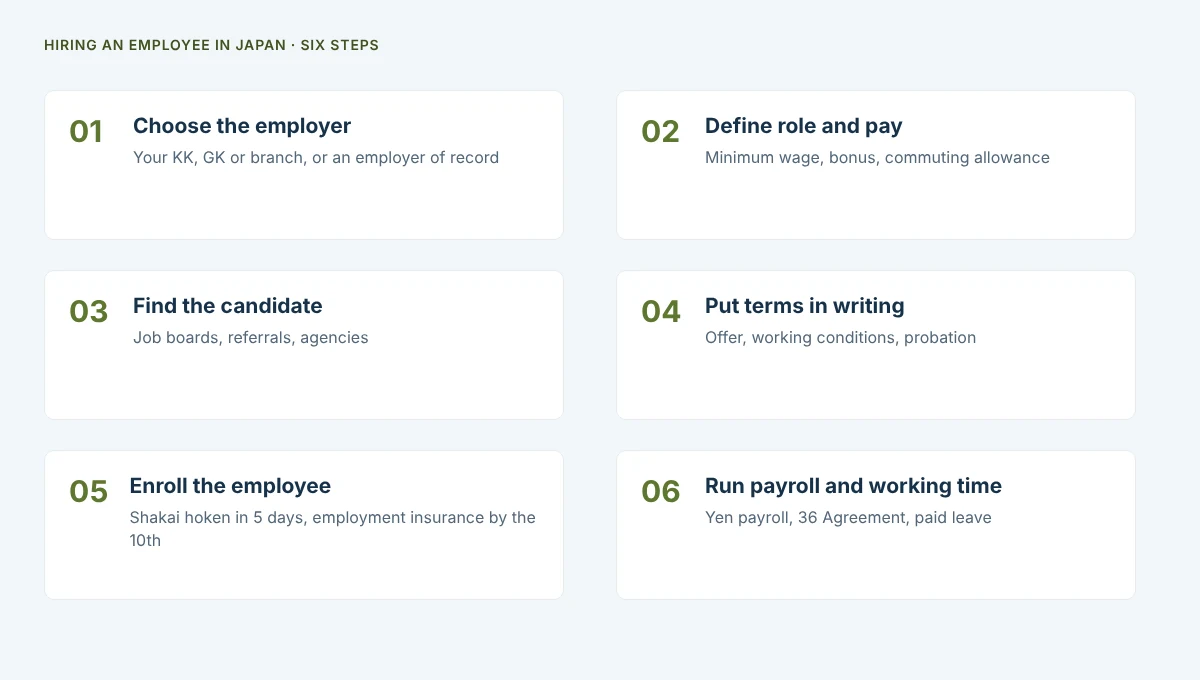
Step 1: Decide who will employ the person
| Route | What you need | Time to first hire |
|---|---|---|
| Your own KK or GK | Registration, a bank account, tax, social and labour insurance registrations | Usually a few months |
| Registered branch | Registration and a representative living in Japan | Usually a few months |
| Employer of record | A service contract and a role review under the dispatch rules | Weeks, once documents are ready |
| Independent contractor | A genuinely independent professional and a business contract | Days, but only for real project work |
Without a Japanese entity, an employer of record is the usual way to employ someone quickly. In Japan it works as worker dispatch: the employing company must be licensed, some jobs are excluded and period limits apply. See how the dispatch rules apply.
Step 2: Define the role and the pay
- Check the minimum wage for the prefecture where the person will work. From October 2026 it is ¥1,280 an hour in Tokyo and ¥1,231 in Osaka.
- Decide whether you offer an annual salary paid in 12 instalments or a monthly salary plus summer and winter bonuses. Most Japanese candidates expect bonuses.
- Add a commuting allowance for office roles. It is customary and free of income tax up to ¥150,000 a month for public transport.
- Budget about 15.7% to 16.5% of salary for employer social insurance in Tokyo, plus bonuses. Our Japan EOR cost guide shows the detail.
Step 3: Find the candidate
Japanese professionals are often recruited through job boards, LinkedIn, referrals and recruitment agencies. Agency fees for experienced hires are commonly around 30% to 35% of first-year pay. Expect a longer process than in many countries, with several interview rounds, and allow for notice at the candidate’s current employer: one month is common in practice, even though the legal minimum for resigning from an indefinite contract is two weeks.
Step 4: Make the offer and put the terms in writing
A job offer (naitei) in Japan is treated as a contract once accepted, so make it carefully. At hiring, the employer must give written working conditions covering the contract period and renewal rules, place of work and duties and how they may change, working hours, holidays, pay and how employment can end. Since April 2024 fixed-term contracts must also state any limit on renewals. Probation of three to six months is common. The 30-day notice rule applies after the first 14 days, and a dismissal must be objectively reasonable from day one.
Step 5: Enroll the employee
- Health insurance and employees’ pension: enrollment filed within 5 days of the start date.
- Employment insurance: enrollment filed by the 10th of the following month.
- My Number and the previous employer’s withholding slip, for tax.
- Resident tax: the deduction from the previous employer is transferred, or starts the following June.
- A signed and filed 36 Agreement before any overtime, and work rules once the workplace has 10 or more employees.
Step 6: Run payroll and manage working time
Pay is made in yen, in full, at least monthly on a fixed date. Income tax withheld is paid by the 10th of the following month, and social insurance by the end of the following month. In December the year-end adjustment settles each employee’s income tax. Working time is 8 hours a day and 40 a week; overtime needs a 36 Agreement and is capped at 45 hours a month and 360 a year under the normal limits. Employees earn 10 days’ paid leave after six months, and the employer must make sure at least 5 days are taken each year.
When employment ends
An employer must give 30 days’ notice or pay in lieu, but notice alone does not make a dismissal lawful: it must be objectively reasonable and socially acceptable, which is a high bar. Most employer-initiated endings are agreed with the employee, often with a separation payment. Social insurance must be closed within 5 days, employment insurance within 10 days, and on request the employer must issue a certificate of employment and pay what is owed within 7 days.
Hiring a foreign national in Japan
A foreign national needs a status of residence that allows the work, most often Engineer/Specialist in Humanities/International Services. For a hire from abroad, the employer in Japan usually applies for a Certificate of Eligibility, which typically takes one to three months. Foreign hires are handled through our Expat Employment in Japan service.
Questions about hiring in Japan
Can a foreign company hire employees in Japan without a company?
Not as the employer itself. It can use an employer of record, which employs the person through a lawful worker dispatch arrangement, or engage a genuinely independent contractor for project work.
How long does it take to hire in Japan?
Finding the candidate usually takes longest. With an employer of record, the employment can start within weeks once the role is reviewed and the candidate’s documents are ready; setting up your own company usually takes a few months.
Do I have to pay a bonus in Japan?
Not by law, but bonuses are customary and become payable once they are fixed in the contract or work rules.
What is the usual probation period in Japan?
Three to six months is common. Courts allow a little more latitude during probation, but a dismissal always needs an objectively reasonable ground; only the 30-day notice requirement is waived in the first 14 days.
Can I hire someone in Japan as a contractor instead?
Only if the work is genuinely independent. If you set the hours and direct the work, the person is likely to be treated as an employee. See independent contractors in Japan.
Hiring your first employee in Japan?
Tell us about the role. We will tell you whether an employer of record fits and what the employment will cost.