
How to Hire Employees in Peru: A 2026 Guide for Foreign Companies
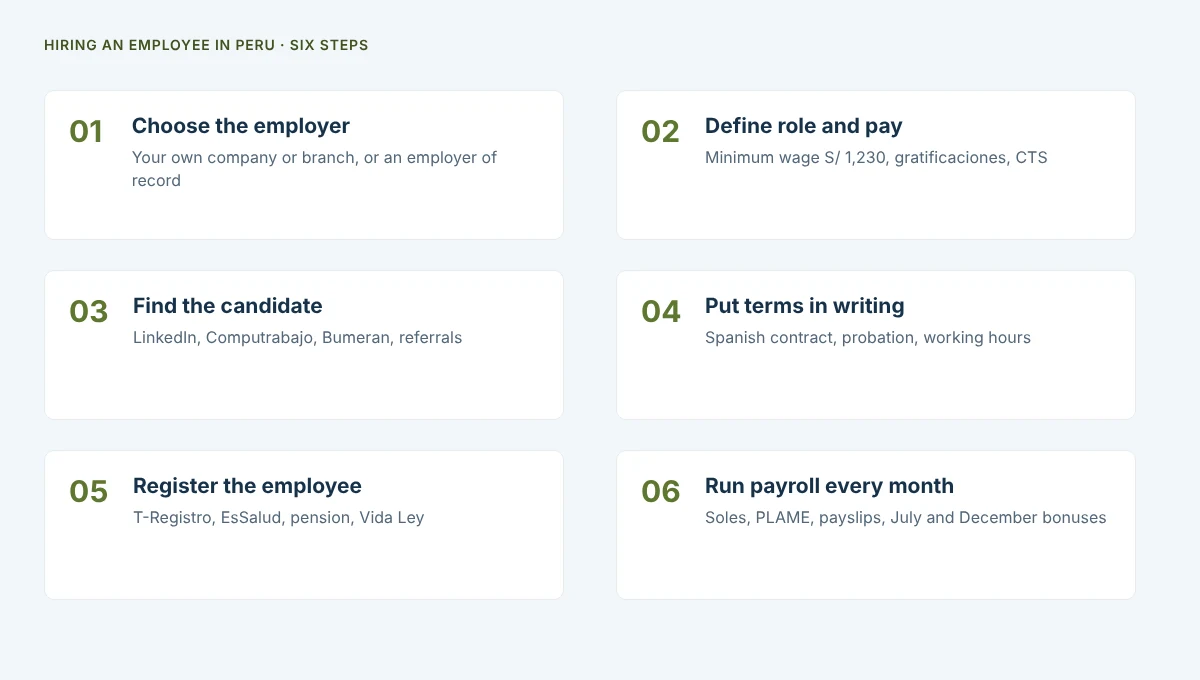
Hiring in Peru takes six steps: decide who will be the employer, set the role and pay, find the person, put the terms in a Spanish contract, register the employee, and run payroll every month. The step that catches foreign companies out is the first. Without a Peruvian company or branch you cannot employ anyone directly, so you need an employer of record, your own entity, or a genuine contractor arrangement.
1. Decide who will employ the person
An employer in Peru needs a taxpayer number (RUC), registers each employee in SUNAT’s T-Registro and files a monthly payroll return (PLAME). A foreign company with no presence in Peru cannot do this. You have three lawful options:
| Option | Best when | Read more |
|---|---|---|
| Employer of record | You want one or a few people in Peru quickly, without setting up | Peru employer of record |
| Your own company or branch | You plan a permanent team, local sales or core work under your own management | Starting a business in Peru |
| Independent contractor | The person is genuinely independent, works for several clients and delivers a defined project | Contractors in Peru |
Be careful with the third option. Peruvian courts apply the principle of primacy of reality: if someone works personally for you, is paid regularly and follows your instructions, they are an employee, whatever the contract says. The back pay, gratificaciones, CTS and fines then fall on whoever the courts treat as the employer.
2. Define the role and the pay
Set a monthly gross salary in soles. The floor is the minimum wage, S/ 1,230 a month from 1 October 2026, with a further rise to S/ 1,300 planned for 2027. Most professional roles in Lima pay well above it.
Budget for what Peru adds to salary: two gratificaciones a year (one salary each in July and December, plus a 9% bonus), CTS severance savings of about one more salary a year, EsSalud health insurance at 9% and Vida Ley life insurance. Together they add about 37% to salary. Our Peru EOR cost guide shows the numbers.
Also decide the working schedule (up to 8 hours a day or 48 a week), whether the role is remote, and whether it is ongoing or for a defined period. The last point decides the contract type.
3. Find the candidate
Most professional hiring in Peru runs through LinkedIn, local job boards such as Computrabajo and Bumeran, university networks and recruitment agencies. For senior or bilingual roles, referrals and specialist recruiters work best. Interview in Spanish where the role needs it, and check expectations on gratificaciones: candidates usually quote a monthly salary and assume the two extra payments on top.
4. Put the terms in writing
- Contract type. An indefinite contract is the default. A fixed-term contract is allowed only for an objective reason written into the contract, such as a new activity, a market need or a specific project, and fixed-term contracts may not total more than five years.
- Language. Use Spanish, with an English translation if your team needs one.
- Probation. Three months by law; up to six months for skilled or trusted roles and up to a year for management, if agreed in writing.
- Contents. Job title and duties, workplace or remote arrangement, schedule, salary, benefits and confidentiality and intellectual property clauses.
- Rules. Give the employee your health and safety rules and, where required, your internal work rules, including for remote work.
5. Register the employee
- Register the employee in T-Registro by the first day of work.
- Record the pension choice: the public ONP or a private AFP. New workers who do not choose are placed in an AFP.
- Arrange Vida Ley life insurance from the first day, and SCTR if the work is high-risk.
- Collect the DNI, bank account details and, for the family allowance, the details of any children under 18 (or up to 24 in higher education).
6. Run payroll every month
Pay in soles on a fixed date. Withhold the employee’s pension and fifth-category income tax, pay EsSalud, file the PLAME return through SUNAT and issue a payslip within three working days of payment. Twice a year add the gratificación (by 15 July and 15 December) and the CTS deposit (by 15 May and 15 November). Keep a daily attendance record, including for remote staff; SUNAFIL inspectors ask for it.
Ending employment
An employee who resigns gives 30 days’ notice, which the employer may waive. During probation, employment can end without cause. After it, a dismissal needs a just cause related to conduct or capacity and a written process: a charge letter and at least six calendar days for the employee to respond (30 for poor performance). Without a just cause, compensation is 1.5 monthly salaries per year of service, capped at 12, and the employee may sue for reinstatement instead, so most exits without cause are agreed. In every case, final benefits (pending salary, vacation, the pro-rata gratificación and CTS) are due within 48 hours of the last day.
Hiring a foreign national
Foreign employees are subject to separate rules, including limits on foreign staff and approval of the employment contract before work starts. See Expat Employment in Peru.
Questions about hiring in Peru
How do I hire employees in Peru?
Decide who will employ the person (your own company or an employer of record), agree the salary and a Spanish contract, register the employee in T-Registro by the first day, and run payroll in soles with EsSalud, pension, income tax, two gratificaciones and CTS.
Can a foreign company hire employees in Peru without a local entity?
Not directly. You need an employer in Peru: your own company or branch, or an employer of record whose Peruvian company employs the person within the intermediation or outsourcing rules. How an EOR works in Peru
How long does it take to hire someone in Peru?
Recruitment usually takes a few weeks. Once you have chosen the person, an employer of record can usually have a local hire ready to start within about five business days. Setting up your own company first adds several weeks.
What is the minimum wage in Peru in 2026?
S/ 1,230 a month from 1 October 2026, up from S/ 1,130. A rise to S/ 1,300 is planned for the first half of 2027. Peru minimum wage 2026
Do I have to pay a 13th month salary in Peru?
Peru pays two: the gratificaciones of one salary each in July and December, plus a 9% bonus on each.
Hiring your first employee in Peru?
Tell us the role and where the person will work. We will confirm the right structure and send the full employment cost before you commit.