
How to Do Business in Japan Without Setting Up a Company
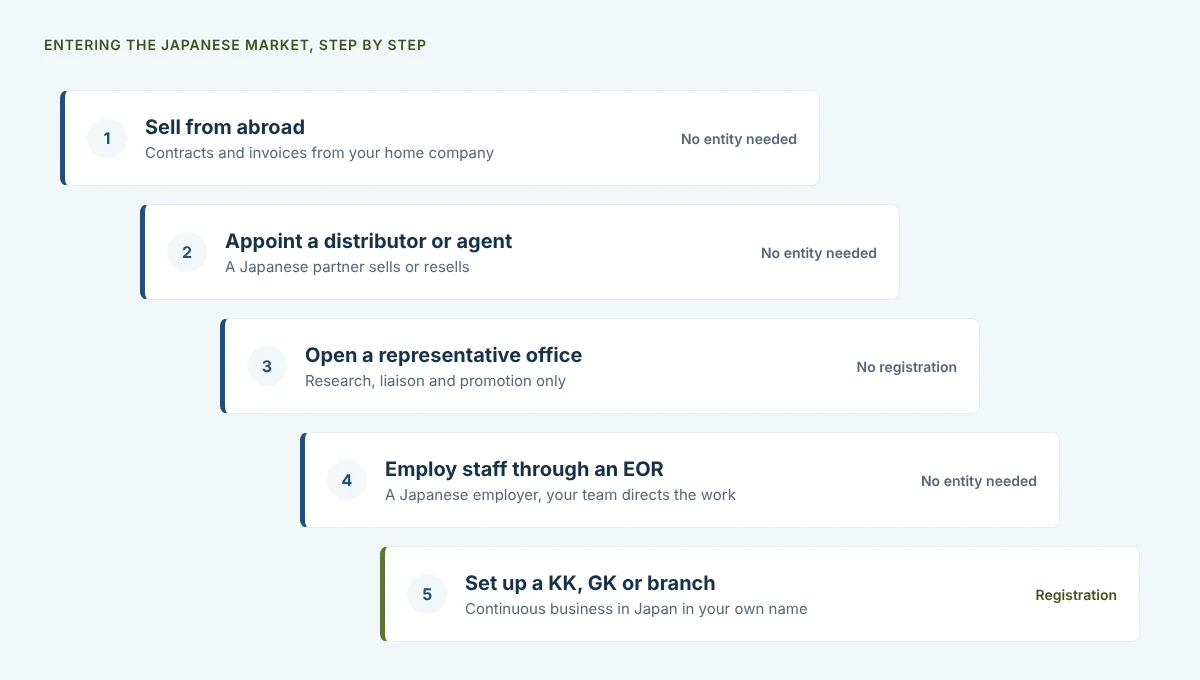
A foreign company can do a good deal in Japan without its own Japanese company. It can sell to Japanese customers from abroad, work through a distributor or agent, research the market through a representative office, and put staff on the ground through an employer of record. What it cannot do without a registered presence is carry on business in Japan continuously in its own name. And whatever route it takes, it needs to watch whether its activities create a taxable presence.
What you can do without a Japanese company
| Activity | Possible without a company? | How |
|---|---|---|
| Sell services or software to Japanese customers | Yes | Contract and invoice from your home company; check Japanese consumption tax rules for digital services |
| Sell physical goods | Yes, through others | Ship to customers who import, or appoint a Japanese distributor or importer |
| Research the market, promote, meet partners | Yes | Business trips, or a representative office for a longer presence |
| Employ Japanese staff | Yes, with limits | An employer of record under the dispatch rules, or a representative office for preparatory work only |
| Engage freelancers | Yes | Genuinely independent contractors; the Freelance Act sets payment and notice duties |
| Employ foreign staff in Japan | Only through a sponsor | A work visa usually needs a sponsoring organisation in Japan |
| Carry on business in Japan continuously in your own name | No | Register a branch, or set up a KK or GK |
Selling to Japanese customers
Cross-border sales. Many software, consulting and B2B service companies sell into Japan from their home country. For digital services supplied to Japanese businesses, the reverse-charge rules generally put Japanese consumption tax on the customer; services to consumers can require the foreign company to register.
Distributors and agents. For goods, the usual route is a Japanese distributor that buys and resells, or an agent that sells on your behalf. A distributor is the simpler choice for tax. An agent who habitually concludes contracts for you, or plays the principal role leading to them, can create a permanent establishment for your company.
Putting people on the ground
Once you need someone in Japan full time, the question is who employs them. Without a Japanese company, an employer of record can employ a Japanese national for you: its Japanese company signs the contract, enrolls the employee in social insurance and runs payroll in yen, while your team directs the work. In Japan this is a worker dispatch arrangement, so the employing company must be licensed and some jobs are excluded; see is an EOR legal in Japan.
For project work, a genuinely independent professional can be engaged as a contractor. For a foreign national, a sponsoring organisation in Japan is usually needed; see Expat Employment in Japan. The step-by-step process is in our guide to hiring employees in Japan.
A representative office: presence without sales
A representative office does not need to be registered. It can carry out preparatory and auxiliary work for its head office, such as market research, collecting information, advertising and liaison, but it cannot sell or conclude sales contracts. It can rent an office and hire local staff, and as an employer it must meet Japanese payroll and insurance duties. Banks and landlords sometimes find it harder to deal with than a registered company.
Tax: the permanent establishment question
Doing business without a company does not automatically keep you out of Japanese corporate tax. Your company has a permanent establishment if it has a fixed place of business in Japan that does more than preparatory or auxiliary work, or a dependent agent who habitually concludes contracts for it or plays the principal role leading to contracts concluded without material change. Japan tightened both rules in its 2018 tax reform. Where a tax treaty defines a permanent establishment differently, the treaty applies.
Practical rules of thumb. Keep sales contracts negotiated and signed outside Japan. Do not give local staff authority to conclude contracts. Keep a representative office to research and liaison. Take tax advice before your Japanese team grows.
When it is time for your own KK, GK or branch
Set up a registered presence when you will carry on business in Japan continuously. The Companies Act does not allow a foreign company to transact business continuously in Japan until it has appointed a representative in Japan and registered; a branch needs at least one representative living in Japan. A KK or GK can be formed with capital of ¥1, and its representatives can live abroad. Registration licence tax starts at ¥150,000 for a KK and ¥60,000 for a GK.
If a founder or manager will move to Japan to run the business, note that the Business Manager visa was tightened on 16 October 2025. It now generally requires ¥30 million of capital, at least one full-time employee who is a Japanese national or holds a status such as permanent resident, spouse of a Japanese national or long-term resident, Japanese language ability at roughly B2 level from the applicant or that employee, and at least three years’ management experience or a relevant degree. See the Immigration Services Agency notice.
A practical sequence
- Start by selling from abroad, or through a distributor or agent
- Open a representative office if you need a base for research and liaison
- Employ your first Japanese staff through an employer of record
- Register a branch or set up a KK or GK once you trade in Japan continuously
- Move your employees to your own company, with their agreement
Questions about doing business in Japan without a company
Can a foreign company do business in Japan without registering?
It can sell from abroad, work through distributors and agents, and run a representative office for preparatory work. To carry on business in Japan continuously in its own name, it must register a branch or set up a Japanese company.
Can a foreign company hire employees in Japan without a company?
Yes, through an employer of record for roles that can lawfully be filled by worker dispatch, or through genuinely independent contractors for project work.
Does a representative office pay corporate tax in Japan?
Not if it really does only preparatory or auxiliary work for the head office. If it starts selling or concluding contracts, it can become a permanent establishment.
Does an employer of record create a permanent establishment?
The EOR arrangement does not create one by itself, but what the employee does, and where, can. If they habitually conclude contracts for you, or play the principal role leading to them, your company may have a permanent establishment.
How long does it take to set up a company in Japan?
Registration can take one to a few weeks once documents are ready. Opening a corporate bank account and completing the tax, social insurance and labour insurance registrations usually take longer, so allow a few months in total.
Need people in Japan before you set up a company?
Through our employer of record service, our Japanese employing partner employs Japanese staff for you, and we help you move them to your own company later.