
Employer of Record · Luxembourg
Employer of Record in Luxembourg
Hire local employees in Luxembourg without setting up your own company, where the role and arrangement meet Luxembourg law. NNRoad coordinates employment contracts, payroll in euros, CCSS declarations and statutory benefits. We agree with you whether lawful, authorised temporary agency work or a genuinely provider-managed service fits the assignment; neither route permits unrestricted staff lending.
Every engagement is reviewed before an offer is made. Last reviewed November 2026; general information, not legal advice.
The short answer
Can you get people working in Luxembourg without your own company?
Yes, subject to the hiring model. For a qualifying temporary assignment, an authorised Local Team can employ the worker while you direct the agreed day-to-day work. For a genuine outsourced service, our Local Team employs and manages the people delivering agreed results. NNRoad and the client select the lawful route together after reviewing the role, duration and actual management arrangements.
A good fit
A permitted temporary need or a defined outsourced workstream in Luxembourg City, Kirchberg or elsewhere: for example IT, sales or operational support. Regulated financial activities need their own permissions; an employment arrangement does not supply those permissions.
Hiring a foreign national
Foreign-national employment and any required residence or work authorisation are reviewed separately. Existing status, nationality and the role determine the route. See Expat Employment in Luxembourg.
Another route is better
If you are already the employer and need payroll calculations and reports, see Luxembourg payroll. For recruiting and paying genuinely independent contractors, see On-Demand Talent.
How it works
How our employer of record service works in Luxembourg
NNRoad HQ coordinates the agreement and service calendar. The qualified Local Team handles employment and local compliance. In authorised temporary agency work, the client directs the assignment and carries applicable user-company duties; in genuine outsourcing, the Local Team directs delivery and the client reviews results. The diagram below illustrates the provider-managed service model. The actual arrangement must match the chosen model in practice.
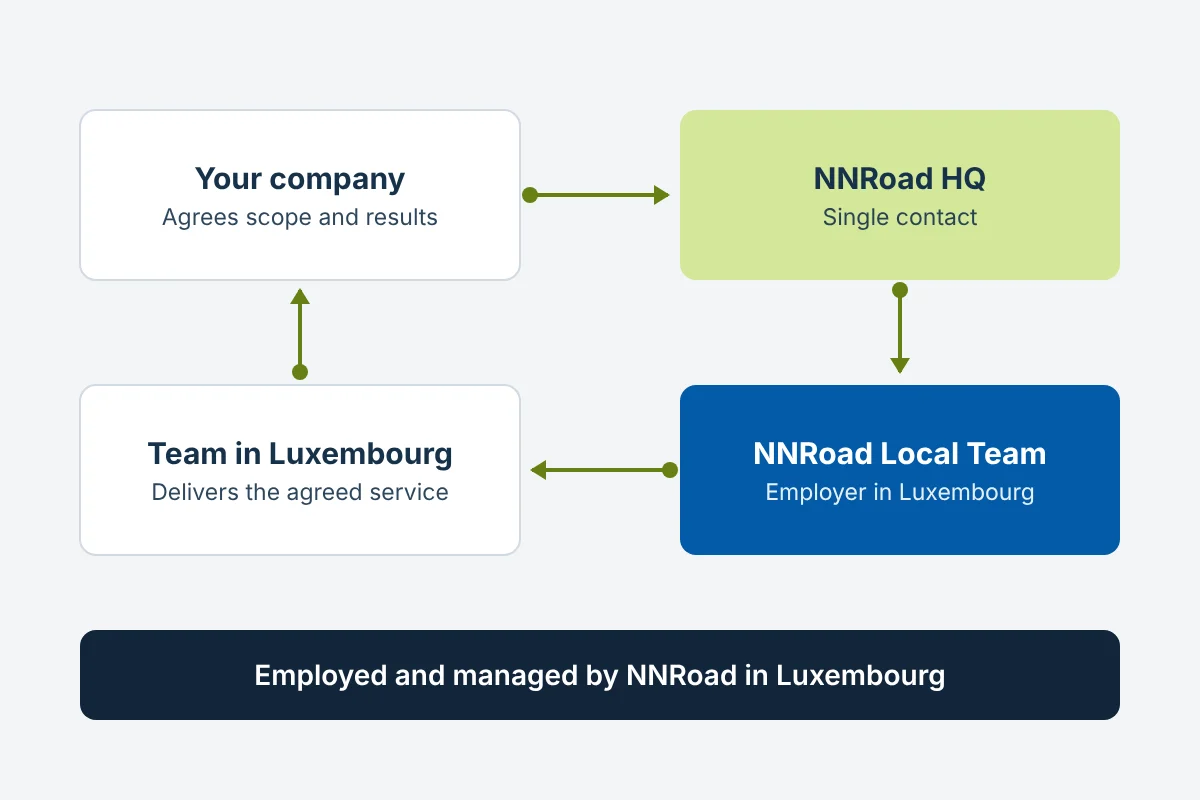
NNRoad HQ and our Local Team
- Employment and management responsibilities matched to the lawful model
- Written contracts and CCSS registration
- Monthly payroll in EUR with tax and social security
- Wage indexation and any required or agreed 13th month
- Cross-border tax and social security checks
- Lawful dismissals, resignations and final pay
Your company
- Defining the role or service, outcomes and duration
- Sharing the information and access the work needs
- Directing a lawful agency assignment or reviewing outsourced results
- Telling NNRoad HQ early about changes in scope
- Funding the monthly invoice on the agreed dates
The legal position
How Luxembourg law treats an employer of record
Employer of record (EOR), professional employer organization (PEO) and global employment organization (GEO) are commercial labels, not legal categories in Luxembourg. What the law looks at is who really employs and directs the worker. These are the rules we build every engagement around:
- Authorised temporary agency work: limited to permitted temporary needs, with business and Labour Ministry authorisations. The usual assignment limit is 12 months including renewals; statutory exceptions require separate review.
- Genuine outsourcing: the Local Team retains real authority over its employees and how the agreed service is delivered. A service contract alone cannot legalise disguised staff lending.
- Wage indexation: qualifying index tranches increase wages by 2.5%; payroll must apply the effective date.
- Cross-border work: residence and days worked outside Luxembourg require separate tax, social-security and work-right checks.
- Employee protection: statutory rights, applicable collective agreements and agency equal-treatment rules must be respected.
What this means for you
Agree who gives instructions, approves time and handles workplace safety before work starts. Employer decisions remain with the Local Team; the client also meets any duties attached to its role. If you later employ the team directly, we review employee rights and any transfer-of-undertaking rules before setting a transition date. Read how to hire employees in Luxembourg.
BEFORE ONBOARDING
Confirm the engagement before hiring
Before onboarding, we confirm the lawful model, role, work location, management responsibilities and employment terms. This gives your team a clear basis for deciding how the engagement will operate.
WHAT WE CONFIRM
Clear responsibilities from the start
Confirm gross salary in euros, applicable wage index and collective agreement, working hours, leave and contractual benefits.
Document who directs the work, the assignment or service scope, workplace responsibilities and the process for changes or ending the engagement.
Our online portal lets clients view employee information, reports and payslips, and lets employees access their own payslips.
Employment support
- Contracts and registration
- Monthly payroll, tax and social security
- Pay slips and employee questions answered locally
- Indexation and leave
- Annual salary certificates
- Final pay and severance when a job ends
Employer cost
What a Luxembourg hire costs on top of salary
Employer contributions depend on the applicable bases, accident bonus-malus factor and Mutualité class. For illustration, a standard employee earning EUR 5,000 monthly, with a 0.65% accident rate, class 2 Mutualité at 0.95% and STM at 0.14%, generates EUR 664.50 in employer contributions (13.29%). This excludes benefits, service charges and other employment costs; it is not a universal rate.
| Item | Who pays | Position in 2026 |
|---|---|---|
| Pension | Employer 8.5%, employee 8.5% | Contribution base capped at EUR 13,856.63 monthly from 1 June 2026 |
| Health | Employer 3.05%, employee 3.05% | Same cap |
| Accident, occupational health and Mutualité | Employer | Accident: 0.65% base × bonus-malus factor; Mutualité: 0.23%, 0.95%, 1.56% or 2.66%; STM: 0.14% where applicable |
| Dependency insurance | Employee 1.4% | No contribution ceiling; deduction of one-quarter of the adult minimum wage, with part-time adjustment where required |
| Income tax | Employee, withheld by the employer | 0% to 42% plus surcharge, by tax class. See the Luxembourg payroll and tax guide |
Also budget for
Allow for agreed bonuses, any contractual or collectively required 13th month, benefits, paid leave and termination liabilities. Ordinary permanent-contract dismissal rules differ from agency assignments, fixed-term contracts and probation.
Quick estimate
Model a salary in our calculator
Use the calculator for an initial salary illustration. Actual net pay and employer cost depend on the tax card, contribution bases, exemptions, benefits and cross-border position; have the Local Team confirm the figures before making an offer.
Employment law
Luxembourg employment rules to plan around
The following summarises ordinary employment rules. Agency assignments have distinct contract, probation and termination rules, and collective agreements can improve employee entitlements. Figures reflect the parameters effective from 1 June 2026.
| Topic | Position in 2026 |
|---|---|
| Contract | Written terms agreed before work starts; special formalities apply to fixed-term and agency contracts |
| Minimum wage | Adult full-time minimum: EUR 2,771.33 monthly unqualified or EUR 3,325.59 qualified, subject to legal qualification criteria |
| Probation | Ordinary contracts: minimum two weeks; maximum normally three or six months by qualification, or twelve months if the indexed salary threshold is met. Agency limits differ |
| Working time | Normally 8 hours daily / 40 weekly; eligible overtime generally earns 1.5 hours off, or at least 140% pay where time off is not possible |
| Annual leave | At least 26 working days for a full year, adjusted for the work schedule; additional entitlements may apply |
| Sick pay | Continued salary through the month containing the 77th incapacity day within an 18-month reference period |
| Notice from the employer | Ordinary dismissal after probation: 2 months below 5 years, 4 months at 5–under 10, and 6 months from 10 years |
| Severance | Eligible ordinary dismissal: 1–12 months by service from 5 years; employers below 20 staff may elect statutory extended notice instead |
For the full picture, see our Luxembourg employment law guide.
Process
How a Luxembourg engagement works with NNRoad
Every engagement starts with a review of the service, so we can confirm the arrangement and the employment terms in writing before anyone is hired. Cut-off, invoice and pay dates are fixed in a working calendar we agree with you.
Once, before your first hire
01 · Client onboarding
YouShare the role or service, location, management needs and expected duration, and complete company verification.
NNRoad HQCoordinates the model review with you, documents responsibilities in the service agreement and confirms the working calendar.
Local TeamChecks legal eligibility, required authorisations, collective agreement, pay and any cross-border arrangements.
For each hire, before the start date
02 · Employee onboarding
YouConfirm the role, work location, access and proposed start date.
Local TeamConfirms employment terms, signs the required contract, arranges applicable CCSS declarations and payroll, and checks the electronic tax card or required interim withholding. Ordinary entry declarations are due within eight days of starting; agency workers use the applicable DECINT procedure. Required work rights must be established before work begins.
NNRoad HQConfirms readiness and the agreed start with you; timing depends on the individual case.
Every month, on the working calendar
03 · Monthly payroll cycle
YouProvide and approve payroll inputs by the cut-off and fund the agreed invoice. Direct the permitted agency assignment or review outsourced results according to the chosen model.
Local TeamChecks time and leave, calculates gross-to-net, applies indexation, handles employer declarations and payments, and issues payslips.
NNRoad HQCoordinates reporting and queries. Clients can view employee information, reports and payslips in the portal; employees can view their own payslips.
Every year
04 · Year-end
The Local Team reconciles payroll records, handles annual employer reporting and salary certificates, and checks any contractual 13th month. Indexation is applied when due, not only at year-end. Leave carryover is reviewed individually: 31 March is not a universal expiry date, and illness, operational constraints or agreed extensions can require later use. NNRoad HQ reviews the next service calendar with you.
When a job ends
05 · Employee offboarding
YouNotify NNRoad HQ of a proposed change or end to the assignment before making commitments to the employee.
Local TeamReviews the contract type, grounds, protected status and required procedure; considers redeployment where relevant; and handles lawful notice, final pay, eligible severance and deregistration.
NNRoad HQCoordinates the documented timeline and handover. Ending the client service does not itself terminate employment.
When you end the service or move to your own company
06 · Client offboarding
Give the contractual service notice. NNRoad HQ coordinates outstanding obligations and records; the Local Team reviews lawful employment endings or a move to your own entity. A qualifying business transfer preserves employee rights by law; other moves need the appropriate agreements and formalities. Final payroll, filings and reconciliation follow the confirmed route.
Checklist
What we need to start in Luxembourg
From you
- The service and results you need
- Where the work is done, including any home working from abroad
- Salary levels in EUR, bonus and benefits
- Your sector, for any collective agreement
- Start date and expected duration
From the employee
- ID card or passport
- Luxembourg social security number, if any
- Country of residence
- Degrees and certificates
- Bank account for salary
Before day one
- Lawful model and written employment terms confirmed
- Work rights and any required approvals checked
- CCSS declaration process and deadlines assigned
- Tax-card status and payroll treatment checked
- Workplace responsibilities and start date confirmed
Why NNRoad
Choosing an employer of record service provider in Luxembourg
One contact, in English
NNRoad HQ handles the agreement, invoices and escalations, so you do not juggle several local providers.
A lawful local employment model
Our qualified Local Team handles the employer role and confirms the authorisations and responsibilities required for the chosen arrangement.
Current law, current numbers
The Local Team checks current rules, indexation, collective agreements and role-specific requirements before onboarding and payroll.
Access to employment records
Clients can view employee information, reports and payslips; employees can access their own payslips.
Predictable months
A working calendar fixes cut-offs, invoices and pay dates, and every payroll comes with a summary.
Data handled with care
Employee information is handled for defined, lawful purposes with GDPR safeguards and access appropriate to each user’s role.
Comparing EOR providers in Luxembourg? Ask which legal model fits your role, which authorisations it requires, who gives instructions, how workplace duties are divided and how cross-border work and employment endings are managed.
PEO and global employment organization are commercial labels, not substitutes for Luxembourg legal requirements. Client-directed work needs an authorised legal basis; genuine outsourced services require real provider management. The label alone does not determine who is responsible.
REVIEW YOUR PLAN
Review my Luxembourg hiring plan
Tell us the role, management needs, location and expected duration. We respond within 24 hours to discuss the lawful model, required documents and next steps. The start date depends on completing the applicable checks and approvals.
- The lawful model and management responsibilities
- Employment terms and payroll requirements
- A realistic start date and the documents needed
FAQ
Luxembourg employer of record FAQs
Straight answers to what overseas companies ask before getting work done in Luxembourg.
Can a foreign company have people working in Luxembourg without a local company?
Yes, where the arrangement meets Luxembourg law. Authorised temporary agency work can support a permitted temporary need under client direction; a genuine outsourced service is managed by the Local Team. We confirm the route with you. See operating in Luxembourg without a company.
Is an employer of record legal in Luxembourg?
EOR is a commercial term, not a separate legal category. A qualifying agency assignment requires the relevant authorisations and compliance with temporary-work rules. Genuine outsourcing requires provider control in practice. Neither model permits unrestricted lending of workers.
How much does it cost to employ someone in Luxembourg?
Budget for gross salary, applicable employer contributions, benefits and other employment costs. Contribution totals vary with the employer and pay basis; the example above uses 13.29% under stated assumptions. The Luxembourg salary calculator is an initial illustration, not a final payroll calculation.
What is wage indexation?
Luxembourg wage indexation adjusts salaries by 2.5% when an index tranche takes effect. Use the effective payroll parameters and check any additional contractual or collective increases.
Can the team live in France, Belgium or Germany?
Potentially. Residence, nationality and the actual pattern of work must be checked. Tax-treaty rules and social-security rules are separate; approval of remote work does not automatically resolve either.
Can NNRoad employ a non-EU national?
This is assessed under our separate Expat Employment service. Eligibility depends on existing status, the role and any required authorisation; employment or a start date cannot be guaranteed before that review.
What notice applies?
For ordinary dismissal from a permanent contract after probation, employer notice is normally two months below five years of service, four months at five to under ten years, and six months from ten years. Agency assignments, fixed-term contracts, probation and serious misconduct have different rules; protected employees require additional checks.
Can the team move to our own Luxembourg company later?
Possibly, after a legal and operational review. A qualifying transfer of an undertaking transfers employment rights by law; otherwise the necessary agreements and formalities must be completed. A client-agreed date alone does not transfer the employees.
Further reading
Plan your work in Luxembourg
Hiring routes, contracts, pay, leave and notice.
When you need a Luxembourg company, and when you do not.
Social security, tax classes and indexation.
Initial employer-cost and net-pay illustrations, subject to assumptions and individual review.
Official sources: temporary agency rules, agency authorisations, CCSS parameters, tax-card rules and ITM. More options: Luxembourg hiring options; rules in detail: Luxembourg employment law guide.
Ready when you are
Get work done in Luxembourg before you open a company
Share the role, work location and proposed management arrangement. We will review the lawful route and explain the documents and steps needed to get started.