
Hiring without an entity in Australia
EOR vs PEO in Australia: Hiring Without Your Own Entity
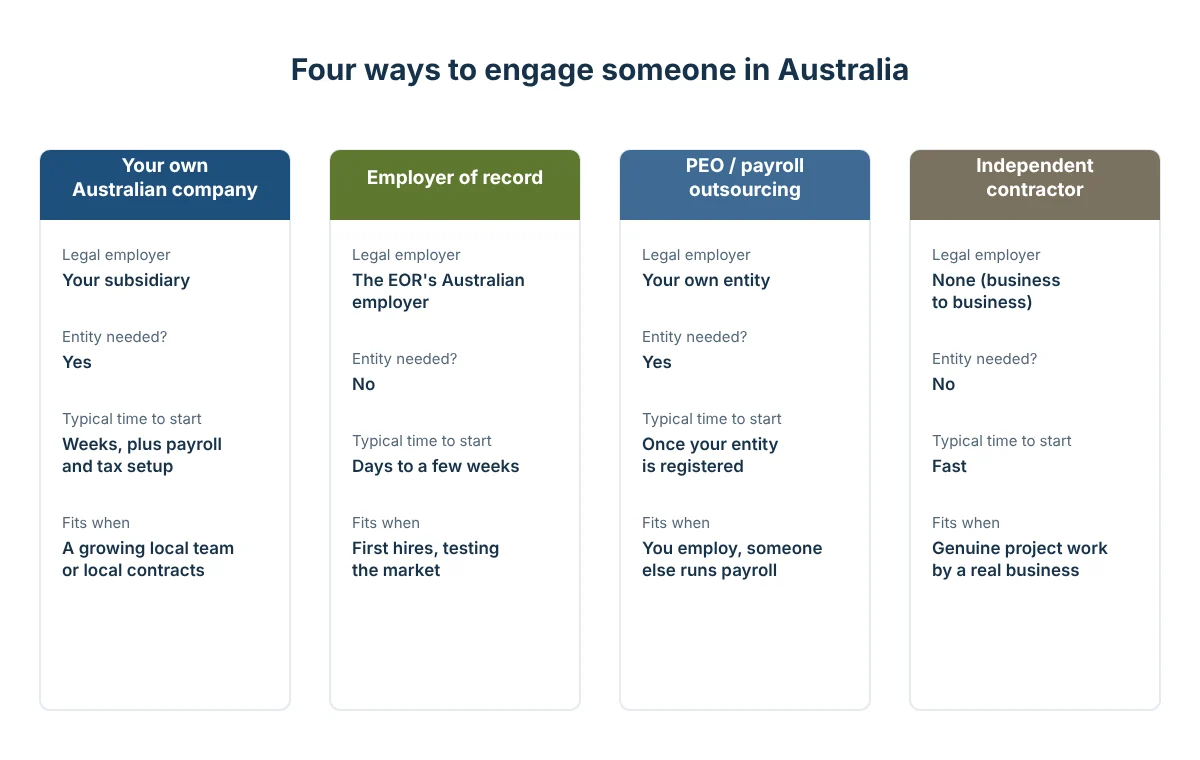
Five ways to employ or engage someone in Australia
| Model | Legal employer | Need an Australian entity? | Usually suits | Watch out for |
|---|---|---|---|---|
| Your own company | Your Australian subsidiary (Pty Ltd) | Yes | A growing team, local customers, long-term roles | Set-up and ongoing compliance: tax registrations, payroll, awards, payroll tax, workers’ compensation |
| Registered foreign company (branch) | Your overseas company, registered with ASIC | Registration (ARBN) and a local agent | Companies already carrying on business in Australia | Your overseas company carries the liabilities directly |
| Employer of record (EOR) | The EOR’s Australian employing entity | No | First hires, testing the market, a bridge while you set up | The EOR must hold labour hire licences in QLD, VIC, SA and the ACT; fixed-term limits apply |
| PEO or payroll outsourcing | Your own entity | Yes | You employ the staff and want payroll and HR run for you | Does not solve the “no entity” problem |
| Independent contractor | Nobody: a business-to-business contract | No | Genuine project work by someone who runs their own business | Sham contracting penalties and super for contractors paid mainly for labour |
Why the word “PEO” causes confusion in Australia
| Label | What it usually means in Australia |
|---|---|
| Employer of record (EOR) | A provider’s Australian entity employs the person; you direct the work. |
| PEO or professional employer organisation | Usually the same EOR service. Sometimes HR and payroll support for a company that already employs its own staff. |
| Global employment organisation (GEO) | Another name for an EOR that works across several countries. |
| Employee leasing or labour hire | A provider employs workers and supplies them to a host business. An EOR arrangement is labour hire in this sense. |
| Umbrella company | A payroll intermediary for contractors who find their own work. How it differs from an EOR. |
Labour-hire licensing schemes operate in Queensland, Victoria, South Australia and the ACT. Assess each arrangement against the relevant definitions, exclusions and exemptions, and verify required licences on the regulator’s register. Victoria’s definition changed on 1 October 2026 to focus on the character of labour supply, including some intermediaries. The location of the worker and the roles of all entities in the supply chain matter.
When an EOR fits, and when it does not
EOR usually fits when
- The person already has the right to work in Australia
- You will direct the work, like any employee
- You have no Australian entity, or it is still being set up
- You want to test the market before committing to a company
- Two years is enough time to decide your long-term set-up
Look at another route when
- The person needs a sponsored visa (see Hire Foreigner in Australia)
- You already have an Australian company (use payroll outsourcing)
- The work is a defined project by a real business (see on-demand talent)
- You plan a large local team or will sign Australian customer contracts
- The role must run beyond two years on the same contract
Hiring without an entity: the five risks to manage
| Risk | What it means | How to manage it |
|---|---|---|
| Unlicensed labour hire | Using an EOR without the right state licence exposes you as the host, not just the provider. | Check the provider’s licence on the state register before you sign. |
| Permanent establishment | Staff who habitually conclude contracts for you can give your company a taxable presence. | Assess the actual Australian activities and applicable treaty with a tax adviser. ATO |
| Contractor misclassification | From 26 August 2024, constitutionally covered businesses generally use the whole-of-relationship test. Different rules can apply to other businesses and valid opt-outs. | Assess the applicable test and the actual arrangement before choosing employment or a contractor engagement. Fair Work |
| Fixed-term limits | Fixed-term contracts are generally capped at two years in total, including renewals. | Assess a lawful ongoing arrangement before expiry. Moving to another entity does not automatically reset fixed-term restrictions or remove employee rights. Fair Work |
| Work rights | NNRoad’s Australia EOR service covers local employees, subject to employment eligibility checks. | Foreign employee hiring is assessed through NNRoad’s separate Hire Foreigner service. |
What setting up your own Australian company involves
Questions about EOR and PEO in Australia
What is the difference between a PEO and an EOR in Australia?
An EOR employs the person through its own Australian entity, so you do not need one. A PEO in the strict sense supports a company that already employs its own staff. In practice most Australian providers that call themselves a PEO offer the EOR model, so ask who signs the employment contract.
Can a foreign company hire employees in Australia without an entity?
Yes, in two ways. It can use an employer of record, or it can register for PAYG withholding and employ people directly, carrying every employer obligation itself. Many companies choose an EOR first and set up a subsidiary later.
Is an employer of record legal in Australia?
Yes. The employee has a normal Australian employment contract with the EOR’s local entity. Because the employee works under the client’s direction, the EOR must hold a labour hire licence in Queensland, Victoria, South Australia and the ACT.
What is a global employment organisation?
A global employment organisation (GEO) is another name for an employer of record that operates in many countries. In Australia it works the same way as an EOR.
Does using an EOR mean my company is doing business in Australia?
Not by itself. Employing through an EOR does not register your company in Australia. But if your staff regularly negotiate or sign contracts for you, you may need tax advice on permanent establishment, and to consider ASIC registration.
How long can we use an EOR in Australia?
As long as each employee’s contract stays within the Fair Work Act rules. Most EOR employment is fixed-term, generally up to two years in total, so plan your own entity or the next step before then.