
Guide · Indonesia
EOR vs PEO vs GEO in Indonesia: How to Hire Without a Local Entity
A foreign company without an Indonesian entity can hire Indonesian staff through an employer of record (EOR): an Indonesian company that employs the person, runs payroll, registers BPJS and withholds tax, while you direct the work. “PEO” and “GEO” are other names used for similar services. Since 30 April 2026 the arrangement is limited to roles that fit Indonesia’s outsourcing rules, so the label matters less than who the legal employer is and whether the role qualifies.
Five ways to employ people in Indonesia
| Route | Who employs | Good for | Watch out for |
|---|---|---|---|
| Your own PT PMA | Your Indonesian subsidiary | A growing team, local sales, imports, licensed activities | Paid-up capital from Rp2.5 billion, investment plan above Rp10 billion, months to set up, ongoing filings |
| Representative office (KPPA) | The representative office | Liaison, promotion and market research | Cannot sell, sign sales contracts or invoice; foreign staff need work permits |
| Employer of record | The provider’s Indonesian company | First hires in supporting roles, without an entity | Role must fit the outsourcing rules; tax presence still depends on what staff do |
| Payroll outsourcing | Your own Indonesian company | Companies that already employ and want payroll handled | You remain the employer and carry the obligations |
| Independent contractor | No one: a business-to-business contract | A defined project by a genuinely independent professional | Can be reclassified as employment if you direct the work like an employee |
Why EOR, PEO and GEO get mixed up
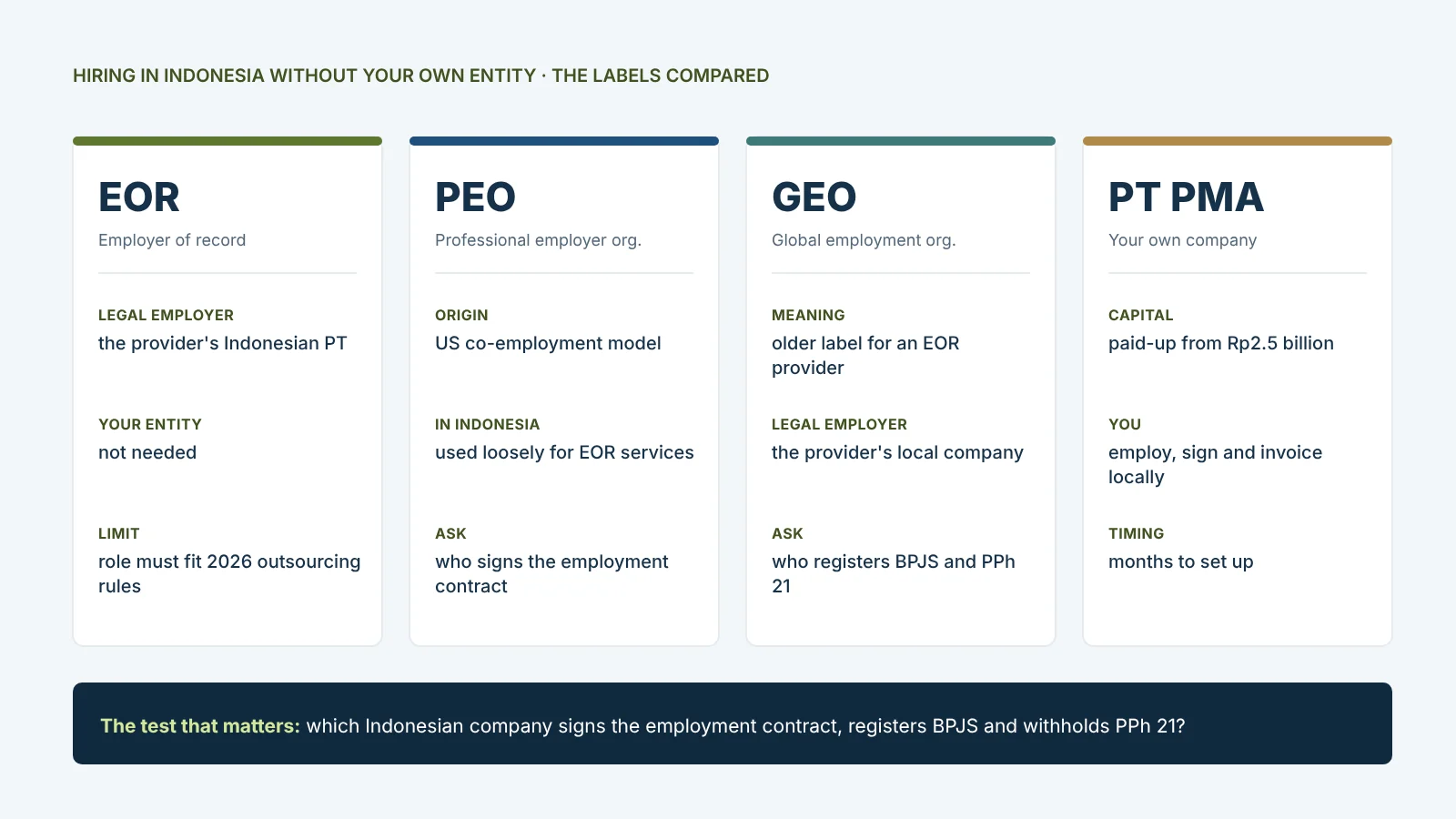
Employer of record (EOR) means a provider that is the legal employer of your staff in another country. Professional employer organization (PEO) comes from the US, where it describes co-employment: the client stays an employer and the PEO shares HR and payroll duties. In Indonesia there is no co-employment model, so providers that call themselves a PEO in Indonesia are usually offering an EOR-type service. Global employment organization (GEO) is an older name for the same kind of provider.
Indonesian law uses none of these terms. It knows the employer, the employment contract (PKWT or PKWTT) and outsourcing (alih daya). So whatever a provider calls itself, ask three questions:
- Which Indonesian company signs the employment contract?
- Which company registers the employee with BPJS and withholds PPh 21?
- How is the arrangement recorded under the outsourcing rules, and who reviews whether the role qualifies?
Is an employer of record legal in Indonesia in 2026?
Yes, within limits. Because there is no EOR-specific law, Indonesian practitioners analyse EOR as outsourcing. Minister of Manpower Regulation No. 7 of 2026, in force since 30 April 2026, allows outsourced work only in six supporting activities: cleaning; food and drink; security; drivers and worker transport; operational support services; and support work in mining, oil, gas and electricity.
| What the regulation requires | What it means for you |
|---|---|
| The outsourcing agreement sets out the work, term, location, number of workers and their rights | Your service contract and the employment contract must match the real role |
| The outsourcing company files the agreement for recording with the local manpower office within 3 working days of signing | Ask for evidence that it was filed and recorded |
| Worker protections are the outsourcing company’s responsibility, and the company receiving the work must make sure they are met | Choose a provider that pays wages, BPJS and THR correctly; it reflects on you |
| Existing agreements stay valid until they expire; the kinds of outsourced work must comply by 30 April 2028 | New arrangements should follow the current list from the start |
“Operational support services” is the category most office roles would rely on, and it is not defined. Expect a role-by-role review rather than a blanket yes. On 6 October 2026 Parliament passed a new Manpower Protection Law; reported drafts narrow outsourcing to five categories and drop the operational support category. As of 18 October 2026 it had not been published, and a transition period is expected. Keep an eye on it before you plan a large team through an EOR.
When an EOR fits, and when it does not
An EOR fits when
- You need one or a few Indonesian employees soon
- The role is a supporting function that can lawfully be outsourced
- You want to test the market before committing capital
- You want one contract and one invoice for payroll, BPJS and tax
Look at other routes when
- The role runs your core business or signs contracts for you
- You will invoice Indonesian customers or import goods
- You expect a larger team for the long term
- The person is a foreign national
Six risks to manage, whichever route you choose
| Risk | How to manage it |
|---|---|
| Role does not fit the outsourcing rules | Get a written role review before the offer |
| Misclassifying an employee as a contractor | Use a contractor only for genuinely independent, project-based work |
| Wrong contract type | Use a PKWT only for temporary work, register it within 3 working days and never add probation to it |
| Pay below the local minimum wage | Check the UMP or UMK for the actual work location, including for remote staff |
| Tax presence for your company | Do not let local staff habitually negotiate or conclude contracts for you; take tax advice |
| A messy exit | Agree in advance how notice, severance and a later transfer to your own PT PMA will work |
Setting up your own PT PMA
A PT PMA is a limited liability company with foreign shareholding. Under BKPM Regulation 5/2025 the minimum paid-up capital is Rp2.5 billion, and the planned investment must exceed Rp10 billion per business line (KBLI) and location, unless a specific rule applies. Foreign ownership limits depend on the business line. Setting up involves the deed of establishment, Ministry of Law approval, a business identification number (NIB) through the OSS system, tax registration, a bank account and, for some activities, further licences.
Many companies start with an employer of record for their first hires and move the team to their own PT PMA once the business case is proven. Moving an employee needs their written agreement and a clear position on recognised service and entitlements.
Questions about hiring without an entity
Is an employer of record the same as a PEO in Indonesia?
Not formally. A PEO, in the US sense, shares employer duties with the client. Indonesia has no co-employment model, so a provider offering “PEO” in Indonesia is usually acting as the legal employer, like an EOR. Ask which company signs the employment contract.
What is a global employment organization?
A GEO is an older name for a provider that employs staff in other countries on a client’s behalf, which today is usually called an employer of record.
Can a foreign company hire in Indonesia without a PT PMA?
Yes, through an employer of record for roles that fit the outsourcing rules, or through genuine independent contractors. A representative office can also employ local staff, but only for non-commercial activities.
Can a foreigner own 100% of a business in Indonesia?
In many business lines, yes. The Positive Investment List opened most sectors to full foreign ownership, but some remain restricted or reserved. Check the KBLI code for your activity.
When should I move from an EOR to my own entity?
When you start invoicing Indonesian customers, importing, need a licensed activity, or the team grows to the point where the capital and filing costs of a PT PMA are justified. The 2026 outsourcing limits may bring that point forward for core roles.
Not sure which route fits your hire?
Tell us about the role and the work city. We will review it against the 2026 outsourcing rules and tell you whether an employer of record, your own entity or another route fits better.