
Guide · Indonesia
Indonesia EOR Cost 2026: Employer Contributions, THR and Worked Examples
Hiring through an employer of record in Indonesia costs three things: the gross salary, the statutory employment costs on top of it, and the provider’s service fee. In 2026 employer BPJS contributions add about 10.24% of salary at the lowest work-accident rate, less on higher salaries because two contributions are capped, and THR adds one month’s wage a year. For most office roles the statutory costs come to roughly 15%–19% of annual salary before the service fee.
The three parts of an EOR bill
| Part | What it covers | Who sets it |
|---|---|---|
| Gross salary | Base pay and fixed allowances, paid to the employee in rupiah | You, at or above the minimum wage for the work location |
| Statutory employment costs | Employer BPJS contributions, THR and, for fixed-term contracts, end-of-contract compensation | Indonesian law |
| Service fee | The local employer, contracts, payroll, BPJS and tax filings, and support | The provider, usually per employee per month |
Optional services such as recruitment, private medical insurance or equipment purchase are usually priced separately.
Employer contributions in 2026
| Contribution | Employer | Employee | Wage base |
|---|---|---|---|
| JHT (old-age savings) | 3.7% | 2% | Full wage |
| JKK (work accident) | 0.24%–1.74% | – | Full wage; rate set by the risk of the work |
| JKM (death) | 0.3% | – | Full wage |
| JP (pension) | 2% | 1% | Wage capped at Rp11,086,300 a month from March 2026 (BPJS Ketenagakerjaan letter B/1226/022026); indexed every March |
| JKP (job loss) | – | – | Funded by the government and from JKK, no extra employer cost |
| BPJS Kesehatan (health) | 4% | 1% | Wage capped at Rp12,000,000 a month |
| Total | 10.24%–11.74% below the caps | 4% |
Employee contributions and PPh 21 income tax are withheld from the employee’s pay, not added to your cost, unless you agree to pay the employee’s tax for them (a gross-up). Sources: BPJS Ketenagakerjaan, BPJS Kesehatan.
Other costs to budget
| Cost | How it works |
|---|---|
| THR | One month’s wage after 12 months of service, pro rata from one month. Paid at least 7 days before the employee’s religious holiday, so it is a cash cost in one month rather than a monthly one. |
| Fixed-term compensation | One month’s wage for each 12 months of a PKWT, paid when the contract ends, pro rata for shorter periods. |
| Overtime | Hourly rate of 1/173 of the monthly wage, at 1.5 times for the first hour and 2 times after that on working days, higher on rest days and holidays. |
| Private medical insurance | Not mandatory, but common for professional roles on top of BPJS Kesehatan. |
| Equipment and expenses | Laptops, phones and approved expenses reimbursed through payroll. |
| End of employment | Severance of up to nine months’ wages and service pay of two to ten months, depending on the reason and length of service. Budget it as a range, not a fixed percentage. |
Three worked examples
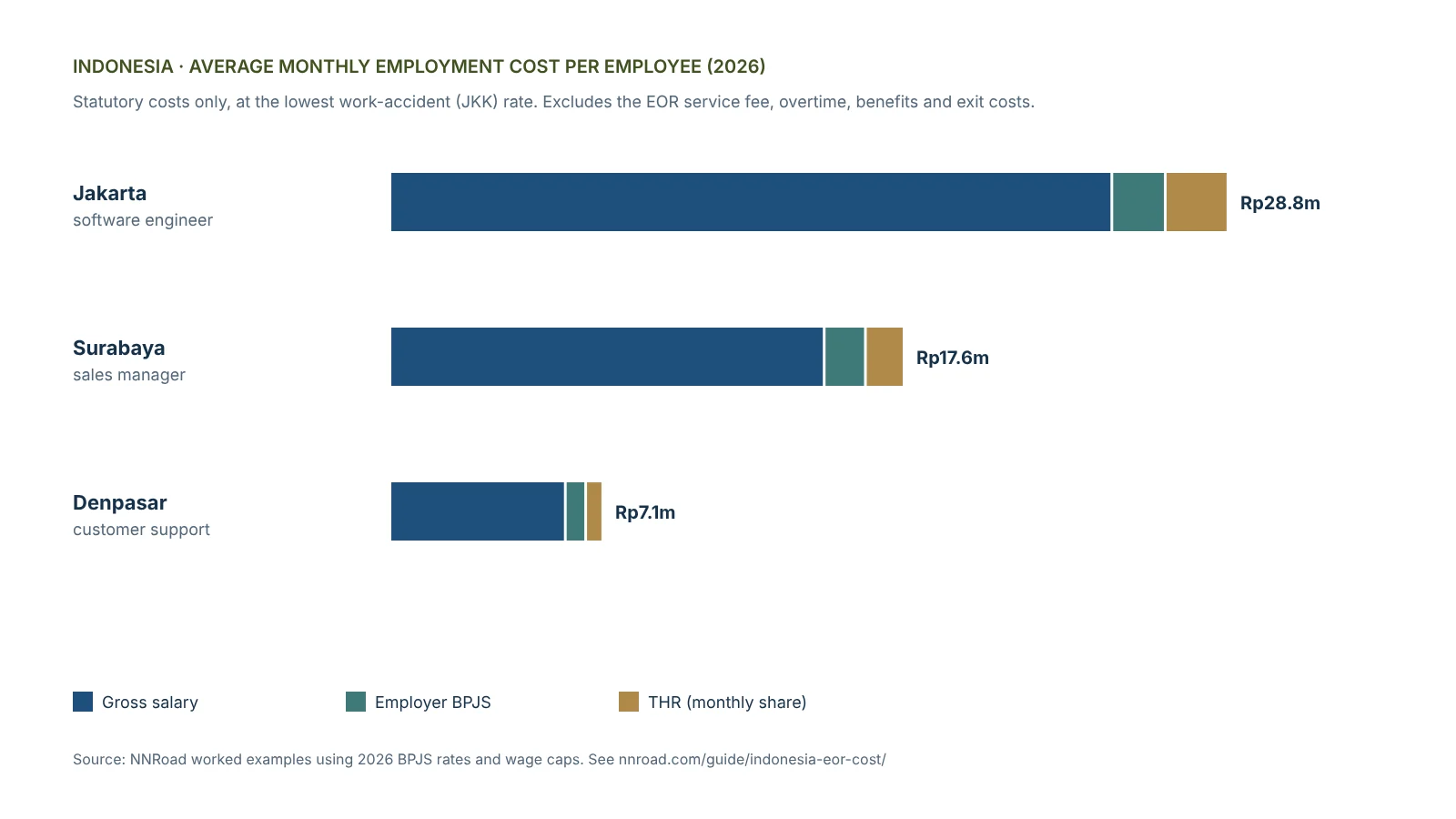
Average monthly statutory cost for three permanent employees in 2026, at the lowest work-accident rate, before the EOR service fee. THR is spread over twelve months for comparison.
| Monthly figures (IDR) | Jakarta software engineer | Surabaya sales manager | Denpasar customer support |
|---|---|---|---|
| Gross salary | 25,000,000 | 15,000,000 | 6,000,000 |
| JHT 3.7% | 925,000 | 555,000 | 222,000 |
| JKK 0.24% | 60,000 | 36,000 | 14,400 |
| JKM 0.3% | 75,000 | 45,000 | 18,000 |
| JP 2% (capped) | 221,726 | 221,726 | 120,000 |
| BPJS Kesehatan 4% (capped) | 480,000 | 480,000 | 240,000 |
| THR, monthly share | 2,083,333 | 1,250,000 | 500,000 |
| Average monthly cost | 28,845,059 | 17,587,726 | 7,114,400 |
| Uplift on salary | 15.4% | 17.3% | 18.6% |
The uplift is lower on higher salaries because the pension and health contributions stop at their wage caps. A higher-risk role, overtime, insurance or a fixed-term contract will push the numbers up.
The yearly view and cash timing
- Every month: salary, employer BPJS and the service fee; BPJS Kesehatan is due by the 10th and BPJS Ketenagakerjaan and PPh 21 by the 15th of the following month
- Before the religious holiday: THR. For Idul Fitri 2027, expected around 10–11 March, that means early March
- December: PPh 21 is recalculated at the annual rates, which can change the employee’s net pay that month
- 1 January: new minimum wages apply; check junior salaries
- At the end: final pay, unused leave and any severance or fixed-term compensation
Salaries are paid in rupiah. If your budget is in US dollars, exchange-rate movements change the cost from month to month.
EOR or your own company: how the costs compare
The statutory costs are the same whoever employs the person. The difference is the fixed cost of running an entity. A PT PMA needs paid-up capital of at least Rp2.5 billion and an investment plan above Rp10 billion, plus set-up costs, a registered office, monthly and annual tax filings, accounting and a local director. For one to a handful of employees in supporting roles, an EOR service fee is usually lower than that overhead. As the team grows, or once you need to invoice Indonesian customers, the balance shifts towards your own entity.
How NNRoad quotes
We do not publish a headline rate, because the right quote depends on the role, the work city, the contract type and the package. After a short review of the role against Indonesia’s outsourcing rules, your proposal lists every line: our monthly service fee, the salary, each employer contribution, THR and any optional service. You see the full cost before you sign, and the monthly invoice follows the same breakdown.
Questions about Indonesia EOR costs
How much does an employer of record cost in Indonesia?
The total is the salary, plus statutory costs of roughly 15%–19% of annual salary for most office roles (employer BPJS and THR), plus the provider’s service fee. Providers usually charge the fee per employee per month; ask for a proposal that shows every line.
Does the EOR fee include BPJS and PPh 21?
The service fee covers the work of registering, calculating and paying BPJS and PPh 21. The contributions themselves are employment costs you pay at cost, and the employee’s PPh 21 is withheld from their pay.
Is THR included in the monthly cost?
THR is paid once a year, before the employee’s religious holiday. Spreading it over twelve months adds about 8.3% of salary to the monthly average.
Is an EOR cheaper than setting up a company in Indonesia?
For a small team, usually yes, because a PT PMA has capital requirements and fixed running costs. The statutory employment costs are the same either way.
Can I pay employees in US dollars to save on exchange costs?
No. Wages in Indonesia must be paid in rupiah. You can be invoiced in US dollars, but exchange-rate movements still affect the cost.
Want the numbers for your hire?
Use the Indonesia employer cost calculator for a quick estimate, or tell us about the role and we will send a full proposal with every line shown.