
Guide · Japan
EOR vs PEO vs GEO in Japan: How to Hire Without a Local Entity
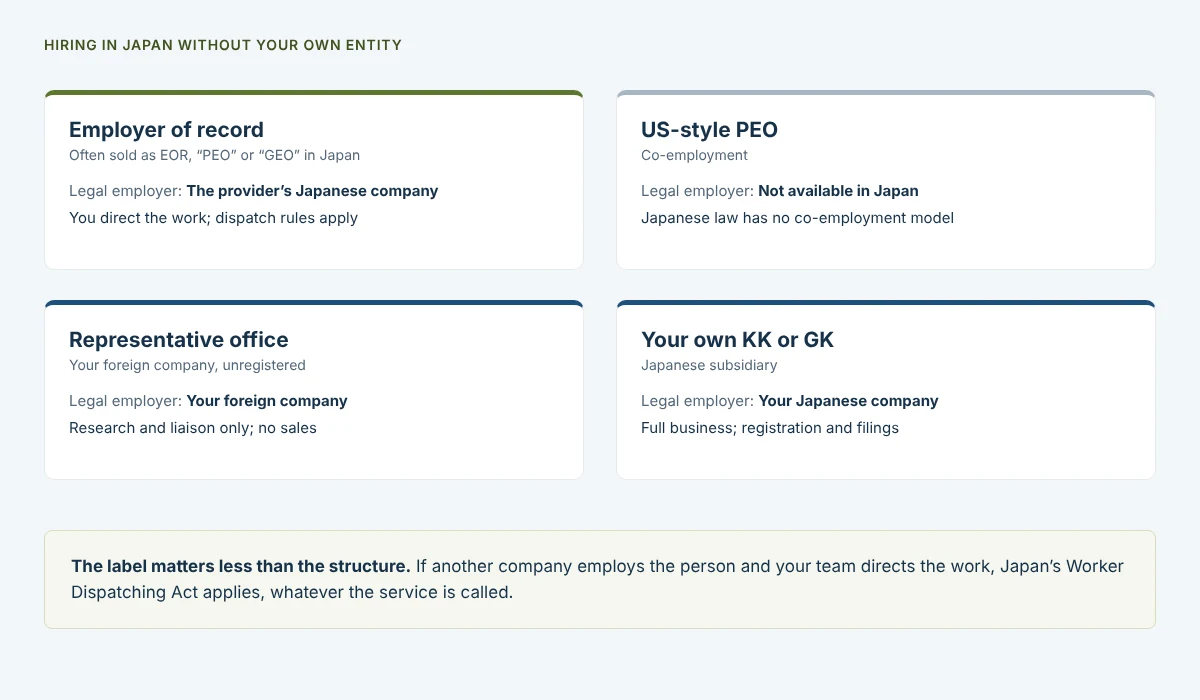
A foreign company without a Japanese entity can employ staff in Japan through an employer of record (EOR): a Japanese company that employs the person, runs payroll, enrolls them in social insurance and withholds tax, while you direct the work. “PEO” and “GEO” are other names used for similar services. In Japan the label matters less than one legal question: when another company employs the person and you direct the work, the Worker Dispatching Act applies.
Six ways to employ or engage people in Japan
| Route | Who employs | Good for | Watch out for |
|---|---|---|---|
| Your own KK or GK | Your Japanese subsidiary | A growing team, local sales, contracts with Japanese customers | Registration, a corporate bank account, tax, social and labour insurance registrations, annual filings |
| Branch of your foreign company | Your foreign company, registered in Japan | Continuous business without a separate subsidiary | At least one representative must live in Japan; your foreign company is directly liable |
| Representative office | Your foreign company | Market research, liaison and promotion | Cannot sell or conclude sales contracts; limited to preparatory and auxiliary work |
| Employer of record | The provider’s Japanese employing company | First hires before you set up; testing the market | Must be a lawful worker dispatch; some jobs are closed to dispatch and period limits apply |
| Payroll outsourcing | Your own Japanese company | Companies that already employ staff in Japan | You remain the employer and carry the obligations |
| Independent contractor | No one: a business-to-business contract | A defined project by a genuinely independent professional | Treated as an employee if you control hours and methods; Freelance Act duties apply |
Why EOR, PEO and GEO get mixed up
Employer of record (EOR) means a provider that is the legal employer of your staff in another country. Professional employer organization (PEO) comes from the US, where it describes co-employment: the client stays an employer and the PEO shares HR and payroll duties. Japan has no co-employment model, so a provider that calls itself a “PEO in Japan” is usually offering an EOR-type service. Global employment organization (GEO) usually means a multinational’s own employing company for staff it sends abroad; some providers use the term loosely for an EOR service.
Japanese law uses none of these terms. It knows the employer, the employment contract, worker dispatch (rōdōsha haken) and contracting for a result (ukeoi). So whatever a provider calls itself, ask three questions:
- Which Japanese company signs the employment contract and enrolls the employee in health insurance, pension and employment insurance?
- Under which legal structure does your team direct the work, and which licence does that structure rely on?
- Who keeps the working-time records and the 36 Agreement that allows overtime?
Is an employer of record legal in Japan?
Yes, when it is set up as what it really is. Under Article 2 of the Worker Dispatching Act, having your own employee work under another company’s instructions is worker dispatch, and running a dispatch business requires a licence from the Ministry of Health, Labour and Welfare (Article 5). Licensed businesses can be checked on the ministry’s public register of dispatch and placement businesses. An EOR in which you direct the employee’s work is therefore a dispatch arrangement, and the rules below apply.
| What the law requires | What it means for you |
|---|---|
| The employing company holds a dispatch licence | Ask for the licence number and check it yourself before you sign |
| No dispatch into construction, port transport, security, or most medical work | These roles need a direct employer or another lawful structure |
| No dispatch on contracts of 30 days or less, with narrow exceptions | Plan for an ongoing role rather than a few days of work |
| A fixed-term dispatched worker can stay in the same organisational unit for up to three years; your workplace limit is also three years, extendable after hearing your majority union or employee representative | Agree the contract type at the start; indefinite-term employees and workers aged 60 and over are outside the limit |
| Your former direct employee cannot be dispatched back to you within one year of leaving | Do not move an existing employee into an EOR straight after they resign, unless they are 60 or over and retired at your mandatory age |
| Pay must follow one of two equal-treatment methods | Expect to share information about how you pay comparable staff, or a benchmark wage to apply |
| The client names a supervisor, keeps a dispatch register and keeps work within the employer’s 36 Agreement | Your manager’s day-to-day role carries legal duties |
Calling the arrangement a service contract does not avoid these rules. Under MHLW Notice No. 37 a genuine contractor must direct its own staff and do the work independently. If a client uses an unlicensed or disguised arrangement, Article 40-6 can deem the client to have offered the worker a direct job. The full checklist is in our article on labour dispatching in Japan.
When an EOR fits, and when it does not
An EOR fits when
- You need one or a few employees in Japan soon
- You want to test the market before committing to an entity
- Your team will direct the role, and the person will not conclude contracts for you
- You want one contract and one invoice for payroll, social insurance and tax
Look at other routes when
- You will continuously sign contracts with and invoice Japanese customers
- The work is construction, port transport, security or medical work
- You expect a larger team for the long term
- The person is a foreign national, whether or not they already live in Japan
Six risks to manage, whichever route you choose
| Risk | How to manage it |
|---|---|
| Unlicensed dispatch or disguised contracting | Use a licensed dispatch structure for any role your team directs, and check the licence |
| Misclassifying an employee as a contractor | Use a contractor only for genuinely independent, project-based work |
| Working-time breaches | Keep overtime within a filed 36 Agreement and record hours; manager titles do not remove overtime pay |
| Ignoring period limits | Agree indefinite or fixed-term employment at the start and diarise the three-year dates |
| Tax presence for your company | Do not let local staff habitually conclude contracts, or play the principal role leading to them, for you; take tax advice |
| A difficult exit | Japanese dismissal rules are strict; agree in advance how an ending or a move to your own company would work |
Setting up your own KK or GK
A kabushiki kaisha (KK) is the familiar Japanese joint-stock company; a godo kaisha (GK) is a lighter limited liability company used by many foreign groups. Both can be formed with capital of ¥1, and since March 2015 its representative (a director of a KK, or a member of a GK) does not have to live in Japan. Registration licence tax is 0.7% of capital, with a minimum of ¥150,000 for a KK and ¥60,000 for a GK. A KK’s articles must also be notarised, for a fee of ¥15,000 to ¥50,000 depending on capital. Registration itself takes one to a few weeks; a corporate bank account and the tax, social insurance and labour insurance registrations usually take longer.
A branch is the other option: your foreign company registers in Japan and appoints at least one representative who lives in Japan. Many companies start with an employer of record for their first hires and move the team to their own entity once the business case is proven. Moving an employee needs their agreement and a clear position on service and leave balances.
Questions about hiring without an entity in Japan
Is an employer of record the same as a PEO in Japan?
Not formally. A PEO, in the US sense, shares employer duties with the client. Japan has no co-employment model, so a provider offering “PEO” in Japan is usually acting as the legal employer, like an EOR. Ask which company signs the employment contract and under which legal structure.
What is a global employment organization?
GEO usually means a multinational’s own employing company for staff it sends abroad. Some providers use it loosely for an employer of record service, so ask who the legal employer in Japan will be.
Can a foreign company hire in Japan without a KK or GK?
Yes, through an employer of record for roles that can be filled by lawful worker dispatch, or through genuine independent contractors. A representative office can also employ local staff, but only for preparatory work such as market research and liaison.
Does a company representative need to live in Japan?
Not for a KK or GK. Since March 2015 a company can be registered with all its representatives living abroad. A branch of a foreign company is different: at least one of its representatives in Japan must have an address in Japan.
When should I move from an EOR to my own entity?
When you start contracting with and invoicing Japanese customers on a continuing basis, need a licence for your activity, or the team grows to the point where the cost of running a KK or GK is justified.
Not sure which route fits your hire?
Tell us about the role and where the person will work. We will review it under the dispatch rules and tell you whether an employer of record, your own entity or another route fits better.